
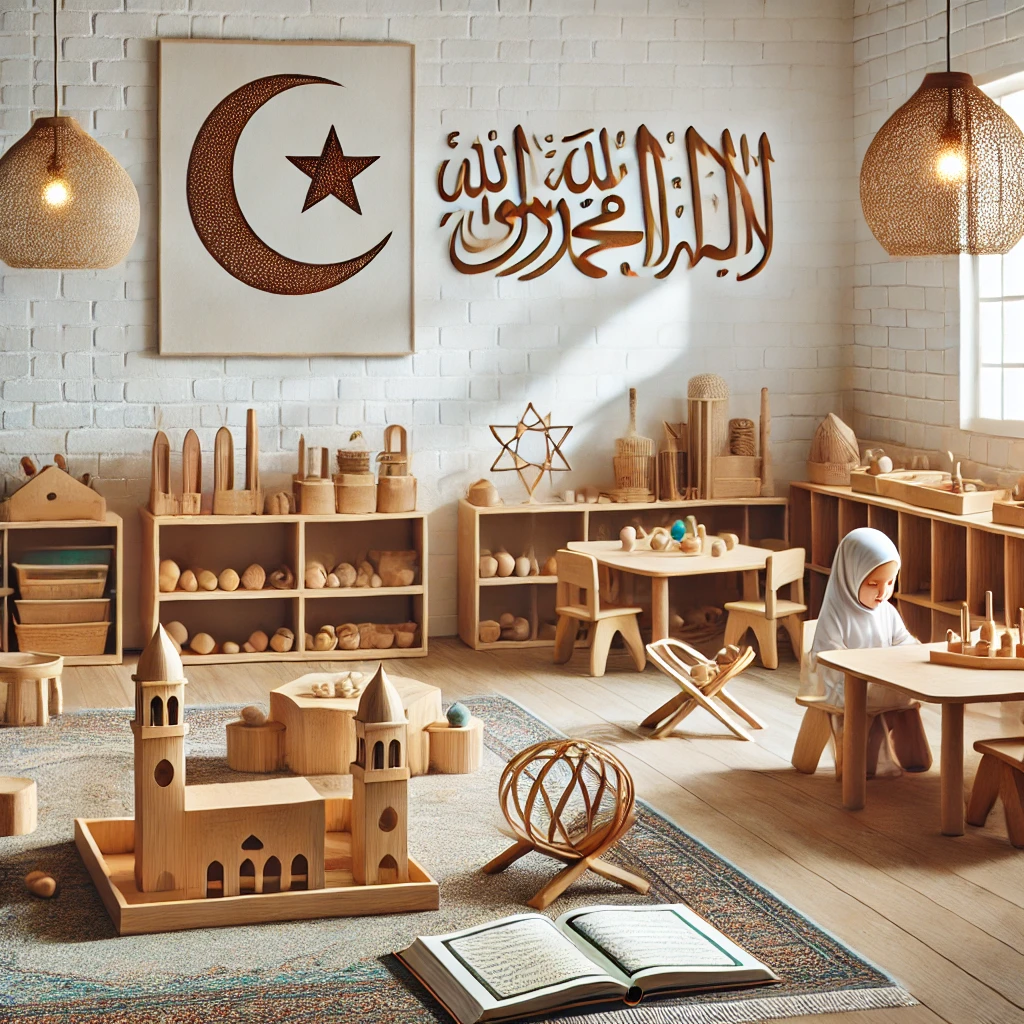
The Montessori method, although developed in a secular context by Maria Montessori, shares many principles compatible with Islamic teachings.
By integrating these two perspectives, educators and parents can provide a rich educational environment that respects Islamic values and supports the holistic development of children.
This article delves into adapting Montessori methods within an Islamic framework.
I. Foundations of the Montessori Method
1. Child-Centered Education
The Montessori method emphasizes that every child is unique and possesses inherent potential to develop.
Instead of imposing uniform learning, this approach tailors education to the child’s pace, interests, and abilities.
This resonates with Islamic principles, where the child is viewed as an amana (sacred trust) entrusted to parents, who are responsible for nurturing their natural qualities while fostering faith.
2. The Prepared Environment
A structured and stimulating environment is at the heart of the Montessori method.
The teaching materials are designed to allow children to discover complex concepts through practical experiences.
This environment encourages independent learning, an essential quality for Muslim children, who are guided to assume their religious responsibilities as they grow older.
3. Sensory Learning
Maria Montessori introduced educational tools that engage the senses to enhance learning. In Islam, sensory stimulation is equally valued, such as by repeatedly listening to Quranic verses or observing nature as a sign of Allah's greatness.
Réservez votre essai gratuit de 30 minutes
Formulaire d'inscription
II. Integrating Islamic Teachings into the Montessori Method
1. Tawhid: The Oneness of Allah
Islamic Montessori education begins with instilling the fundamental concept of tawhid (the oneness of Allah).
This can be done through activities that showcase the beauty of creation, encouraging children to reflect on Allah’s omnipotence and wisdom.
Examples:
- Exploring natural cycles (water, seasons) to recognize the perfection of creation.
- Reading illustrated Quranic stories about the prophets.
2. Akhlâq: Morality and Ethics
Good manners (adab) and Islamic ethics (akhlâq) are crucial in Muslim education. These values can be incorporated into Montessori activities that promote cooperation, mutual respect, and kindness.
Examples:
- Guiding children to help their peers, share resources, or express gratitude.
3. Practical Worship (Ibadah)
In an Islamic Montessori setting, children gradually learn to perform acts of worship, such as prayer (salât). A prepared environment could include:
- A prayer corner with a mat, a hijab for girls, and posters of supplications (du’a).
- A colorful clock indicating prayer times to introduce children to spiritual punctuality.
III. The Prepared Environment with an Islamic Perspective
1. Islamic Educational Materials
Traditional Montessori tools can be enriched with Islamic elements:
- Islamic month cards: To teach the lunar months such as Ramadan or Dhul-Hijjah.
- Kaaba puzzles: A hands-on activity to teach about Islamic holy places.
- Arabic movable alphabets: Encouraging Quranic learning from an early age.
2. Active Quranic Learning
Montessori methods emphasize memorization through sensory activities. In this context:
- Children can listen to and repeat Quranic verses using auditory tools.
- Surahs can be linked to illustrated cards to associate them with stories or Islamic concepts.
3. Observations and Nature
Nature plays a central role in Montessori education. In Islam, observing nature is a form of worship, as it reflects Allah’s greatness.
Examples:
- Observing plants to understand the miracle of creation.
- Planting seeds to learn the importance of nurturing what Allah has entrusted to humans.
IV. Developing Independence and Responsibility
1. Learning to Pray Independently
One of the goals of Islamic education is to make children independent in their religious practices. Through the Montessori method, children learn to perform ablution, pray, and recite du’a without constantly relying on adults.
This builds their confidence and strengthens their personal connection with Allah.
2. Encouraging Decision-Making
In Montessori environments, children are encouraged to choose between various beneficial activities. In Islam, this practice can be guided by spiritual values, helping children understand the positive consequences of their choices for their faith and morality.
V. Collaboration Between Parents and Teachers
1. Continuity Between Home and School
An Islamic Montessori educational environment works best when practices at home mirror those at school.
Examples:
- Encouraging autonomy in daily tasks (dressing, tidying up).
- Continuing Quranic learning and memorization at home.
2. Parental Involvement
Parents play a crucial role in Islamic Montessori education. They must not only model exemplary behavior but also actively participate in their child’s learning by reinforcing Islamic teachings.
VI. Benefits of the Montessori Method in Islam
1. Spiritual Development
Children grow up understanding the basics of their faith, such as tawhid, the pillars of Islam, and good manners. This helps them build a strong connection with their religion from an early age.
2. Holistic Learning
The Montessori approach combines intellectual and spiritual education, enabling children to thrive in a balanced manner.
3. Autonomy and Responsibility
Children become active learners, capable of taking initiative and making thoughtful decisions.
4. Respect for Others
Montessori values of mutual help and respect, integrated with Islamic teachings, encourage children to become responsible members of the community.
Conclusion
Integrating the Montessori method into an Islamic framework offers a comprehensive educational approach, where modern pedagogical principles harmonize with the spiritual teachings of Islam.
By nurturing intellect, independence, and faith, this approach prepares Muslim children to become balanced individuals, spiritually aware and active in their communities.
Parents and educators can adapt these principles at home or in educational institutions, providing children with a stimulating and faith-centered learning environment.
Let me know if you'd like a specific section enhanced further!
To know more: discover our online kids courses

Aucun commentaire
Aucun commentaire pour le moment.