
Introduction
In this fifteenth lesson on learning the Tajweed of the Holy Quran, we continue our study of the rules of elongation. Here, we will examine the elongations that are followed by a sukun or a shadda.
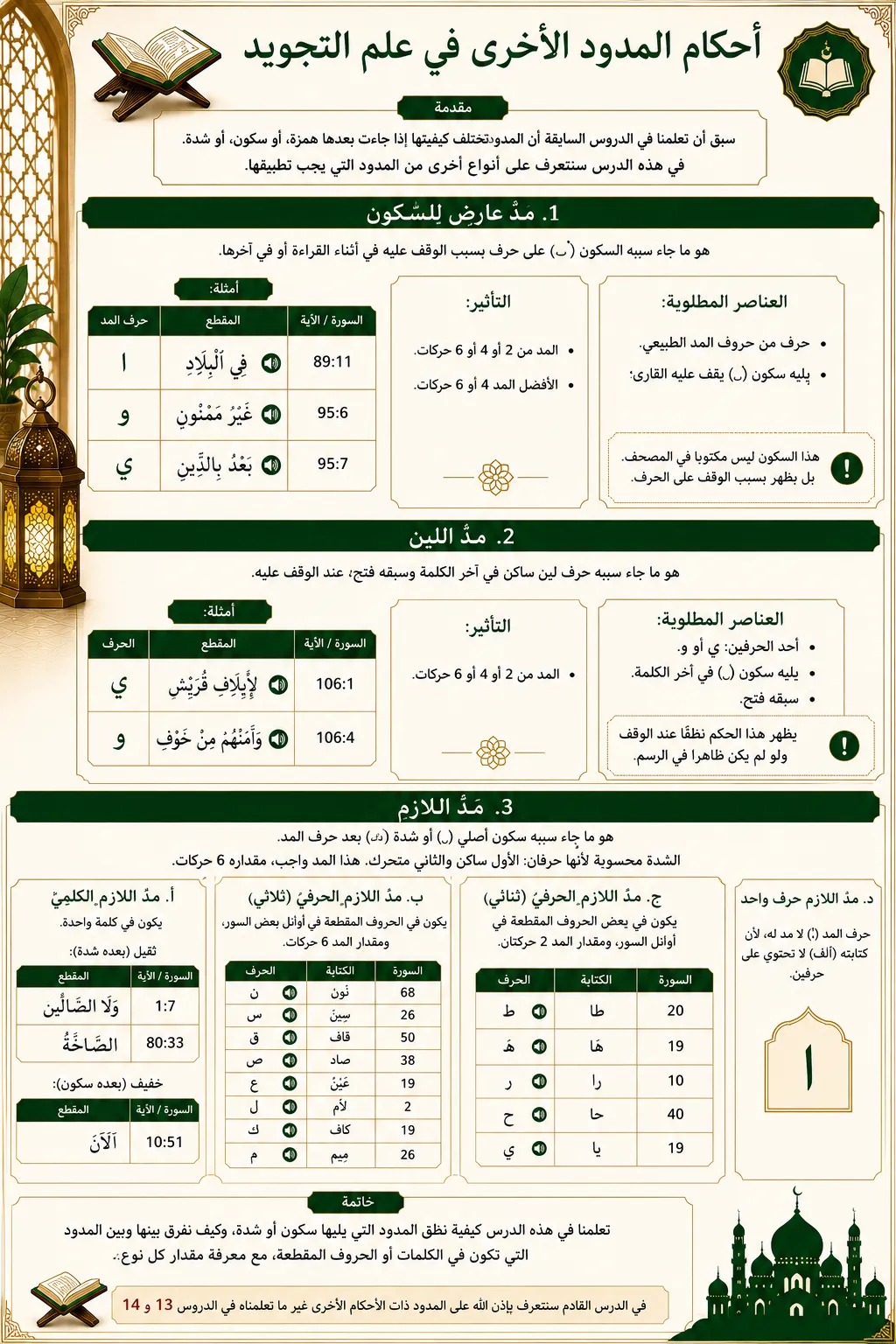
1. Elongation Caused by a Sukun — مَدٌّ عارِضٌ لِلسُّكونِ
This elongation occurs when a sukun (ـْ) is placed on a letter because the reader stops during recitation, whether in the middle or at the end of a verse.
Required elements:
- A natural elongation letter
- Followed by a sukun on which the reader stops
This sukun is not written in the Quranic text; it appears only because the reader stops.
Effect:
- Elongation of 2, 4 or 6 counts
- It is preferable to elongate for 4 or 6 counts
Examples:
| Elongation Letter | Verse Excerpt | Surah / Verse |
|---|---|---|
| ا | فِي الْبِلَادِ |
89:11 |
| و | غَيْرُ مَمْنُونٍ |
95:6 |
| ي | بَعْدُ بِالدِّينِ |
95:7 |
2. Soft Elongation — مَدُّ اللِّينِ
This elongation occurs when a word contains a diphthong and the reader chooses to stop on it, whether in the middle or at the end of a verse.
Required elements:
- One of the following letters: ي or و
- Followed by a sukun on the final letter
- Preceded by a fatha
This rule appears orally when the reader stops on the Arabic letter, even if it is not visible in writing.
Effects:
- Elongation of 2, 4 or 6 counts
Examples:
| Letter | Verse Excerpt | Surah / Verse |
|---|---|---|
| ي | لِإِيلَافِ قُرَيْشٍ |
106:1 |
| و | وَآمَنَهُم مِّنْ خَوْفٍ |
106:4 |
3. Necessary Elongation — مَدُّ اللّازِمِ
Required elements:
- A natural elongation
- Followed by a sukun (ـْ) or a shadda (ـّ)
The shadda is included because it represents two letters: the first one with sukun and the second one with a vowel.
This elongation lasts for 6 counts and is obligatory, or lazim.
There are two types: word-based (كَلِمي) and letter-based (حَرفي).
a. Necessary Word-Based Elongation — مَدُّ اللازِمِ الكَلِمي
Found within a single word, this elongation is heavy (ثَقيل) when followed by a shadda.
| Verse Excerpt | Surah / Verse |
|---|---|
| وَلَا الضَّالِّينَ |
1:7 |
| الصَّاخَّةُ |
80:33 |
It is light (خَفيف) when followed by a sukun.
| Verse Excerpt | Surah / Verse |
|---|---|
| آلْآنَ |
10:51 |
b. Necessary Letter-Based Elongation Composed of Three Letters
This elongation appears at the beginning of certain surahs, in the disconnected letters (الحروف المقطعة), such as ن or ص.
The elongation lasts for 6 counts for these letters:
| Letter | Spelling | Surah |
|---|---|---|
| ن |
نُون | 68 |
| س |
سِين | 26 |
| ق |
قاف | 50 |
| ص |
صاد | 38 |
| ع |
عَيْن | 19 |
| ل |
لام | 2 |
| ك |
كاف | 19 |
| م |
مِيم | 26 |
c. Necessary Letter-Based Elongation Composed of Two Letters
The following letters are elongated for two counts:
| Letter | Spelling | Surah |
|---|---|---|
| ط | طَا |
20 |
| هـ | هَا |
19 |
| ر | را |
10 |
| ح | حا |
40 |
| ي | يا |
19 |
d. Necessary Elongation of a Single Letter
The Arabic letter ا (Alif) does not take an elongation because its spelling (اَلِف) does not contain one.
Conclusion
We have learned how to pronounce elongations followed by a sukun or a shadda, and how to distinguish between those found within words and those found in the opening letters of certain surahs.
In the next lesson, we will study elongations that have other effects than those covered in previous lessons.
Réservez votre essai gratuit de 30 minutes
Formulaire d'inscription

Aucun commentaire
Aucun commentaire pour le moment.