

Online Quran memorization raises real doubts. Parents wonder whether their child can truly make progress without sitting in front of a sheikh in a mosque or traditional madrasa. Adults ask themselves whether it is too late to start, or whether the distance will simply get in the way. These concerns are legitimate — and they deserve an honest answer, grounded in the real experience of thousands of students who have taken this path.
The short answer is: yes, online Quran memorization is not only possible, it can be more effective than you might expect. Provided you choose the right method and the right support.
Why Do So Many People Still Doubt Online Hifz?
The doubt is often rooted in a very specific image: a young hafiz seated in a Quran school, reciting in front of his teacher, being corrected immediately, surrounded by other students in a setting of collective emulation. This model has existed for centuries and has proven its worth. It is therefore natural to wonder whether a screen can come close to matching its value.
A few concerns come up repeatedly:
- Pronunciation correction: how can the teacher hear and correct tajweed at a distance?
- Regularity and discipline: without the physical structure of an institution, will the student really keep going?
- Human connection: the teacher-student relationship, which is fundamental in Islamic transmission, can it survive the distance?
- Distractions at home: the home environment seems ill-suited to the concentration required for hifz.
These are real concerns. But they are often based on an outdated picture of what distance learning can offer today.
What Technology Has Changed
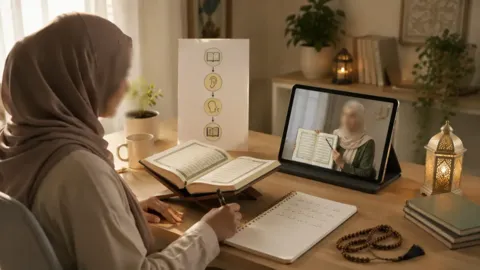
Online Quran memorization in 2025 has nothing to do with watching a YouTube video. One-to-one classes via video conferencing allow real-time interaction, exactly as in person — sometimes with even more focus, since the student is alone with the teacher, without the disruptions of a shared classroom.
A skilled teacher, through a simple high-definition call, can:
- Listen to recitation syllable by syllable and correct immediately
- Identify errors in makhraj (articulation points) with precision
- Adapt the memorization pace in real time based on the student's progress
- Use digital tools to highlight verses, note review points, and structure progression
The quality of teaching depends above all on the competence of the teacher and the pedagogical relationship — two elements that are not tied to physical presence.
Individual Classes: The Key to Success for Online Hifz
While group Quran memorization can work for some learners, it is the individual class that delivers the best results for online hifz. For one simple reason: every student has their own pace, their own memory, and their own specific difficulties.
In a group class online, the teacher must manage five, ten, sometimes twenty students at once. There is no time to listen to you recite for ten minutes, correct your pronunciation of the letter ض, or adapt the method to the way you learn best. In a one-to-one class, all of this is possible — and this is precisely what makes the difference over time.
The child who memorizes quickly can advance without waiting for the others. The adult returning after years away from the Quran can restart at their own pace, without shame or comparison. The parent who only has thirty minutes each evening can structure their progress around that single slot.
This is exactly the model we offer at Al-Dirassa: a qualified, dedicated teacher who follows each student individually and adapts every session to their real needs.
Réservez votre essai gratuit de 30 minutes
Formulaire d'inscription
How Does an Online Quran Memorization Class Actually Work?
For those who have never taken this kind of class, here is how a typical session at Al-Dirassa unfolds:
- Revision: The student recites the verses memorized in the previous session. The teacher listens carefully and corrects any tajweed or memorization errors.
- Consolidation: Any verses that are still fragile are revisited, repeated, and solidified before moving on.
- New lesson: The teacher introduces the new verses to be memorized, reads them aloud, explains the applicable tajweed rules, and ensures the student leaves with a solid foundation.
- Homework and objectives: A personalized revision plan is given for the days ahead, with clear and realistic goals.
This structure faithfully mirrors what happens in an in-person class — with the added advantage that it can be followed from home, at whatever time suits best.
Online Quran Memorization as an Adult: Breaking the "Too Late" Myth
Many adults dream of memorizing the Quran but tell themselves they have passed the age for it. That their memory is no longer as quick as it was at ten years old. That hifz is reserved for children.
This is not what the experience of our students shows.
Adults of thirty, forty, even fifty have memorized complete surahs, and in some cases entire ajza', by working consistently with an online teacher. What they may lack in raw memorization speed, they more than make up for in motivation, understanding of the meaning, and the kind of discipline that children do not always possess.
The Prophet ﷺ said:
"The best among you are those who learn the Quran and teach it."
This excellence carries no age limit.
For Parents: Can You Really Entrust Your Child's Hifz to an Online Teacher?
This is often the most sensitive question. The bond between a child and their Quran teacher is something precious — almost sacred in our tradition. Can it truly develop through a screen?
The answer, observed across hundreds of students, is yes — under certain conditions. The teacher must be patient, pedagogically skilled, experienced with children, and capable of sustaining their attention over time. At Al-Dirassa, our teachers are selected precisely for these qualities, in addition to their expertise in tajweed and memorization.
Parents often report a pleasant surprise: the child, seated in front of a teacher whose full attention is devoted to them alone during the session, is often more focused than in a crowded classroom. The teacher notices immediately when the child is tired, distracted, or on the contrary enthusiastic — and adjusts the session accordingly.
To learn more about Quran learning for children, you can read our dedicated article on teaching the Quran to children, which covers the best approaches by age group.
The Conditions for Success: What Really Makes the Difference
Online Quran memorization can fail, as any learning endeavor can — when the right conditions are not in place. Here is what genuinely determines results:
- Consistency: Two sessions per week with daily revision is worth far more than five sessions with no personal work in between.
- A qualified and patient teacher: Tajweed certification is necessary, but pedagogical skill is equally important.
- A quiet environment: Finding a calm corner at home, however small, makes a real difference.
- Realistic goals: Expecting to memorize a full juz' in one month as a beginner is a promise that often leads to giving up. Slow, solid progress is always preferable.
- Parental involvement for children: Even a brief moment of parental engagement — listening to the evening recitation, offering encouragement — significantly increases the chances of success.
If you would like to understand the tajweed rules that accompany memorization, our online tajweed guide is a valuable complementary resource.
Conclusion: Online Quran Memorization — A Serious and Accessible Path
Online Quran memorization is not a shortcut, nor a diminished version of traditional hifz. It is a serious, demanding path that requires the same effort as any other — but one that offers a flexibility and a level of personalized support that few physical institutions can match. For families without access to a good Quran school nearby, for adults whose schedules make travel impossible, for children who need tailored guidance: online learning is often the best available option.
What matters is to begin — with intention, with a good teacher, and with the certainty that every verse memorized is a light that never goes out.
Réservez votre essai gratuit de 30 minutes
Formulaire d'inscription
FAQ — Frequently Asked Questions About Online Quran Memorization
Can you memorize the Quran online without knowing Arabic?
Yes, absolutely. Quran memorization (hifz) does not require an understanding of Arabic. Millions of Muslims around the world, whose mother tongue is not Arabic, have memorized the Quran by learning to recite the verses correctly through the rules of tajweed. A good teacher will guide you phonetically, and understanding the meaning can come alongside or after, at your own pace.
How long does it take to memorize the Quran online?
The duration varies considerably depending on how much time is devoted daily, the age of the student, and their working method. A child working consistently may memorize the complete Quran in three to five years. An adult dedicating thirty minutes a day can reasonably expect to memorize one juz' within a few months. More important than speed is the solidity of memorization: it is always better to advance slowly and retain durably.
How do you choose a good online hifz teacher?
Several criteria are essential: a recognized tajweed certification (ideally with an ijaza), confirmed experience in teaching hifz, and a pedagogical approach suited to your profile — whether you are a child, an adult beginner, or at an intermediate level. It is also important to be able to attend a trial session before committing, so you can assess the quality of the teaching and your compatibility with the teacher. At Al-Dirassa, we offer a free trial session so you can form your own opinion before starting.



Aucun commentaire
Aucun commentaire pour le moment.