
The Magnificent Legacy of Masjid an-Nabawi: The Heartbeat of Madinah
Masjid an-Nabawi, famously known as the Mosque of the Prophet, stands as an enduring symbol of Islam's rich history and the unwavering devotion of its followers. Its foundations are embedded deeply in the pivotal events of early Islamic history, resonating with stories of faith, unity, and the Prophet Muhammad's (PBUH) enduring love for his Ummah.
A Divinely Guided Foundation
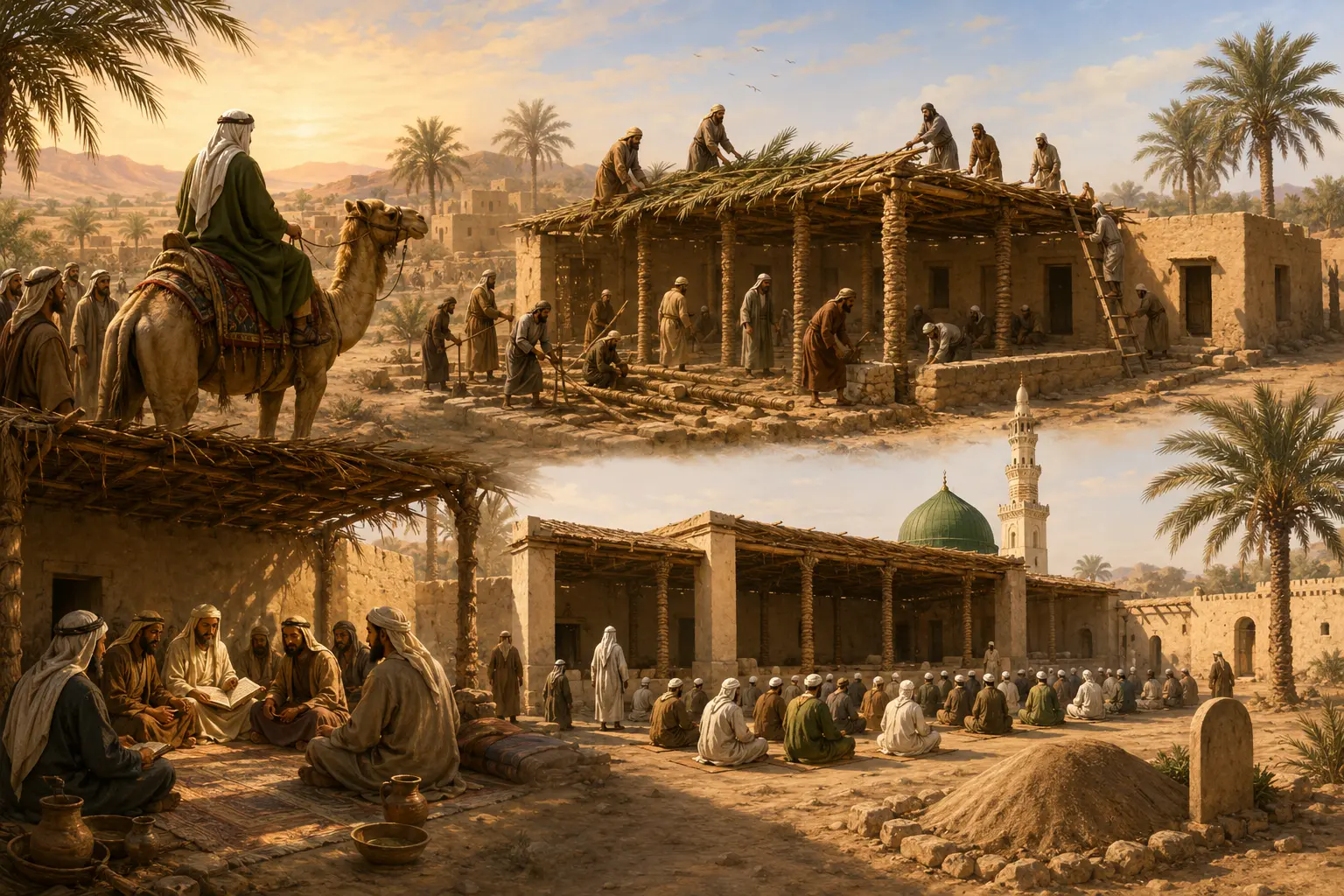
The Prophet's migration from Mecca to Madinah marked the beginning of a new chapter for Islam. On arrival, the citizens of Madinah eagerly awaited his decision on where to build his residence. Divinely guided, the Prophet's camel settled on a piece of land owned by the orphaned brothers, Suhail and Sahl. Here, the construction of the now-iconic Masjid an-Nabawi commenced.
Constructed initially with modest means, its walls were made of bricks while its roof was thatched with palm leaves. The mosque was designed with three entrances: the "Atikah, " the "Entranceway of Mercy, " and "Jibril's Entrance, " which was the Prophet's favorite. Adjacent to the mosque, the Prophet (PBUH) also established residences for his wives, including Aisha and Sauda.
Réservez votre essai gratuit de 30 minutes
Formulaire d'inscription
The Shelter of As-Suffah
Behind Masjid an-Nabawi, the Prophet Muhammad (SAW) built 'as-Suffah, ' a shaded area offering refuge to the less fortunate. This addition was more than just an architectural feature; it embodied the principles of compassion, hospitality, and community, fundamental tenets of Islam. As-Suffah served as a resting place for travelers, underlining the inclusive nature of the Prophet’s vision for his mosque.
Change of Qibla: A Turning Point
A significant moment in Islamic history was the change of Qibla from Jerusalem to Mecca. This divine commandment led to the reorientation of the mosque, marking the second of its two reconstructions during the Prophet's lifetime.
Expansion for an Expanding Ummah
As Islam spread and more pilgrims journeyed to Madinah, the need for a larger prayer space became evident. Addressing this need, Hazrat Usman financed a significant expansion, increasing the mosque's dimensions to 50x50 meters and elevating its height to 11.5 feet.
More Than Just a Mosque: The Heart of Islamic Enlightenment
Masjid an-Nabawi stands not only as a place of worship but as a beacon of knowledge and enlightenment. The Prophet (PBUH) said, “Whoever performs forty salah in my masjid...shall remain free of hypocrisy.” Beyond prayers, it was here that the Sahabas immersed themselves in the study of the Quran, benefiting directly from the Prophet’s wisdom. The mosque served as a nucleus from which Islamic teachings radiated, enlightening hearts and minds.
Final Resting Place of the Prophet
One of the most poignant aspects of Masjid an-Nabawi is its proximity to the final resting place of Prophet Muhammad (PBUH). Upon his passing, he was laid to rest in the house of his wife, Aisha, adjacent to the mosque. This sacred site continues to draw millions of believers, expressing their love and seeking blessings.
In Conclusion
Masjid an-Nabawi, with its towering green dome and minarets, stands as a testament to the timeless teachings of Islam and the lasting legacy of the Prophet Muhammad (PBUH). More than just a building, it encapsulates the spirit of an era, the dedication of the early Muslims, and remains a focal point for the entire Ummah. As you walk its storied halls or pray beneath its majestic dome, you are treading upon the very ground that witnessed the formative years of Islam, making it a truly humbling experience.
The Al-Dirassa Institute provides a range of online courses in Arabic, Quran, and Islam tailored for non-Arabic speakers. To enroll in our courses or learn more, please don’t hesitate to get in touch with us today.




Aucun commentaire
Aucun commentaire pour le moment.