
In the sacred text of the Holy Quran, the letter hamza (ء) manifests in two distinct forms:
- Hamza Al-Wasl: Unique in its application, Hamza Al-Wasl exclusively appears at the onset of words. Its pronunciation hinges on its position within a verse. When it stands at the commencement of a verse, it is enunciated. Conversely, if it is situated within the midst of a verse, its vocalization is bypassed, making it silent.
Illustrations:
- For Hamza Al-Wasl, consider the following instance where it is pronounced:
اهْدِنَا الصِّرَاطَ الْمُسْتَقِيمَ
Guide us to the straight path - (1:6)
Understanding these nuanced rules surrounding hamza enhances the precision and beauty of Quranic recitation. The presence or absence of its sound, especially in the case of Hamza Al-Wasl, can significantly alter the melody and meaning of the verses, making it crucial for those studying the Quran to be aware of these distinctions.
2. Hamza Al-Wasl in Silence: While the Hamza Al-Wasl is distinctive in its positioning at the start of words, its vocalization can be mutable. When this unique hamza finds its place not at the beginning of a verse but rather embedded within its lines, its sound gracefully recedes into silence, seamlessly blending into the flow of the recitation.
Illustrations:
- In this specific instance of Hamza Al-Wasl, its pronunciation is elegantly omitted:
وَامْرَأَتُهُ حَمَّالَةَ الْحَطَبِ
May the hands of Abu Lahab be ruined, and ruined is he. (111:1)
The silent rendition of Hamza Al-Wasl when situated mid-verse is not merely a phonetic choice but a reflection of the rhythmic cadence and linguistic artistry of the Holy Quran. Grasping this subtle variance is not just about adhering to grammatical standards but also about embracing the harmonious ebb and flow that is intrinsic to Quranic verses.
-
Hamza Al-Qat': Representing versatility within the tapestry of Quranic recitation, Hamza Al-Qat' can be discovered at various junctures of a word—whether at its beginning, nestled in the middle, or concluding its end. Distinct from its counterpart, Hamza Al-Wasl, the Hamza Al-Qat' stands unwavering in its pronunciation, regardless of its placement within a word or its location within a verse.
This consistency ensures that Hamza Al-Qat' retains its sonic presence, adding depth and dimension to the melodic contours of the recitation. It's not merely a letter, but a testament to the meticulous design and rhythmic integrity of the Arabic language as embodied in the Holy Quran.
Distinguishing Features:
- Ubiquity: Hamza Al-Qat' is versatile, gracing words from start to finish.
- Unwavering Pronunciation: Its sound remains resolute, irrespective of its position in a word or verse.
Understanding the nuances of Hamza Al-Qat' enriches one's connection with the Quran, as it underlines the text's intricate sound patterns and the profound layers of meaning that resonate through every syllable and sound.
Example:
إِيَّاكَ نَعْبُدُ وَإِيَّاكَ نَسْتَعِينُ
It is You we worship and You we ask for help. (1:5)
1. The Consistent Presence: Hamza Al-Qat' in Quranic Recitation
The Hamza Al-Qat' (ء) is a steadfast fixture in the realm of Quranic recitation. Whether one initiates a verse or continues a line, this particular hamza maintains its written and vocal prominence, never wavering in its representation.
Its versatility shines through its positioning: it can be gracefully placed at the start of words, securely anchored in the middle, or poised elegantly at their conclusion. This applies across various linguistic structures, be they nouns, verbs, or particles.
Moreover, the Hamza Al-Qat' holds a distinct honor: it is consistently and diligently penned in the Holy Quran, preserving its legacy and significance in the sacred text. This unwavering representation highlights its importance and underscores the meticulous nature of Quranic transcription and recitation.
Vocalized Hamza (ء) Following the Definite Article 'ال' in Arabic
When the Hamza (ء) with its vowel marks follows the definite article 'ال', it extends for two beats, specifically when positioned between the Alif (ا) and Lam (ل).
Example:
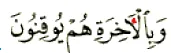
and of the Hereafter, they are certain [in faith]. (2:4)
When the hamza with its vowel marks isn't extended for two beats, it's positioned atop the Alif, rather than between the Alif and Lam.
Example:

And when it is said to them, "Do not cause corruption on the earth, " they say, "We are but reformers." (2:11)
2. The Transitional Sound: Hamza Al-Wasl
The Hamza Al-Wasl serves as a phonetic gateway in the rich tapestry of Arabic recitation. This unique hamza emerges in pronunciation specifically when it graces the start of a word that either initiates or resumes a recitation. It's not merely a sound, but an invitation—a gentle call that beckons listeners into the rhythm and melody of the text.
As one delves deeper into the nuances of Arabic phonetics, the role of Hamza Al-Wasl becomes evident. While many letters and sounds in the language are consistent in their articulation, the Hamza Al-Wasl is dynamic, contingent upon its position and the context of its usage. In this way, it embodies the fluidity and versatility of Arabic, setting the tone for a recitation that is both authentic and evocative.
A. Accented with a Fatha
When initiating its reading as part of the definite article 'ال', it is vocalized with the short vowel mark, fatha.
Example:
الْحَمْدُ لِلَّهِ رَبِّ الْعَالَمِينَ
[All] praise is [due] to Allah, Lord of the worlds - (1:2)
B. Accented with a Kasra
When beginning to read a verb with Hamza Al-Wasl at the start, and its third letter is marked with a fatha, the hamza is vocalized with the short vowel mark, kasra.
Example:
اقْرَأْ بِاسْمِ رَبِّكَ الَّذِي خَلَقَ
Recite in the name of your Lord who created - (96:1)
B. Accented with a Damma
When initiating the reading of an imperative verb with Hamza Al-Wasl at the start, and its third letter bears a mandatory damma, the hamza is vocalized with the short vowel mark, damma.
Example:
ادْخُلُوهَا بِسَلَامٍ آمِنِينَ
[Having been told], "Enter it in peace, safe [and secure]." (15:46)
C. Unstable
The Hamza Al-Wasl remains silent when the preceding word is read continuously without a pause. This is because the subsequent letter, marked with a sukoon, can lean on the final letter of the prior word, eliminating the need for the hamza's pronunciation.
Example:
إِنَّمَا يَأْمُرُكُم بِالسُّوءِ وَالْفَحْشَاءِ
He only orders you to evil and immorality (2:169)
D. Within a Phrase
When initiating with Hamza Al-Wasl, it is vocalized using the short vowels: fatha, kasra, or damma.
However, when nestled within a phrase, the Hamza Al-Wasl remains silent. This is because it's impractical to resume reading with this hamza when it's situated mid-phrase.
Examples:
وَبِالْحَقِّ أَنزَلْنَاهُ وَبِالْحَقِّ نَزَلَ ۗ وَمَا أَرْسَلْنَاكَ إِلَّا مُبَشِّرًا وَنَذِيرًا
And with the truth We have sent the Qur'an down, and with the truth it has descended. And We have not sent you, [O Muhammad], except as a bringer of good tidings and a warner. (17:105)
وَاللَّهُ مُحِيطٌ بِالْكَافِرِينَ
But Allah is encompassing of the disbelievers. (2:19)
E. The Questioning Hamza: أ
When an interrogative hamza precedes a Hamza Al-Wasl paired with a kasra, the Hamza Al-Wasl is omitted, leaving the questioning hamza أَ accented with a fatha.
Examples:
قُلْ أَتَّخَذْتُمْ عِندَ اللَّهِ عَهْدًا
" Say, "Have you taken a covenant with Allah? (2:80)
أَطَّلَعَ الْغَيْبَ أَمِ اتَّخَذَ عِندَ الرَّحْمَـٰنِ عَهْدًا
Has he looked into the unseen, or has he taken from the Most Merciful a promise? (79:18)
وَمَنْ أَظْلَمُ مِمَّنِ افْتَرَىٰ عَلَى اللَّهِ كَذِبًا أَوْ كَذَّبَ بِآيَاتِهِ ۗ إِنَّهُ لَا يُفْلِحُ الظَّالِمُونَ
And who is more unjust than one who invents about Allah a lie or denies His verses? Indeed, the wrongdoers will not succeed. (6:21)
أَصْطَفَى الْبَنَاتِ عَلَى الْبَنِينَ
Has He chosen daughters over sons? (37:153)
أَتَّخَذْنَاهُمْ سِخْرِيًّا أَمْ زَاغَتْ عَنْهُمُ الْأَبْصَارُ
Is it [because] we took them in ridicule, or has [our] vision turned away from them?" (38:63)
قَالَ يَا إِبْلِيسُ مَا مَنَعَكَ أَن تَسْجُدَ لِمَا خَلَقْتُ بِيَدَيَّ ۖ أَسْتَكْبَرْتَ أَمْ كُنتَ مِنَ الْعَالِينَ
[Allah] said, "O Iblees, what prevented you from prostrating to that which I created with My hands? Were you arrogant [then], or were you [already] among the haughty?" (38:75)
سَوَاءٌ عَلَيْهِمْ أَسْتَغْفَرْتَ لَهُمْ أَمْ لَمْ تَسْتَغْفِرْ لَهُمْ
It is all the same for them whether you ask forgiveness for them (63:6)
F. When a Lengthening Letter Precedes Hamza Al-Wasl
The Hamza Al-Wasl is consistently vocalized at the start of a verse or sentence. However, its pronunciation is omitted when situated mid-verse or within a sentence.
Furthermore, if Hamza Al-Wasl appears mid-verse, preceded by a lengthening letter, both remain silent. In such instances, the accompanying letter to the lengthening one is articulated with a single beat.
Examples:
قُلْ يَا أَيُّهَا الْكَافِرُونَ
Say, "O disbelievers, (109:1)
فَلْيَعْبُدُوا رَبَّ هَـٰذَا الْبَيْتِ
Let them worship the Lord of this House, (106:3)
كَلَّا ۖ لَيُنبَذَنَّ فِي الْحُطَمَةِ
No! He will surely be thrown into the Crusher. (104:4)
G. Pronouncing an Indefinite Word with Tanween Before Hamza Al-Wasl
When an indefinite word ending in tanween precedes a Hamza Al-Wasl, which is then followed by a letter with sukoon, the noon from the tanween is not articulated as a noon with sukoon.
In the midst of a verse, Hamza Al-Wasl remains silent. In written form, the Hamza Al-Wasl is nestled between two letters with sukoûn: the noon sakeen from the tanween and the subsequent letter after the Hamza Al-Wasl.
Example:
وَالْوَزْنُ يَوْمَئِذٍ الْحَقُّ
And the weighing [of deeds] that Day will be the truth (7:8)
When spoken, the unpronounced Hamza Al-Wasl results in the noon sakeen of the tanween being directly followed by a letter with sukoon.
Given that two successive letters each bearing a sukoon cannot be read together, the noon sakeen is then given the vowel kasra. Additionally, when a word ending in tanween is followed by a definite word (beginning with alif lam), two adjacent sukoons are not permissible in Arabic recitation. As a solution, the noon of the tanween is marked with the kasra vowel, facilitating a smooth link with the alif lam.
Examples:
وَقَالَ الَّذِينَ كَفَرُوا إِنْ هَـٰذَا إِلَّا إِفْكٌ افْتَرَاهُ وَأَعَانَهُ عَلَيْهِ قَوْمٌ آخَرُونَ
And those who disbelieve say, "This [Qur'an] is not except a falsehood he invented, and another people assisted him in it." (25:4)
كَذَّبَتْ قَوْمُ لُوطٍ الْمُرْسَلِينَ
The people of Lot denied the messengers (2:160)
Conclusion
This Tajweed rules lesson has concluded. Insha'Allah, the next lesson will cover the rules of the assimilation of two Letters.
At the Al-dirassa Institute, we provide an accessible path to mastering Tajweed under the guidance of skilled instructors. Should you wish to pursue this further, we warmly invite you to reach out to us.




Aucun commentaire
Aucun commentaire pour le moment.