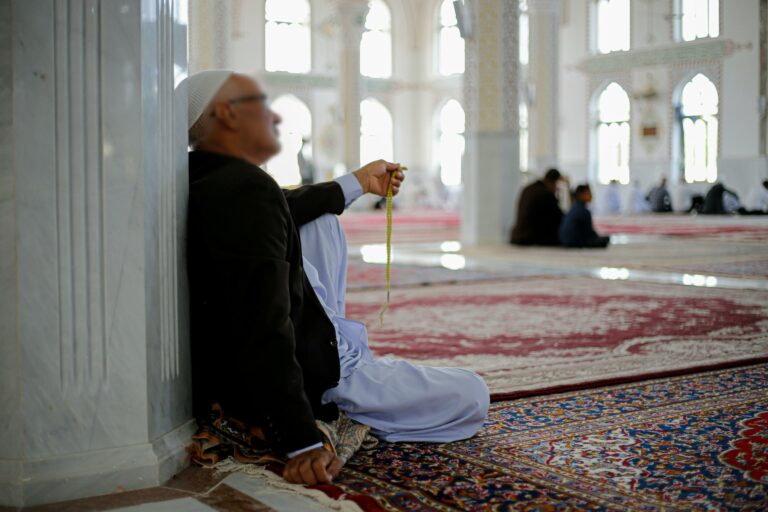
The Muslim was not created to live detached from the remembrance of Allah, Exalted be He.
On the contrary, dhikr, daily adhkār, and istighfār form the living heart of faith — the constant bond between the servant and his Lord.
In a world marked by distraction, restlessness, and forgetfulness, the Muslim’s routine is built upon a simple yet fundamental principle: remembering Allah constantly, in an authentic and consistent manner.
The purpose of this article is to highlight the importance of dhikr, the morning and evening adhkār, and istighfār — their spiritual benefits, their protective role, and how to practically integrate them into daily life, in light of the Qur’an and the authentic Sunnah.
Read also
What Is Dhikr in Islam?
The word dhikr (ذِكْر) literally means remembrance. In Islam, it refers to every form of remembering Allah — whether through the tongue, the heart, or one’s actions.
Dhikr includes, among other things:
- the recitation of the Qur’an,
- the glorification of Allah (subḥānallāh),
- praising Him (al-ḥamdu liLlāh),
- affirming His Oneness (lā ilāha illa Llāh),
- magnifying Allah (Allāhu akbar),
- seeking forgiveness (istighfār).
Allah, Exalted be He, clearly commands:
“O you who believe! Remember Allah with abundant remembrance.”
(Qur’an, al-Aḥzāb, 33:41)
This verse shows that dhikr is not meant to be occasional.
It must be abundant, constant, and firmly anchored in the daily life of the believer.
The Difference Between Dhikr, Adhkār, and Istighfār
To understand the Muslim’s spiritual routine, it is essential to distinguish between these three complementary concepts:
Dhikr
Dhikr is the general term that encompasses every form of remembrance of Allah, without restriction to a specific time.
Adhkār
Adhkār are specific formulas taught by the Prophet ﷺ, associated with particular moments:
- in the morning,
- in the evening,
- after the obligatory prayers,
- before sleeping,
- during moments of fear, distress, or joy.
Istighfār
Istighfār is the act of seeking forgiveness from Allah. It is an integral part of dhikr and represents a major key to purifying the heart and easing hardships. Together, these three elements form the foundation of the practicing Muslim’s routine.
The Importance of Dhikr in the Qur’an
The Qur’an grants dhikr a central, repeated, and emphatic place. The remembrance of Allah is not presented as a simple spiritual recommendation, but as a foundation of faith, a source of life for the heart, and a key to success.
Qur’anic commentators have extensively reflected on these verses. Among them, Shaykh ʿAbd ar-Raḥmān as-Saʿdī (may Allah have mercy on him) particularly emphasized the practical and transformative dimension of dhikr.
Dhikr Brings Peace to the Heart
Allah, Exalted be He, says:
“Indeed, it is through the remembrance of Allah that hearts find peace.”
(Qur’an, ar-Raʿd, 13:28)
In his tafsīr, as-Saʿdī explains that this verse means nothing can grant the heart true and lasting tranquility except the remembrance of Allah.
He clarifies that hearts are naturally anxious, unstable, and exposed to fears and worries, and that dhikr acts as a real — not illusory — source of calm.
According to as-Saʿdī, the remembrance of Allah:
- reassures the heart regarding destiny,
- strengthens trust in divine wisdom,
- removes anxiety about the future.
He stresses that material pleasures, social success, or distractions offer only temporary relief, whereas dhikr produces a deep, continuous, and renewed peace.
This peace is not symbolic; it manifests as serenity, emotional stability, and firmness of the heart when facing trials.
Dhikr Elevates the Believer and Honors Him
Allah, Exalted be He, says:
“So remember Me; I will remember you.”
(Qur’an, al-Baqarah, 2:152)
As-Saʿdī explains that this verse contains an immense promise, founded upon divine reciprocity: if the servant remembers Allah, Allah remembers him in return.
He clarifies that Allah’s remembrance of His servant is nobler, higher, and more beneficial than anything the servant could imagine.
To be remembered by Allah means:
- to be mentioned among the angels,
- to receive His assistance,
- to be granted His mercy and support.
As-Saʿdī emphasizes that this verse encourages the believer to increase in dhikr, for every act of remembrance — even a discreet one — is known to Allah and rewarded with real spiritual elevation. Dhikr is therefore not merely a personal act; it is a direct means of drawing closer to Allah.
Dhikr Is a Sign of Success
Allah, Exalted be He, says:
“And remember Allah abundantly so that you may be successful.”
(Qur’an, al-Jumuʿah, 62:10)
In his commentary, as-Saʿdī explains that the success mentioned here is comprehensive and includes:
- religious success,
- uprightness of the heart,
- success in actions,
- and success in the Hereafter.
He highlights that the verse uses the expression “abundantly,” showing that while occasional dhikr is beneficial, true success is tied to consistency and repetition.
According to as-Saʿdī, dhikr:
- illuminates the intellect,
- strengthens faith,
- facilitates obedience,
- keeps sin at a distance.
Thus, the more the servant multiplies the remembrance of Allah, the more the causes of success open before him — in his deeds, his choices, and his relationship with his Lord.
Through these verses, three fundamental realities emerge:
- Dhikr brings real and lasting peace to the heart.
- Dhikr elevates the believer through divine remembrance in return.
- Dhikr is a key to success in this world and the Hereafter.
The Qur’an therefore does not present dhikr as a secondary practice, but as a central pillar of the believer’s life — without which the heart weakens, becomes agitated, and turns away.
Dhikr as a Remedy for the Diseases of the Heart
Scholars have explained that spiritual ailments — such as anxiety, sadness, ostentation, heedlessness, or excessive attachment to this worldly life — are diseases of the heart.
The Qur’an and the Sunnah have identified dhikr as their primary remedy.
The Heart Needs Dhikr as the Body Needs Food
Ibn Taymiyyah explains that the human heart cannot remain healthy without the remembrance of Allah. He writes that dhikr is to the heart what water is to fish.
He clarifies that when the heart is deprived of dhikr:
- it weakens,
- it darkens,
- it becomes unstable and anxious, even if outwardly the person appears content.
Thus, the absence of dhikr is itself a disease, not merely a shortcoming.
Dhikr Drives Away Anxiety and Sadness
Ibn Taymiyyah clearly states that the main causes of sadness and anxiety are forgetting Allah and excessive attachment to the world, while the remembrance of Allah is the most effective means of dispelling them.
This perfectly aligns with the statement of Allah, Exalted be He:
“Indeed, it is through the remembrance of Allah that hearts find peace.”
(Qur’an, ar-Raʿd, 13:28)
Ibn Taymiyyah explains that this peace is not merely emotional, but also intellectual and spiritual, because dhikr restores meaning to trials, places destiny back into Allah’s hands, and removes from the heart the burden of excessive fear.
Dhikr Protects Against Spiritual Illnesses
In Diseases of the Hearts, Ibn Taymiyyah explains that repeated sins, heedlessness, and unchecked desires lead to:
- hardness of the heart,
- spiritual blindness,
- gradual distancing from Allah.
He explains that dhikr acts as a protective barrier, preventing the heart from settling into forgetfulness, restraining negative thoughts, and weakening the influence of Shayṭān.
This is in perfect harmony with the statement of Allah, Exalted be He:
“And whoever turns away from My remembrance will indeed have a constricted life.”
(Qur’an, Ṭā-Hā, 20:124)
Ibn Taymiyyah explains that this “constricted life” does not merely refer to material poverty, but above all to inner suffocation, constant dissatisfaction, and agitation of the heart.
Dhikr Is a Source of Inner Strength and Steadfastness
Ibn Taymiyyah also emphasizes that dhikr strengthens the believer’s resolve and firmness.
He explains that the one who increases in the remembrance of Allah:
- resists temptations more effectively,
- perseveres more consistently in obedience,
- endures trials with greater ease.
This sheds light on the statement of Allah, Exalted be He:
“O you who believe! Remember Allah with abundant remembrance.”
(Qur’an, al-Aḥzāb, 33:41)
According to Ibn Taymiyyah, the command to remember Allah abundantly indicates that both quantity and regularity have a direct impact on the strength of the heart.
Dhikr as a Key to Healing the Heart
Ibn Taymiyyah concludes that the diseases of the heart are not cured solely through knowledge, nor solely through asceticism, but through the combination of sound knowledge and constant dhikr.
He affirms that dhikr serves as both prevention and cure:
- prevention against relapse,
- and healing from already established ailments.
For this reason, he considers the remembrance of Allah to be the most powerful and most accessible remedy for the believer.
A clear truth emerges:
- dhikr is the life of the heart,
- its absence is a major cause of illness,
- its consistency is a direct cause of healing, peace, and success.
The Muslim’s routine, therefore, cannot be sound or complete without granting a central place to dhikr.
The Benefits of Dhikr According to the Sunnah
The Sunnah of the Prophet ﷺ confirms, explains, and deepens what the Qur’an teaches about dhikr. The prophetic words and practice show that the remembrance of Allah is the very life of the heart, and that abandoning it leads to real spiritual weakening.
Ibn al-Qayyim, may Allah have mercy on him, extensively explained the effects of dhikr on the soul, the heart, and faith in Zād al-Maʿād, relying on authentic hadiths.
Dhikr Is the Life of the Heart
The Prophet ﷺ said:
“The example of the one who remembers his Lord and the one who does not remember Him is like that of the living and the dead.” (al-Bukhārī)
Ibn al-Qayyim explains that this hadith establishes a real, not symbolic, comparison.
According to him:
- the heart that remembers Allah is alive, illuminated, and responsive,
- whereas the heart deprived of dhikr is like a dead heart, even if the person is physically alive.
He clarifies that:
- the life of the heart manifests through faith, reverent fear, and love of Allah,
- while its death manifests through heedlessness, hardness, and distance from remembrance.
Thus, dhikr is not a simple spiritual addition; it is the very condition of inner life.
Dhikr Is the Best Occupation of the Servant
In Zād al-Maʿād, Ibn al-Qayyim emphasizes that the Prophet ﷺ was the most consistent of people in dhikr, in all circumstances:
- while traveling and while at home,
- in times of ease as well as hardship,
- by day and by night.
He explains that this constancy shows dhikr to be the easiest and most accessible form of worship, yet one of the heaviest on the scale.
In this regard, he cites the statement of the Prophet ﷺ:
“The people of Paradise will regret nothing except the moments in which they did not remember Allah.”
(reported by at-Ṭabarānī – meaning authenticated)
Ibn al-Qayyim comments that this regret is not due to sin, but to having missed an opportunity for elevation and closeness.
Every moment without dhikr is therefore a real loss, even if it is not counted as disobedience.
Dhikr Protects the Heart and Directs It Toward Allah
Ibn al-Qayyim also explains that dhikr:
- protects the heart from the invasion of negative thoughts,
- weakens the influence of Shayṭān,
- prevents excessive attachment to this worldly life.
He shows that the Prophet ﷺ used dhikr as a constant shield, and that the more the servant multiplies remembrance, the firmer his heart becomes, his faith strengthens, and his attachment to Allah grows.
Dhikr thus acts as a preventive protection, even before spiritual illness takes hold.
Dhikr Is a Source of Lasting Joy and Reward
In Zād al-Maʿād, Ibn al-Qayyim stresses an essential point: dhikr is a form of worship whose reward begins in this world before the Hereafter.
He explains that the remembrance of Allah generates inner joy, contentment of the heart, and a spiritual sweetness that nothing else can replace.
This reality explains why the Prophet ﷺ taught his community to increase dhikr in all circumstances, as it is an immediate, lasting, and endlessly renewable good.
Synthesis According to the Sunnah and Ibn al-Qayyim
In light of the Sunnah and the teachings of Ibn al-Qayyim in Zād al-Maʿād, it becomes clear that:
- dhikr is the life of the heart,
- abandoning it leads to a form of spiritual death,
- every moment without dhikr is a missed opportunity,
- its consistency is a source of joy, protection, and elevation.
The Muslim’s routine therefore cannot be sound or complete without a strong and constant attachment to dhikr, as practiced and taught by the Prophet ﷺ.
Morning and Evening Adhkār: A Daily Shield
Among the most important and regular forms of dhikr are the morning and evening adhkār. They hold a central place in the Sunnah of the Prophet ﷺ and constitute one of the most powerful means of spiritual protection for the believer.
Ibn al-Qayyim explains in Zād al-Maʿād that the Prophet ﷺ never abandoned these adhkār — whether traveling or at home, in ease or in hardship. This consistency shows that they are not merely optional supplications, but a true prophetic routine.
A Constant Practice of the Prophet ﷺ
Ibn al-Qayyim highlights that the Prophet ﷺ had specific adhkār:
- at the beginning of the day,
- at the end of the day,
- and at the transition between day and night.
He explains that these moments correspond to shifts in state, during which the servant is more exposed to the whispers of Shayṭān, visible and invisible dangers, and the trials decreed by Allah.
This is precisely why the Prophet ﷺ instituted specific adhkār for these times — so that the believer begins and ends his day under the protection of Allah.
Morning and Evening Adhkār as Protection
Ibn Taymiyyah, in Al-Kalim aṭ-Ṭayyib, explains that authentic adhkār are spiritual fortifications. He likens the one who recites them regularly to a person who takes refuge in a strong citadel, safe from the enemy.
He affirms that the more complete and consistent the dhikr, the stronger and more lasting the protection.
This means that neglecting these adhkār exposes the heart and the person to spiritual harm, even if it is not immediately perceived.
Protection Against Evil and Shayṭān
In Zād al-Maʿād, Ibn al-Qayyim explains that Shayṭān lies in wait during moments of inattention, particularly at the beginning of the day and at nightfall.
The morning and evening adhkār close the doors through which Shayṭān operates, prevent his insinuations from settling, and weaken his influence over the heart.
This aligns with the many hadiths in which the Prophet ﷺ taught specific formulas of protection to be recited at these times.
Shaykh ʿAbd ar-Razzāq al-Badr explains in Jawāmiʿ al-Adʿiyah an-Nabawiyyah that these adhkār combine:
- seeking protection,
- affirming tawḥīd,
- placing complete trust in Allah.
This combination is what makes these adhkār particularly effective.
Protection Against Visible and Invisible Trials
Ibn al-Qayyim explains that the morning and evening adhkār do not only protect against Shayṭān, but also:
- against calamities,
- against sudden trials,
- against the harm of creation,
- and against what Allah has decreed as a test for the servant.
He explains that the believer who entrusts himself to Allah every morning and every evening places both his day and his night under divine care. This entrusting does not necessarily prevent every trial, but it reduces their impact, facilitates patience, and preserves the heart.
A Cause of Barakah Throughout the Day and the Night
Shaykh ʿAbd ar-Razzāq al-Badr emphasizes a fundamental point: the morning and evening adhkār are a direct cause of barakah.
He explains that barakah manifests itself through:
- ease in one’s affairs,
- clarity in decision-making,
- serenity in the heart,
- and an invisible yet real form of protection.
A believer may accomplish many actions in a day without barakah, or few actions with barakah — thanks to these adhkār.
A Comprehensive Prophetic Proof
The meaning of many authentic hadiths shows that whoever recites the morning and evening adhkār is protected until the next appointed time.
Even if the Prophet ﷺ did not summarize this reality in a single literal statement, the convergence of authentic narrations clearly establishes this principle:
The morning and evening adhkār form a daily spiritual armor, renewed every day and every night.
A clear reality emerges:
- the morning and evening adhkār are an essential protection,
- their consistency is a cause of spiritual safety,
- abandoning them exposes the believer, even if he is unaware of it.
Every authentic Muslim routine therefore begins and ends with these adhkār, for they are the believer’s daily shield.
Istighfār: A Key to Relief and Provision
Istighfār (seeking forgiveness) occupies a central place in the Muslim’s routine. It is not limited to moments of sin alone, but is a fundamental means of purifying the heart, lifting hardships, and opening the doors of provision.
The texts of the Qur’an, the practice of the Prophet ﷺ, and the explanations of the scholars show that istighfār affects both the servant’s inner state and his external reality.
Istighfār in the Qur’an: A Clear Divine Promise
Allah, Exalted be He, relates the words of the Prophet Nūḥ
ʿalayhi s-salām:
“Seek forgiveness from your Lord; indeed, He is Ever-Forgiving.
He will send down upon you rain in abundance,
grant you wealth and children,
and provide for you gardens and rivers.”
(Qur’an, Nūḥ, 71:10–12)
Ibn al-Qayyim explains in Zād al-Maʿād that this passage establishes a direct link between istighfār and the improvement of the servant’s condition.
He highlights that the benefits mentioned here are not only spiritual, but also material and tangible.
Istighfār is a legislated cause of provision, relief, and blessing.
Istighfār as a Means Against Trials
Ibn Taymiyyah explains, in his writings on the diseases of the heart, that sins and heedlessness are among the primary causes of hardship — whether psychological, spiritual, or material.
He clarifies that istighfār:
- erases the effects of sin on the heart,
- lightens the weight of trials,
- opens the door to divine mercy.
This aligns with the statement of Allah, Exalted be He:
“Allah would not punish them while you are among them, nor would Allah punish them while they seek forgiveness.”
(Qur’an, al-Anfāl, 8:33)
As long as istighfār is present, punishment is repelled and mercy remains.
The Constant Practice of the Prophet ﷺ
The Prophet ﷺ — despite being protected from sin — said:
“I seek Allah’s forgiveness and repent to Him more than seventy times a day.”
(al-Bukhārī)
Ibn al-Qayyim explains that this prophetic consistency shows that istighfār is not reserved for major sinners, nor limited to moments of obvious fault, but is part of the believer’s daily worship.
The Prophet ﷺ Used Istighfār:
- to elevate his rank,
- to strengthen his closeness to Allah,
- and to teach his community the value of perseverance in repentance.
Istighfār as Purification of the Heart
Ibn Taymiyyah states that the heart becomes stained by sins just as the body becomes soiled by dust, and that istighfār acts as regular cleansing — continuous purification and protection against hardness of the heart.
Without istighfār, the heart hardens, even if a person performs other acts of worship.
This is why istighfār is inseparable from dhikr in the Muslim’s routine.
A Key to Provision and Ease
Shaykh ʿAbd ar-Razzāq al-Badr explains in Jawāmiʿ al-Adʿiyah an-Nabawiyyah that many believers seek ease, barakah, and open doors, without realizing that one of the most powerful keys lies in regular istighfār.
He reminds that istighfār:
- attracts mercy,
- removes obstacles,
- and prepares the heart to receive Allah’s blessings.
Synthesis: A Major Key in the Muslim’s Routine
It becomes clear that istighfār is:
- a purification of the heart,
- a cause of relief in the face of trials,
- a means of provision and barakah,
- a key to closeness to Allah.
No authentic Muslim routine can therefore be complete without granting a daily and consistent place to istighfār.
How to Establish the Muslim’s Daily Routine
Establishing a spiritual routine does not mean multiplying actions until exhaustion. On the contrary, the Sunnah teaches consistency, even in simple deeds.
An effective routine is realistic, regular, and centered on the remembrance of Allah, Exalted be He.
The Prophet ﷺ said:
“The most beloved deeds to Allah are those done consistently, even if they are few.”
(al-Bukhārī, Muslim)
The Muslim’s routine can thus be structured around four key moments.
Morning: Beginning the Day Under Allah’s Protection
The morning is a decisive moment. It is when intentions are set, the day begins, and the believer places himself under Allah’s care.
The morning routine is mainly based on:
- the morning adhkār, recited after the Fajr prayer,
- dhikr of gratitude, acknowledging the blessings received,
- a sincere intention, directing the entire day toward obedience.
The morning adhkār form a spiritual shield against visible and invisible harm. They allow the believer to entrust his day to Allah, Exalted be He, before engaging in daily activities.
Dhikr of gratitude instills a positive and thankful mindset, reminding the believer that each new day is a gift, not an entitlement.
Finally, a sincere intention transforms ordinary actions — work, studies, family responsibilities — into acts of worship when they are performed for Allah.
During the Day: Maintaining the Connection Through Continuous Dhikr
Daily life exposes the believer to forgetfulness, distraction, and spiritual fatigue. For this reason, the Sunnah encourages continuous dhikr throughout the day.
This dhikr takes the form of short and repeated phrases, frequent istighfār, and sending prayers upon the Prophet ﷺ.
Continuous dhikr requires neither isolation nor special availability. It can be practiced while walking, working, waiting, or during moments of silence.
Frequent istighfār continuously cleanses the heart, erasing traces of negligence and unintentional shortcomings.
As for sending prayers upon the Prophet ﷺ, it strengthens love for the Messenger of Allah, raises the believer in rank, and brings immense reward.
Thus, even amid daily occupations, the bond with Allah is never broken.
After the Prayers: Strengthening the Relationship With Allah
The obligatory prayers are the pillars of the Muslim’s day. The moments that follow them are particularly conducive to dhikr.
The post-prayer routine is based on:
- the adhkār after the prayer,
- tasbīḥ (glorification),
- taḥmīd (praise),
- and takbīr (exalting Allah).
These adhkār allow one to:
- complete the prayer,
- repair possible shortcomings,
- prolong the presence of the heart after worship.
They also serve as protection between two prayers, keeping the believer in a state of remembrance and spiritual awareness.
Evening and Before Sleeping: Ending the Day in Remembrance
The end of the day is a moment of vulnerability. Fatigue sets in, the mind relaxes, and Shayṭān intensifies his efforts.
The evening routine includes:
- the evening adhkār,
- ruqyah through the recitation of protective sūrahs,
- complete reliance upon Allah, Exalted be He, before sleep.
The evening adhkār allow the believer to entrust the night to Allah, protect himself from unseen dangers, and close the day as it began — with remembrance.
Before sleeping, the believer places his soul entirely in Allah’s care, aware that sleep is a form of entrusting the soul to Him.
Thus, the Muslim’s day begins and ends with dhikr, forming a continuous circle of protection and serenity.
Common Mistakes to Avoid
Despite the simplicity of this routine, certain mistakes can reduce its benefits.
Neglecting Consistency
Initial enthusiasm may lead to intense but short-lived practice. Yet consistency is more beloved than abundant actions that are later abandoned.
Reciting Mechanically Without Presence of the Heart
Dhikr is not a mechanical recitation. Without attention and understanding, it loses much of its effect on the heart.
Restricting Dhikr to Times of Difficulty
The remembrance of Allah should not be limited to moments of distress. It is protection before trials, not only a refuge afterward.
Believing That Occasional Dhikr Is Sufficient
Occasional dhikr is beneficial, but true transformation of the heart requires repetition and regularity.
Conclusion
The Muslim’s routine is neither heavy nor inaccessible. It is built upon specific moments, simple actions, and a sincere intention.
The one who structures his day around dhikr, adhkār, and istighfār lives under Allah’s protection, Exalted be He, and moves through life with serenity, clarity, and confidence.
FAQ – Common Questions About Dhikr, Adhkār, and Istighfār
1) What is the difference between dhikr and adhkār?
Dhikr refers to the general remembrance of Allah (Qur’an, tasbīḥ, praise, istighfār, etc.).
Adhkār are specific formulas taught by the Prophet ﷺ, often tied to particular moments (morning, evening, after prayer, before sleeping).
2) When should the morning adhkār be recited?
The ideal time is after the Fajr prayer until sunrise.
They remain permissible until the Ẓuhr prayer if one was delayed or missed them.
3) When do the evening adhkār begin?
They may begin after the ‘Aṣr prayer, with the ideal time being after Maghrib.
The goal is to end the day under Allah’s protection.
4) Is it serious if I forget the morning or evening adhkār?
It is not a sin in itself, but you miss out on a great benefit and protection.
The most important thing is to resume the routine as soon as possible and seek consistency.
5) Can dhikr be done without concentration?
Dhikr remains a good deed, but its effect on the heart is stronger with presence, understanding, and sincerity.
The goal is progress: begin simply, then improve the quality.
6) How many times should istighfār be done each day?
There is no obligatory number, but the Prophet ﷺ sought forgiveness very frequently (more than seventy times a day according to an authentic hadith).
The best approach is consistency, even if the amount is small.
7) What is the best dhikr for daily protection?
Among the most well-known are the morning and evening adhkār, Āyat al-Kursī, and the protective sūrahs (al-Ikhlāṣ, al-Falaq, an-Nās) according to the Sunnah.
The most “powerful” dhikr is the one practiced consistently.
8) Does dhikr replace practical means (work, treatment, effort)?
No. The Muslim combines lawful means with tawakkul.
Dhikr strengthens the heart but does not cancel personal responsibility.
9) What is the best simple routine for beginners?
A realistic routine:
- morning adhkār after Fajr,
- adhkār after each prayer (tasbīḥ, taḥmīd, takbīr),
- evening adhkār,
- supplications before sleeping. Even if you start small, consistency is what matters most.
10) What does “keeping the tongue moist with dhikr” mean?
It refers to frequently occupying the tongue with the remembrance of Allah without a fixed time — tasbīḥ, istighfār, praise, sending prayers upon the Prophet ﷺ, and so on.
It is not a single formula, but a state of consistency.
Conclusion: Dhikr, the Living Heart of Faith
The Muslim’s routine is not based on accumulating actions, but on consistency in remembering Allah, Exalted be He. It is not quantity that transforms the heart, but regularity, sincerity, and presence of the heart.
Dhikr, adhkār, and istighfār are not secondary practices. They are the living heart of faith, the source of inner tranquility, and the permanent bond between the servant and his Lord.
They represent:
- daily protection against evil and heedlessness,
- a source of peace and stability for the heart,
- a direct path to closeness to Allah.
The Prophet ﷺ summarized this reality in a concise and comprehensive statement:
“Supplication is worship.”
(at-Tirmidhī)
Beginning today — even with little, but with consistency — is enough to transform a life.
For the one who clings to the remembrance of Allah sees his heart illuminated, his trials lightened, and his faith strengthened, day after day.
📥 To Go Further
🎓
Enjoy a free trial to learn the Qur’an and Arabic with Al-Dirassa