
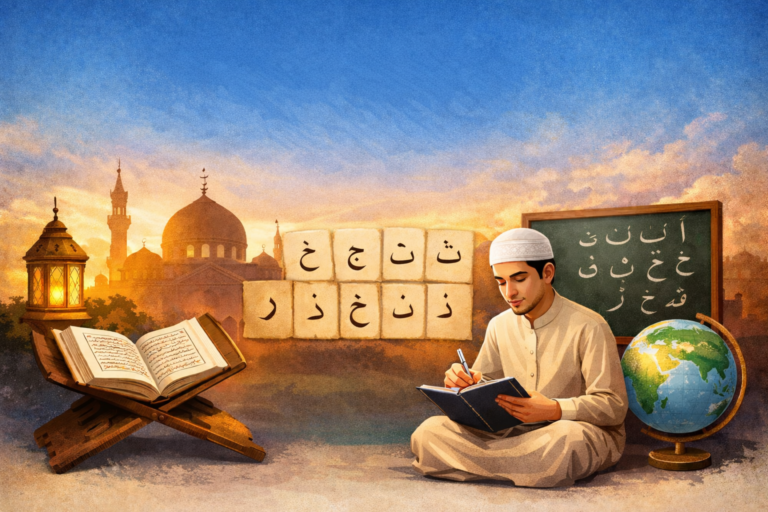
Learning Arabic is now within everyone’s reach, even if you are a complete beginner, a French speaker, or someone who thinks languages do not come easily. Contrary to common assumptions, Arabic is not an impossible language: it is structured, logical, and entirely accessible when it is taught with a clear and progressive method.
Whether your goal is to read and understand the Quran, speak Arabic, or simply learn Modern Standard Arabic online, this article is designed to guide you step by step. You will discover how to learn Arabic effectively through a progression that is especially suitable for French speakers: alphabet, reading, vocabulary, grammar, then comprehension and expression.
This guide answers the main questions beginners usually ask: how to learn Arabic from scratch, how long it takes to make real progress, and which method produces lasting results. You will find here a practical, structured, and results-oriented approach, rooted in the real teaching of Arabic to thousands of students.
Learning Arabic is not simply about acquiring another language. It is about gaining access to a language of meaning, structure, and depth, one that holds a unique place on the religious, cultural, and intellectual levels. For French speakers, the reasons to learn Arabic are many, and they often complement one another.
Arabic is the language of the Quran, supplications, and the words of the Prophet ﷺ. While translations are useful, they can never fully replace direct access to the original text. Learning Arabic makes it possible to:
For many students, learning Arabic is first and foremost a spiritual journey, motivated by the desire to draw closer to Allah through direct understanding.
Arabic is spoken in more than twenty countries and by hundreds of millions of people around the world. Learning Arabic allows you to:
Arabic is not a frozen language. It is a living language used in media, education, diplomacy, and daily life.
Many people believe Arabic is difficult. In reality, Arabic is built on a clear internal logic, especially through its root system. Once the foundations are in place:
With a method adapted to French speakers, Arabic often feels more coherent than French itself, which contains many exceptions.
The real difficulty does not come from the language itself, but from the method used to learn it. Studying Arabic without structure, without a teacher, or without a clear progression often leads to frustration and abandonment. By contrast, a progressive method helps learners:
That is exactly why Al-Dirassa offers a method designed specifically for French speakers, with qualified teachers and real guidance.
When starting Arabic, the key is not the amount of information you study, but the order in which you learn it. Many failures come from a poor method: trying to speak too early, learning complex rules without solid foundations, or skipping essential steps. Learning Arabic effectively requires a clear, structured progression, especially one adapted to French-speaking beginners.
The Arabic alphabet is often seen as a major obstacle, when in fact it is usually the simplest and fastest stage when taught properly. It contains 28 letters, and many of their sounds already exist in French.
Here is the full Arabic alphabet in order:
ا ب ت ث ج ح خ د ذ ر ز
س ش ص ض ط ظ ع غ
ف ق ك ل م ن ه و ي
At this stage, the goal is not perfect writing, but rather to:
With a progressive method, a beginner can recognize and read Arabic letters within just a few days.
Some Arabic letters do not exist in French, such as ع، ق، خ، غ, and ض. These sounds should not be learned in a purely theoretical way, but through listening and guided repetition.
At this stage, it is essential to:
Good pronunciation from the beginning prevents mistakes that are much harder to correct later, especially when reading the Quran.
Once the alphabet and vowels are understood, reading develops quickly. The beginner starts by reading:
This stage is often highly motivating, because the student realizes that Arabic can already be read without translation, sometimes in less than 30 days.
Learning Arabic does not mean memorizing thousands of isolated words. During the first weeks, the focus should be on:
Because Arabic is based on roots, each new word often helps unlock several others.
Once reading is established and some vocabulary is in place, the student begins to discover:
This is the point at which Arabic becomes truly meaningful, and the learner starts to grasp the overall meaning of a text or a verse.
Although some foundations can be learned alone, progressing without guidance often leads to confusion and stagnation. A teacher helps to:
That is why Al-Dirassa offers structured support designed specifically for French-speaking beginners, with qualified teachers and a proven method.
One of the most frequent questions people ask before starting Arabic is this: how long does it really take? The answer depends on several factors, including consistency, the method used, the quality of guidance, and the learner’s goal. With a structured approach and proper support, Arabic is a language in which progress can be both visible and encouraging.
For a complete beginner, learning to read Arabic is usually the quickest milestone to reach. By following a progressive path through:
it is possible to begin reading Arabic in 30 to 45 days, even with no prior background. At that stage, the learner can read words, simple sentences, and begin decoding Quranic verses.
After a few weeks, the learner reaches a functional beginner level. This means being able to:
This level is enough to begin understanding simple texts and to continue with deeper study.
With regular and guided study, the learner progresses toward an intermediate level. At this stage, it becomes possible to:
This is usually where the language begins to feel more fluid, and overall comprehension improves noticeably.
After several months of serious learning, the student can reach an advanced level, especially if studying Modern Standard Arabic or Quranic Arabic. At this point, it becomes possible to:
The time needed to learn Arabic depends less on talent than on method. The most important elements are:
With structured support and a method adapted to French speakers, learning Arabic becomes faster, clearer, and more effective.
When starting Arabic, one question comes up again and again: can you learn Arabic on your own, or do you really need a teacher? In truth, it depends on what you want to learn, your goals, and the level of precision you are aiming for. Both paths exist, but they do not lead to the same results.
Today, there are many resources for self-study: videos, apps, books, and PDF guides. Learning alone can be useful for:
However, this approach quickly shows its limits. Without guidance, it is difficult to:
Many beginners stop after a few weeks, not because they lack motivation, but because they lack structure and meaningful feedback.
Being guided by a teacher changes the learning experience completely. A qualified teacher helps to:
This is especially important for French speakers, because certain challenges such as pronunciation, reading, and sentence structure often require targeted support.
When learning Arabic for a religious purpose, guidance becomes even more important. Incorrect pronunciation or approximate understanding can lead to mistakes in:
A teacher helps ensure that the learning process remains accurate, respectful, and faithful to the language.
In many cases, the most effective path is to combine:
That is exactly what Al-Dirassa offers: a structured method designed for French speakers, with qualified teachers and genuine follow-up.
Learning Arabic requires a clear, progressive method that is adapted to French speakers. This is precisely where many methods fail: they are too theoretical, poorly structured, or designed for learners with a completely different linguistic background. The Al-Dirassa method was built to address these real challenges, drawing on the experience of teaching thousands of students.
The Al-Dirassa method is based on a logical progression, without rushing through the foundations. Each learner follows a clear path:
This progression makes it possible to obtain fast results while building lasting foundations.
The difficulties French speakers encounter are well known: sound confusion, weak articulation, and difficulty understanding certain structures. The Al-Dirassa method takes these specific needs into account and adapts:
The goal is not simply to teach rules, but to help learners truly understand the Arabic language.
One of the pillars of the Al-Dirassa method is the support of qualified teachers who specialize in teaching Arabic to non-native speakers. They help learners to:
This method is especially appreciated by learners who want to study Arabic in order to understand the Quran. The learning path respects:
This helps avoid approximations and supports a serious, lasting form of learning.
Al-Dirassa classes are available online, which makes it possible to:
Thanks to a structured method, real support, and qualified teachers, Al-Dirassa helps French speakers learn Arabic effectively and sustainably.
When starting Arabic, certain mistakes can slow progress significantly and sometimes even lead to giving up. These mistakes usually do not come from a lack of ability, but from poor method or disorganized learning. Knowing them in advance helps you progress more calmly and efficiently.
One of the most common mistakes is wanting to speak Arabic from the very first weeks. Arabic is a language that is built first through reading and correct pronunciation. Without solid reading foundations, comprehension and expression remain fragile.
In Arabic, even a slight pronunciation mistake can completely change the meaning of a word. Ignoring this issue early on often creates habits that are hard to correct later, especially in Quran reading. Pronunciation should be worked on from the first lessons with a reliable model.
Accumulating videos, apps, or PDF resources without a clear plan leads to confusion. Arabic requires a logical progression: alphabet, reading, vocabulary, grammar, then comprehension. Without structure, effort becomes inefficient.
Motivation sometimes pushes learners to rush ahead. Yet Arabic rewards patience and consistency. It is better to learn a little well than a lot superficially.
Long sessions spaced far apart are less effective than shorter and more regular study. Even 15 to 30 minutes a day can produce steady progress.
For beginners, mixing standard Arabic with dialects often makes the learning process unnecessarily confusing. It is better to focus first on Modern Standard Arabic, which is the shared foundation behind the dialects and essential for understanding the Quran.
Autonomy is useful, but learning alone for too long without feedback often leads to blocks. Guidance helps correct mistakes, maintain motivation, and accelerate progress.
Avoiding these mistakes saves precious time and allows for a more peaceful learning experience.
The best website for learning Arabic is one that offers a clear method, qualified teachers, a structured progression, and real support. Al-Dirassa is specifically designed for French speakers, with online classes adapted to complete beginners as well as more advanced learners.
Yes, Arabic can absolutely be learned effectively online, provided the method is serious and well structured. Online learning now makes it possible to have a teacher, learning materials, and personalized follow-up while keeping a great deal of flexibility.
With a structured method, it is possible to:
Arabic is not inherently difficult. It is logical and based on roots and regular rules. Most difficulties come from a poor method or from a lack of structure in the learning process.
For beginners, it is strongly recommended to begin with Modern Standard Arabic. It is the common foundation behind the dialects and the language of the Quran, books, and formal instruction. Dialects can be learned later if needed.
Yes, learning Arabic to understand the Quran is not only possible, but highly recommended. By studying standard Arabic with correct pronunciation, it becomes possible to gradually understand the meaning of verses without relying only on translation.
It is possible to learn some basic elements alone, such as the alphabet or some vocabulary. However, for real progress, error correction, and long-term consistency, support from a teacher is strongly recommended.
Al-Dirassa Arabic courses are intended for:
Learning Arabic is an accessible, enriching, and deeply rewarding project when it is approached with the right method. By following a clear progression, avoiding common mistakes, and benefiting from proper guidance, anyone can learn Arabic effectively, even from absolute beginner level.
Don’t want to go through the translation anymore?
30 free minutes with your qualified Egyptian teacher.
Al-dirassa Institute offers you a gift to help you begin your journey to being fluent in Arabic and learning the Quran.
Al-dirassa Institute offers you a gift to help you begin your journey to being fluent in Arabic and learning the Quran.