
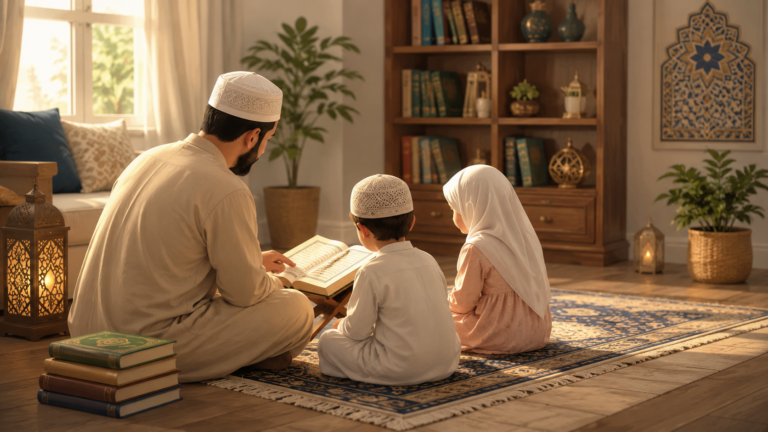
Teaching Islam to your children at home is one of the deepest responsibilities a Muslim parent can carry. It is not simply about passing down rules or rituals. It is a spiritual inheritance, an identity, and a relationship with Allah that we help build, brick by brick, from a young age. And yet, many parents feel overwhelmed by this responsibility: where should we begin? How can we balance religious education with everyday family life? How can we teach strong values without discouraging the child?
This guide is for you. Whether you have been practicing for many years or you are a recent convert, whether your child is 3 or 12, the foundations of Islamic education at home remain the same: consistency, gentleness, example, and gradual progress.
The mosque, weekend Islamic school, online classes — all of these are valuable. But no outside setting can replace what happens within the walls of the home. This is where your child sees you pray, hears you make du’a, and watches how you respond to hardship. The home is the first school, and parents are the first teachers.
The Prophet ﷺ said:
“Each of you is a shepherd, and each of you will be questioned about those under his care.”
(Sahih al-Bukhari)
This responsibility should not feel crushing when approached with wisdom and calm. The goal is not to turn the home into a rigid classroom, but to create an environment where Islam is naturally present, where it is part of daily life rather than something imposed as a burden.
Before speaking about halal and haram, and even before teaching the prayer in detail, we need to place a simple and beautiful certainty in the child’s heart: Allah exists, He created us, He loves us, and there is meaning behind everything we experience. This is the foundation of aqeedah, taught in a way that suits the child’s age.
For very young children, from around 2 to 5 years old, this can happen through simple questions: “Do you see the sky? Who created it?” or “When you are hungry and you eat, who do we thank?” These small conversations, repeated with warmth and tenderness, build an emotional memory of faith that can be far stronger than any formal lesson.
Begin with a few simple and meaningful names: Ar-Rahman, the Most Merciful; Al-Khaliq, the Creator; As-Sami’, the One who hears everything. Connect these names to real moments in your child’s life: “You know, when you feel alone, Allah always hears you, because He is As-Sami’.” This kind of connection makes theology accessible, alive, and comforting for a child.
Prayer is the central pillar of Islam. The Prophet ﷺ instructed us to accustom children to prayer from the age of 7, and to encourage them more firmly from the age of 10. But “accustoming” does not mean forcing. It means introducing prayer gradually, with wisdom and kindness.
Children first learn by imitation. Pray in front of them. Let them stand beside you on the prayer mat. Do not correct every small detail too early. What matters at the beginning is that they associate prayer with something calm, beautiful, and shared with you. The technical details will come with time.
Once your child is around 6 or 7, begin teaching the movements one by one: the takbir, standing, ruku’, sujud. Then introduce Al-Fatihah, the essential surah of the prayer. Take your time. A child who prays two rak’ah with focus and love has gained more than a child who recites mechanically without understanding what he or she is doing.
The Quran lies at the heart of Muslim identity. Many parents dream of seeing their child recite, memorize, and understand the Book of Allah. This is a beautiful and reachable goal, as long as the approach is right.
Al-Fatihah, Al-Ikhlas, Al-Falaq, An-Nas, Al-Kawthar… These short surahs are ideal for beginners. They are rhythmic, beautiful to recite, and can be memorized fairly quickly. Repeat them during prayer, in the car, or before bedtime.
Ten minutes a day, every day, is far more effective than one long hour on Saturday. Quran learning depends on regular repetition and constant revision. If you do not yet have a routine, begin with five minutes every evening before bed. Over time, this quiet moment can become a ritual your child actually looks forward to.
This is a very common concern among parents. Not having learned tajweed properly as a child does not mean you cannot offer this treasure to your own children. There are solutions, especially online Quran classes for children, taught by qualified teachers who adapt to each child’s level and age. Al-Dirassa offers Quran classes for children with trained and experienced teachers — a precious option for parents who want a serious framework without unnecessary pressure.
Islamic education is not limited to formal lessons. It is lived through daily actions and the habits you build together as a family.
Teaching the du’a before eating, the du’a when leaving the house, and the du’a before sleeping creates small bridges between ordinary life and awareness of Allah. A child who says Bismillah before eating from the age of 3 will carry that habit for life. This is not empty routine. It is a renewed presence of Allah throughout the day.
Children love stories, and Islam is full of powerful ones: Ibrahim questioning the idols, Yusuf facing the jealousy of his brothers, Maryam and her devotion, Musa standing before Pharaoh. These stories teach faith, patience, honesty, and courage in a way that is vivid and memorable. Read them together before bedtime, talk about them, and ask your child what he or she understood from the story.
Ramadan, Eid al-Fitr, Eid al-Adha — these moments are wonderful opportunities for Islamic learning. Explain the meaning of fasting, the joy of giving, and the story behind the sacrifice of Ibrahim. Involve your child in the preparations and let them feel the beauty of these occasions. Faith is also built through positive emotions connected to Islam.
Understanding the language of the Quran, even partially, transforms a child’s relationship with the religion. It is no longer only a phonetic recitation. It becomes a conversation with the Sacred Text. Arabic is not reserved for elites or for families from Arabic-speaking backgrounds. Every child can learn it, provided the teaching is structured and gentle.
If you do not speak Arabic yourself, or if you want serious follow-up, online Arabic classes for children are becoming an increasingly popular solution among Muslim families. One-to-one or small-group sessions, held on Zoom with native teachers, offer a format that fits the reality of modern family life.
A home where Quran recitation is heard, where prayer is visible, and where Islamic books are within reach has a deeper impact on a child than we often realize. This does not mean covering every wall with calligraphy or creating a strict atmosphere. It simply means offering quiet but steady signs that tell the child: “In this family, Allah has a place.”
No teaching method can replace example. If your child sees you praying, making dhikr, reading the Quran, helping neighbors out of faith and sincerity, these actions become normal in their eyes. But if Islam is only visible through prohibitions, the child may begin to associate it with restriction rather than beauty.
One of the most common challenges parents face is maintaining consistency without becoming rigid or discouraged. Here are a few helpful reminders:
There is no shame in recognizing your limits. Many parents do not feel confident enough in tajweed, classical Arabic, or Quranic grammar to teach these subjects properly. In that case, turning to a qualified teacher is not only reasonable, it can be the best decision for the child.
Online classes are now an ideal solution for many Muslim families: no travel, flexible schedules, and teachers from Arabic-speaking countries or serious Islamic backgrounds. Your child can progress from home in a safe and structured environment, while receiving personalized teaching.
Teaching Islam to your children at home is an act of love as much as an act of faith. It means building, brick by brick, a relationship between your child and their Lord — a relationship that can guide them throughout life, long after your direct presence and supervision. Begin where you are, with what you have. Consistency matters more than perfection, and gentleness matters more than strictness.
And if you would like to go further and give your child a serious framework to learn Quran or Arabic with qualified teachers, Al-Dirassa offers you a free trial class to discover our method and meet our teachers. A simple first step, with no commitment, to lay the foundations of a strong and fulfilling Islamic education.
👉 Book a free trial class for my child
There is no such thing as too early when it comes to gently introducing a child to Islam. From birth, the adhan whispered into the newborn’s ear is already a first act of spiritual education. Between the ages of 2 and 4, a child can begin repeating Bismillah and discovering the name of Allah through everyday conversations. Prayer can be introduced gradually around the age of 6 or 7, in line with the Prophetic guidance. The essential point is to adapt the content and method to the child’s age and maturity, without forcing or rushing.
This is one of the most common questions Muslim parents ask. The good news is that there are now accessible and effective solutions. You can begin by exposing your child to high-quality recitations through trusted apps or channels, memorizing the short surahs of Juz’ Amma together, and, for structured tajweed learning, seeking help from a qualified teacher through online Quran classes for children. These classes, often taught by huffaz or teachers trained in Egypt, Saudi Arabia, or other centers of Islamic learning, allow the child to build correct recitation from the beginning, regardless of the parents’ own level.
A child’s resistance is often a sign that the approach needs to be adjusted. If Islam is presented only through rules, prohibitions, and obligations, the child may begin to see it as a burden. But when Islam is introduced through beautiful stories, shared family moments, joyful du’as, and small celebrations of progress, motivation becomes much more natural and lasting. The key is to connect Islam with positive emotions: safety, gratitude, beauty, and family connection. And if the resistance continues, changing the format — for example, working with an outside teacher or joining an online class with someone who knows how to speak to children — can make a real difference.
Don’t want to go through the translation anymore?
30 free minutes with your qualified Egyptian teacher.
Al-dirassa Institute offers you a gift to help you begin your journey to being fluent in Arabic and learning the Quran.
Al-dirassa Institute offers you a gift to help you begin your journey to being fluent in Arabic and learning the Quran.