
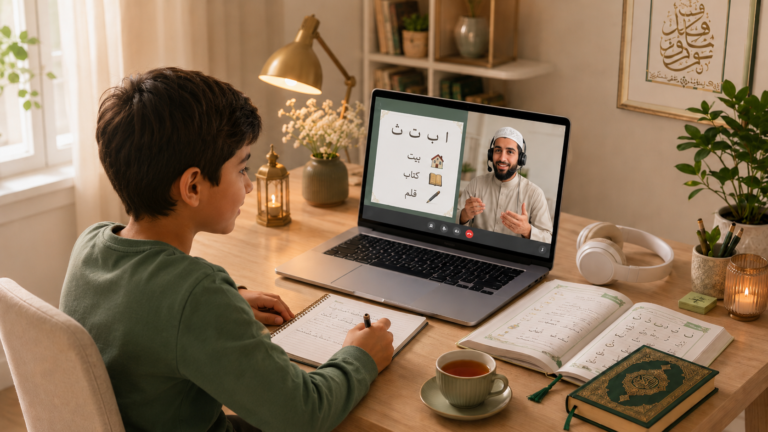
You’ve probably thought about it more than once. Maybe you’ve already searched for private Arabic lessons online, visited a few websites, hesitated — then closed the tab. That hesitation is completely normal. Committing to remote learning, with a teacher you’ve never met, in a language as rich and layered as Arabic, deserves an honest conversation. So here is what you can genuinely expect from this experience — no embellishment, no empty promises.
A decade ago, learning Arabic seriously meant either enrolling in a local mosque — often with inconvenient schedules — or traveling to an Arabic-speaking country. That reality has changed completely. Distance learning platforms have made accessible what once seemed reserved for a fortunate few.
The one-on-one private format with a native teacher combines the best of both worlds: the quality of individualised instruction and the total flexibility of online learning. You choose your schedule, you learn from home, and you progress at your own pace — without ever sacrificing pedagogical depth.
Beyond the practical side, there is a spiritual dimension that resonates deeply with many Muslim learners. Understanding the Quran in its original language, accessing the texts directly, reciting with greater awareness — these are profound motivations that give each lesson a meaning that goes far beyond simple language acquisition.
A serious school never places you in a course without evaluating your level first. At Al-Dirassa, this step is simple and stress-free: a short questionnaire or a brief exchange with a pedagogical advisor helps determine whether you are starting from absolute zero, whether you already have some foundations, or whether you are looking to consolidate an intermediate level.
This phase matters enormously. It conditions everything that follows. A learner placed in a level too advanced will disengage quickly; too easy, and they will lose interest. The goal is to find the right balance between stimulating challenge and smooth progression.
Here is what a 45 to 60-minute session with a native teacher typically looks like:
Everything takes place via Zoom or Google Meet, with screen sharing available for working on texts or charts. The quality of your connection plays a role, of course — but in 99% of cases, a basic internet connection is more than sufficient.
“My name is Sarah, I’m 31 and I live in London. I converted eight years ago and had learned to recite a few surahs phonetically — but I had no idea what I was actually saying. The idea of taking lessons scared me: what if I was too far behind? What if the teacher was condescending? What if I made no progress?”
“I tried a free trial lesson out of curiosity more than anything. The teacher put me at ease straight away. He assessed my level calmly, explained the proposed programme, and reassured me — many of his students begin from scratch at my age. Four months later, I read the Arabic alphabet without hesitation, I’m starting to catch glimpses of meaning in short surahs, and I genuinely look forward to my lessons.”
This fictional account reflects a widely documented reality: the fear of starting is almost always the only real obstacle. Once the first lesson is behind you, the vast majority of learners never look back.
It cannot be said enough: the quality of a private lesson depends almost entirely on the teacher. A native Arabic speaker with genuine pedagogical training makes a colossal difference compared to an app or YouTube videos, however well-made those may be.
Why? Because a human teacher adapts. They see when you are struggling with a grammatical rule. They hear your pronunciation and correct it in real time. They choose examples that match your context and your motivations. If you are learning Arabic to better understand the Quran, they will incorporate verses into the exercises. If you want to converse in spoken Arabic, they will adapt the programme accordingly.
This living personalisation — impossible to simulate with any machine — is what makes private lessons the most effective format for making rapid, lasting progress.
Absolutely not. Courses begin from absolute zero — including for adults who have never seen a single Arabic character in their life. Learning the alphabet, the sounds, and correct pronunciation forms the first stage of the programme, always approached with patience and method.
The first visible results — recognising letters, reading simple words — typically appear after 4 to 8 weeks of regular lessons. To reach fluent Quranic reading, expect between 6 and 12 months depending on your learning pace and the number of sessions per week.
This is a legitimate concern. At any serious institution, it is always possible to change teachers if the pedagogical relationship does not feel right. The affinity between teacher and learner is a key factor in progress — no serious school will keep you in an uncomfortable situation.
Before signing up anywhere, a few simple criteria allow you to assess the seriousness of a platform:
Al-Dirassa meets all of these criteria. Our team of native teachers accompanies hundreds of French-speaking learners every week — in France and across the world — on their journey into the Arabic language and the Quran. Discover our online Arabic course programme and start when you are ready.
Private Arabic lessons online are not a magic solution. They require consistency, a measure of patience, and the willingness to persevere even when a grammar rule refuses to stick. But the experience of hundreds of learners confirms it: with a good teacher, an adapted programme, and genuine motivation — whether spiritual, cultural, or personal — progress is real, and often faster than you imagined.
So if you are still hesitating, here is the best advice we can offer: start with a trial lesson. No commitment, no pressure. Just to see. The rest will follow naturally. Book your free trial lesson here and take that first step.
This question comes up often, and the answer is clear: online private lessons are at least as effective as face-to-face learning, provided you choose a qualified teacher. The video-conference format allows for real human interaction, real-time corrections, and complete interactivity. Many learners even find that being at home, without the stress of commuting, actually improves concentration. What matters most is the quality of the teacher and the regularity of the student.
Prices vary depending on the platform, the level of the course, and the duration of sessions. Generally, expect to pay between £15 and £40 per hour for a private lesson with a native teacher. Specialised platforms like Al-Dirassa often offer monthly packages or session bundles that bring the per-hour cost down. A free trial lesson is frequently available, allowing you to evaluate the quality before any financial commitment.
Both options exist. Islamic specialised platforms like Al-Dirassa offer distinct curricula: Classical and Quranic Arabic for those who want to read and understand the Quran, and colloquial Arabic (Egyptian, Moroccan, Levantine, etc.) for those who want to communicate in spoken Arabic. It is entirely possible to focus exclusively on Quranic Arabic from the very first lesson, with a programme incorporating verse reading, tajweed rules, and understanding of sacred texts.
Don’t want to go through the translation anymore?
30 free minutes with your qualified Egyptian teacher.
Al-dirassa Institute offers you a gift to help you begin your journey to being fluent in Arabic and learning the Quran.
Al-dirassa Institute offers you a gift to help you begin your journey to being fluent in Arabic and learning the Quran.