
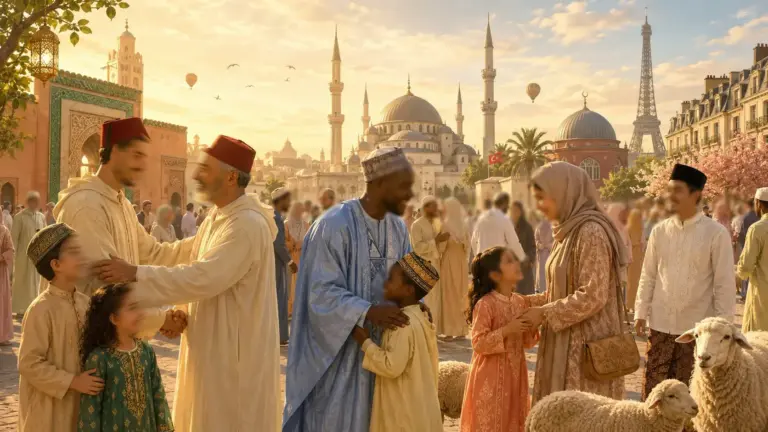
The anticipation is building. Eid al-Adha 2026 is approaching, and with it comes that unmistakable spiritual atmosphere that settles over Muslim households across the globe. For many, this is the most meaningful celebration of the Islamic year — deeper than Eid al-Fitr, more rooted in prophetic history, more charged with collective emotion. Whether you are in France, the UK, North Africa, or beyond, this guide covers everything you need: the expected date, how the prayer unfolds, the traditions observed in different countries, and how to approach this blessed day with full awareness.
Based on astronomical calculations of the Hijri calendar, Eid al-Adha 2026 is expected to fall around Wednesday, 27 May 2026, corresponding to the 10th of Dhul Hijja 1447. Some sources indicate 26 May as a possibility, depending on the method of moon-sighting adopted by each country.
As with all Islamic dates, the official confirmation comes only after the sighting of the crescent moon. In France and across Europe, religious authorities — including local mosque councils and national bodies — typically announce the confirmed date one or two days before the celebration. A one-day difference between Western countries and the Gulf states is entirely normal and does not affect the validity of the observance.
The Islamic calendar is a lunar calendar, counting 354 to 355 days per year — roughly 10 to 11 days shorter than the Gregorian calendar. This means Eid al-Adha moves back by about 10 days each year in the civil calendar. On top of that, different countries use different methods: some follow astronomical calculations, others require an actual visual sighting of the crescent. This explains why neighbouring countries sometimes celebrate on different days — a diversity that the tradition of Islam fully accommodates.
Before logistics and traditions, it is worth pausing on what this celebration is truly about.
Eid al-Adha — the “Feast of Sacrifice” — commemorates one of the most profound moments in prophetic history: the trial of Ibrahim (peace be upon him). Commanded by Allah in a dream, he prepares to sacrifice his son Ismail. At the very moment of the act, Allah sends a ram as a ransom — a sign of His acceptance of Ibrahim’s complete submission.
Allah says in the Quran (Surah As-Saffat, 37:103-107): “When they had both submitted and he laid him down on his forehead, We called out to him: ‘O Ibrahim! You have fulfilled the vision.’ Indeed, this is how We reward those who do good. That was truly a revealing test. And We ransomed his son with a great sacrifice.”
This feast is not merely a family celebration. It is a yearly reminder of what submission to Allah means — and of the divine mercy that answers sincere devotion.
The prayer of Eid al-Adha is one of the most distinctive features of the celebration. Here is everything you need to know to prepare for it.
The Eid prayer consists of two rak’at, with additional takbirat (according to the majority opinion: 7 in the first rak’a and 5 in the second, outside of the opening takbir). It is followed by a khutbah (sermon), which should be listened to attentively.
It is also a Sunnah to return home by a different route from the one taken to the prayer — a practice scholars have explained as a way of bearing witness to as many places as possible on this blessed day.
From the evening before Eid until the end of the days of Tashreeq (13th of Dhul Hijja), Muslims are encouraged to repeat frequently:
Allahu Akbar, Allahu Akbar, la ilaha illallah, Allahu Akbar, Allahu Akbar wa lillahil hamd.
The spiritual core of Eid al-Adha is universal. But the way it is celebrated varies enormously from one culture to the next — and this diversity is one of the most beautiful expressions of Islam’s presence across the globe.
For Muslims in France — a community of several million — Eid al-Adha is a day of intense family gathering. The prayer takes place early in the morning at mosques or in rented halls. The sacrifice is often entrusted to a certified halal butcher or carried out at a licensed slaughterhouse. The rest of the day is spent visiting family, sharing meals, and giving gifts to children.
In Morocco, Eid al-Adha — simply known as l’Aid — is arguably the most important day of the year. Every family that can afford to does so sacrifices a sheep. Preparations begin weeks in advance. The entire country comes to a standstill: transport, shops, public services. The meat is traditionally divided into three portions: one for the family, one for relatives and neighbours, one for those in need.
In Turkey, the celebration is called Kurban Bayramı (“the Festival of Sacrifice”) and is a national public holiday lasting four days. Families reunite, visits are made to the graves of ancestors, and meat is distributed to neighbours and the poor. The spirit of solidarity is particularly strong.
Known as Tabaski, this is perhaps the most emotionally charged celebration in the West African Muslim calendar. Every family — regardless of means — makes every effort to have their sheep. Women dress in vibrant traditional outfits, children receive new clothes, and the day is filled with music, joy, and abundant meals shared with the community.
Indonesia, the world’s most populous Muslim-majority country, marks Eid al-Adha with massive open-air prayers, sometimes gathering tens of thousands of worshippers in a single space. The sacrifice there includes cows and buffalo alongside sheep, and the meat is distributed on a large scale to underprivileged neighbourhoods.
Eid al-Adha and the Hajj pilgrimage are inseparable. The feast falls on the 10th of Dhul Hijja — the most significant day of the pilgrimage at Mecca. While millions of pilgrims perform their sacrifice at Mina, Muslims around the world who are not on Hajj commemorate that same act in their own homes.
This synchronicity is one of the most powerful expressions of the unity of the ummah: whether you are in Mecca or Manchester, in Casablanca or Kuala Lumpur, every Muslim on earth is living the same spiritual moment at the same time.
Eid al-Adha is often a moment when many Muslims feel a renewed desire to grow closer to their faith — and in particular, to better understand what they recite in their prayers. If you feel that pull, there is no better time to act on it.
Understanding Surah As-Saffat in its original language, grasping the meaning of the invocations repeated throughout the celebration, reading the Quran without constantly consulting the translation — all of this becomes attainable through structured Arabic learning. Explore our online Arabic courses with native-speaking teachers, designed for all levels — adults, children, and complete beginners.
And if you want to give your children this precious gift, know that there is no better age to start than now. A child who learns Arabic early enters the Quran with a fluency that takes adults years to build. Book a free trial lesson — for yourself or for your child — and take that first step toward a deeper connection with the Book of Allah.
Eid al-Adha 2026, expected around 27 May, is far more than a holiday. It is an invitation to remember what it means to trust Allah completely, to share generously with those around us, and to renew our intention to deepen our faith. Whether you celebrate in Paris, London, Casablanca, Dakar or Jakarta, may this Eid bring you peace, blessings, and a renewed sense of what truly matters.
Taqabbal Allahu minna wa minkum — may Allah accept from us and from you.
Based on astronomical calculations, Eid al-Adha 2026 is expected to fall around Wednesday, 27 May 2026, corresponding to the 10th of Dhul Hijja 1447. This is a provisional date: the official confirmation will come from religious authorities after the sighting of the crescent moon. A one-day difference between countries (for example, between France and Saudi Arabia) is normal and does not affect the validity of the celebration.
No — fasting on the day of Eid al-Adha is forbidden (haram) in Islam. The day is one of celebration, not fasting. However, it is recommended not to eat anything before the Eid prayer, so that the first food of the day is the meat of the sacrifice. The Prophet ﷺ specifically prohibited fasting on both Eid days.
No. The sacrifice can be performed on your behalf by a trusted butcher or through a certified Islamic organisation. The important thing is that the intention is made and that the sacrifice is carried out according to Islamic guidelines — with a healthy animal, slaughtered correctly, with the name of Allah invoked. Many Muslims in Western countries delegate this to abattoirs or charitable organisations that distribute the meat to those in need in different parts of the world.
Don’t want to go through the translation anymore?
30 free minutes with your qualified Egyptian teacher.
Al-dirassa Institute offers you a gift to help you begin your journey to being fluent in Arabic and learning the Quran.
Al-dirassa Institute offers you a gift to help you begin your journey to being fluent in Arabic and learning the Quran.