
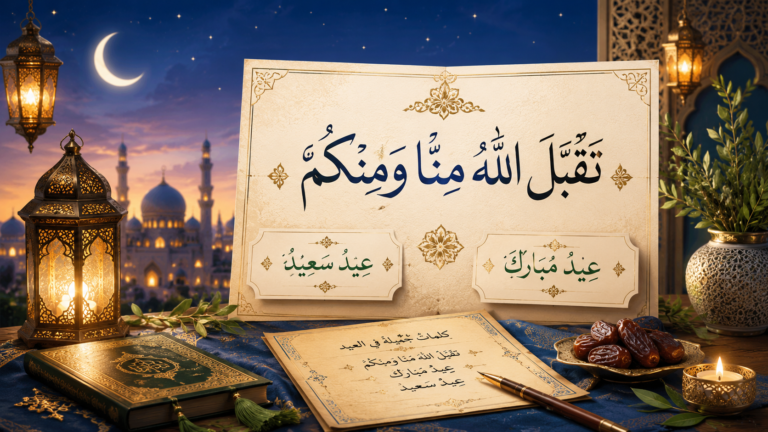
Eid is just around the corner, and with it comes a question many Muslims quietly ask themselves: how do you say “Happy Eid” in Arabic? Not simply to make a good impression — but to greet your loved ones with the right words, the ones the Prophet ﷺ himself used. Between the classical formulas, regional expressions, and cultural variations, it is easy to feel uncertain. This article gives you the correct phrases, their pronunciation, their exact meaning, and everything you need to use them confidently and sincerely.
Before talking about “Happy Eid,” it is important to understand that in Islam, the most authentic Eid greeting is not simply a festive pleasantry. It is a supplication — a request addressed to Allah to accept the acts of worship of everyone present.
The formula transmitted by the companions of the Prophet ﷺ is:
تَقَبَّلَ اللهُ مِنَّا وَمِنْكُمْ
Taqabbal Allahu minna wa minkum
May Allah accept from us and from you.
This phrase is reported by the companions as the way they greeted one another on Eid. Ibn Hajar al-Asqalani mentions it in Fath al-Bari as an established practice among the Sahaba.
The standard response to this greeting is identical:
تَقَبَّلَ اللهُ مِنَّا وَمِنْكُمْ
Taqabbal Allahu minna wa minkum
Or in a slightly fuller version:
تَقَبَّلَ اللهُ مِنَّا وَمِنْكُمْ وَغَفَرَ لَنَا وَلَكُمْ
Taqabbal Allahu minna wa minkum wa ghafara lana wa lakum
May Allah accept from us and from you, and forgive us and you.
Arabic pronunciation can feel intimidating at first, especially for those who have not yet studied the language. Here is a simple word-by-word guide:
If you are not yet comfortable with Arabic, start simply. Intention matters, and no one expects perfect pronunciation. But if you want to improve — and truly understand what you are saying — structured learning with a native teacher makes all the difference.
Beyond the prophetic formula, the most widespread greeting across the Muslim world is:
عِيدٌ مُبَارَكٌ
Eid Mubarak
Blessed celebration.
The word عِيدٌ (Eid) comes from the Arabic root عَوْدَ (aouda), meaning “to return.” Eid is therefore literally “that which returns” — a cyclical celebration, a recurring moment of joy and gratitude.
The word مُبَارَكٌ (Mubarak) comes from the root بَرَكَ (baraka), denoting divine blessing — a grace that spreads and multiplies. To say “Eid Mubarak” is to wish that this celebration be filled with Allah’s blessing.
This phrase works in speech and in writing — in a message, a text, a social media post, or to open a speech. It is understood and appreciated in all Arabic-speaking countries and in the vast majority of non-Arab Muslim communities worldwide.
You may also have heard:
عِيدٌ سَعِيدٌ
Eid Said
Happy celebration.
The word سَعِيدٌ (Said) comes from سَعَادَة (sa’ada), meaning happiness or felicity. “Eid Said” is the equivalent of “Happy Eid” — a more general, warm greeting, widely used across the Middle East and in Arabic-language media.
The difference between the two:
Both are correct. Both are beautiful. The choice depends largely on your context and the background of the person you are greeting.
One of the most fascinating things about Arabic is the richness of its regional variations. Here is how Eid is wished in different parts of the world:
In Moroccan Darija, you will often hear:
عيد مبارك وكل عام وأنتم بخير
Eid Mubarak w kull ‘am w antum bikhir
“Blessed Eid, and may every year find you in good health.”
Egyptians commonly say:
كل سنة وأنت طيب
Kull sana w anta tayyib
“May every year find you well.”
This is a versatile greeting used for all celebrations and birthdays across Egypt — warm, familiar, and deeply affectionate.
While Turkish is the dominant language, the Arabic formula Taqabbal Allahu minna wa minkum remains widely used in religious circles and after the Eid prayer at mosques throughout Turkey.
During Tabaski, greetings are often a beautiful mix of Wolof, French and Arabic. The phrase Eid Mubarak is universally understood and used, often woven alongside wishes in local languages.
Looking for something to write in a WhatsApp message, a card, or a social media post? Here is a complete, classic, and truly beautiful formula:
تَقَبَّلَ اللهُ مِنَّا وَمِنْكُمْ — عِيدٌ مُبَارَكٌ
Taqabbal Allahu minna wa minkum — Eid Mubarak
May Allah accept from us and from you — Blessed Eid.
This combination is both spiritually grounded and warmly festive. It suits every context: family, friends, Muslim colleagues, or social media posts reaching a diverse audience.
There is something profoundly different between repeating a phrase and understanding every word of it. When you say Taqabbal Allahu minna wa minkum while knowing exactly what it means — that you are asking Allah to accept from you, not simply saying “Happy Eid” — the phrase takes on a completely different weight.
This is what people who learn Arabic consistently describe: a more direct, more intimate connection with the words of their faith. And this connection does not require years of intense study. With the right approach and a native teacher, first results often come within just a few weeks.
If the desire to understand what you recite has crossed your mind — even briefly — this is the right moment to act on it. Explore our online Arabic courses with native-speaking teachers, designed for all levels — complete beginners, intermediate learners, adults and children alike.
And if you want to give your children this gift — the ability to understand their prayers, their Eid greetings, and the words of the Quran from a young age — know that there is no better time to start than now. Book a free trial lesson for yourself or your child, and take that first step into the language of the Quran.
Knowing how to say “Happy Eid” in Arabic is far more than mastering a polite phrase. It is a way of entering the language of the Quran through one of its gentlest doors — the door of shared joy, of blessings sought together, of love expressed in the very words the first Muslims used to greet one another.
Whether you say Taqabbal Allahu minna wa minkum, Eid Mubarak or Eid Said, what matters most is that the wish comes from the heart. And if this small piece of Arabic has sparked a desire to learn more — that is probably your sign to begin.
Taqabbal Allahu minna wa minkum — may Allah accept from us and from you.
The most accurate and traditionally correct response is to repeat the same phrase: Taqabbal Allahu minna wa minkum — “May Allah accept from us and from you.” You can also add wa ghafara lana wa lakum (“and forgive us and you”) for a fuller reply. This is the practice reported from the companions of the Prophet ﷺ, who responded to Eid greetings with the same words they received.
Yes, absolutely. The phrase Eid Mubarak is used for both major Islamic celebrations: Eid al-Fitr (the celebration marking the end of Ramadan) and Eid al-Adha (the Feast of Sacrifice, coinciding with the Hajj). The word “Eid” refers to any Islamic celebration, and “Mubarak” applies to all occasions of blessing. The formula Taqabbal Allahu minna wa minkum is more specifically associated with both Eids as an act of worship-oriented greeting.
In Arabic, “Eid Mubarak” is written: عِيدٌ مُبَارَكٌ. You can copy and paste this directly into a WhatsApp message, text, or social media post. For the complete formula, use: تَقَبَّلَ اللهُ مِنَّا وَمِنْكُمْ — عِيدٌ مُبَارَكٌ. If you would like to learn to write Arabic yourself — including the alphabet, connected letters, and basic calligraphy — this is entirely achievable with a few weeks of structured lessons with a qualified teacher.
Don’t want to go through the translation anymore?
30 free minutes with your qualified Egyptian teacher.
Al-dirassa Institute offers you a gift to help you begin your journey to being fluent in Arabic and learning the Quran.
Al-dirassa Institute offers you a gift to help you begin your journey to being fluent in Arabic and learning the Quran.