
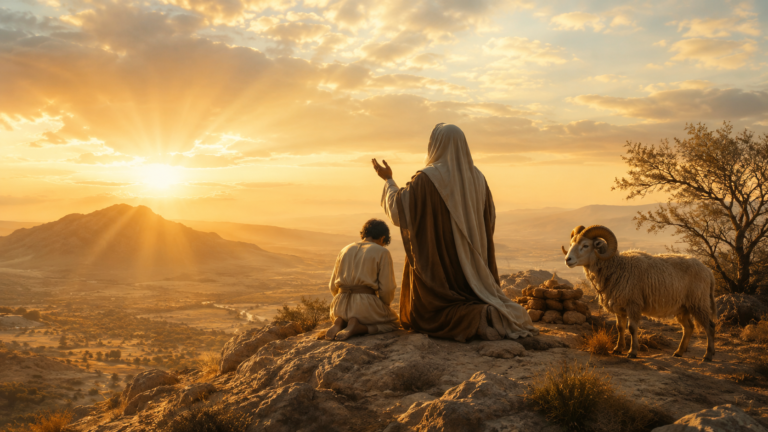
Every year, as Eid al-Adha approaches, hundreds of millions of Muslims commemorate one of the most moving narratives in the entire Quranic revelation: the sacrifice of Ibrahim ﷺ. And yet, behind the preparations, the family gatherings, and the shared meals, how many of us take the time to sit with this story as the Quran actually tells it? How many of us truly measure its spiritual depth, its human dimension, its universal reach?
This article is not a surface-level reminder. It is an invitation to read the story of Ibrahim ﷺ with the eyes of the heart — from the Quranic text itself — so that Eid al-Adha becomes, once again, far more than a celebration.
The central passage is found in Surah As-Saffat (37), verses 100 to 111. It is one of the most dense and intense narratives in the entire Quran. Every word is carefully chosen; every exchange between Ibrahim and Ismail ﷺ breathes a rare and genuine human truth.
Ibrahim ﷺ begins with a supplication:
“My Lord, grant me (a child) from among the righteous.” (As-Saffat, 37:100)
Allah grants him a son — described in the following verse as a boy who is forbearing (halim). Then comes the dream. Ibrahim ﷺ sees himself slaughtering his son in a vision. In the Prophetic tradition, the dreams of prophets carry the weight of revelation. Ibrahim understands what this means.
What follows is one of the most moving dialogues in all of sacred scripture:
“O my son, I have seen in a dream that I must sacrifice you. So tell me what you think.” (As-Saffat, 37:102)
Ibrahim hides nothing from his son. He does not impose. He invites, he asks. And Ismail’s ﷺ response carries a spiritual maturity that takes one’s breath away:
“O my father, do what you have been commanded. You will find me, if Allah wills, among the patient.” (As-Saffat, 37:102)
No revolt. No bargaining. A complete, clear-eyed, freely chosen submission.
When both had submitted and Ibrahim had laid his son face-down, Allah called out to him:
“O Ibrahim, you have confirmed the vision. Thus do We reward the doers of good.” (As-Saffat, 37:104-105)
The act was not completed physically. And this is no accident. The Quran is entirely clear on this point:
“Neither their flesh nor their blood reaches Allah, but what does reach Him is the piety from you.” (Al-Hajj, 22:37)
This verse states the essential truth: Allah never wanted suffering for its own sake. What He sought was the interior movement of the heart. The capitulation of the ego before His will. The release of what one loves most — not out of masochism, but out of absolute trust in the One who knows what we do not.
Ibrahim ﷺ loved Ismail. Deeply. He had waited long for this son, had asked Allah for him by name. And it was precisely because he loved him so profoundly that the test carried such weight. A sacrifice that costs nothing is not a sacrifice.
What the story of Ibrahim illustrates with incomparable force is the notion of tawakkul — complete reliance on Allah, even when the situation seems beyond comprehension. Ibrahim did not understand the purpose of this trial. But he trusted the One who placed it before him.
This trust is not passivity. It is an act. A difficult act, requiring genuine inner work. And it is precisely this disposition of the heart that Allah chose to commemorate forever through Eid al-Adha.
A detail of the text that is often underappreciated deserves attention: Ibrahim asks his son’s opinion. He could have acted without telling him. He chooses instead to involve him in the trial — to give him the opportunity to participate consciously, with full knowledge.
And Ismail consents. He is not a passive victim — he is a full spiritual actor who freely chooses to submit to Allah. His answer — “you will find me among the patient” — is not resignation. It is greatness.
This double sacrifice — a father who gives what he holds most dear, and a son who offers his own life — is the most complete figure of submission to Allah that the Quran has transmitted to us.
The story of Ibrahim is shared, in varying forms, across all three Abrahamic religions. But the Quran brings something that neither the Torah nor the Bible presents in quite the same way: the dialogical dimension, Ismail’s freely given consent, and the centering of intention as the core of the act itself.
The Quran calls Ibrahim Khalilullah — the Friend of Allah. This title, unique in the entire revelation, says something essential about the nature of their relationship: a closeness grounded in trust, faithfulness, and a love that flows between the Creator and His creation.
“Who is better in religion than one who submits his face to Allah while being a doer of good, and follows the religion of Ibrahim, inclining toward truth? And Allah took Ibrahim as an intimate friend.” (An-Nisa, 4:125)
This verse puts the question to each of us. Not abstractly — personally. What is my relationship with Allah? Do I carry that quality of trust that characterized Ibrahim? Not necessarily at the same level — but in the same direction, in the orientation of the heart.
Commemorating Ibrahim’s sacrifice is not only about offering an animal and distributing meat — though these acts have their own value and barakah. It is also about turning an honest question inward: what am I holding too tightly in my hands?
For some, it is an ambition. For others, a relationship. For others still, a self-image, a fear of others’ judgment, a habit that creates distance from Allah. The “sacrifice” called of each person takes a different form — but the spiritual logic is the same: let go, and remember that nothing truly belongs to us.
Eid al-Adha is also an act of solidarity. The meat of the sacrifice is traditionally divided into three portions: one for the family, one for relatives and neighbors, one for the poor. This is an economic redistribution embedded in a spiritual ritual — a reminder that the wealth and possessions we hold have been entrusted to us, not granted as absolute ownership.
In a world of widening inequalities, this social dimension of sacrifice remains entirely relevant. It says that faith is never purely individual — it is also measured in the care we take of one another.
The verses of Surah As-Saffat on Ibrahim ﷺ are among the passages every Muslim gains from knowing in their original language. Quranic Arabic has a density, a musicality, and a semantic precision that translations — however careful — can only partially capture.
Understanding halim (forbearing, patient), aslama (he submitted), tawakkul (complete trust) directly from the Arabic text is to access a layer of meaning that reading in translation alone cannot fully reach. It is also to develop a different relationship with Allah’s Book — more direct, more intimate.
If you want to read and understand the Quran in its original language, the Arabic courses for adults at Al-Dirassa offer a serious and accessible gateway: native-speaking teachers, structured progression, and online classes designed to fit around your schedule.
For your children, learning to recite and understand the surahs related to Ibrahim ﷺ from an early age is a gift of lasting spiritual grounding. The Quran courses for children at Al-Dirassa offer a warm, progressive pedagogy with qualified teachers who know how to engage young learners.
The sacrifice of Ibrahim in the Quran is not a story frozen in an ancient text. It is a mirror held up to every generation — a narrative that poses, with undiminished relevance, the fundamental question of faith: how far do you trust Allah?
Eid al-Adha is not merely a celebration. It is an annual opportunity to remember that submission to Allah — Ibrahim’s, Ismail’s, and ours — is not a constraint. It is a liberation. The liberation from everything that binds us to anything other than Him.
May this celebration be, for you and your loved ones, a moment of spiritual renewal, sincere generosity, and deepened connection with the Quran. Taqabbal Allahu minna wa minkum.
This is one of the deepest questions the narrative raises — and the Quran addresses it directly: Allah never intended the death of Ismail. What He sought was to test the sincerity of Ibrahim’s faith, and to give him the opportunity to manifest it fully. The trial was not divine cruelty; it was an occasion for greatness. Ibrahim proved, in deed and not in words, that nothing — not even what he loved most in the world — held a place in his heart above Allah. The ram sent as a substitute at the final moment is a sign of divine mercy: Allah wanted the submission of the heart, not the blood. This story teaches us that in Islam, the trial is not a punishment — it is an elevation.
The Quran does not explicitly name the son in the Surah As-Saffat passage. However, the vast majority of Muslim scholars and Quranic commentators agree that it was Ismail ﷺ. Several textual arguments support this position: the birth of Isaac is announced immediately after the trial as an additional reward granted to Ibrahim, which logically implies that Isaac had not yet been born at the time of the sacrifice. The Jewish and Christian traditions mention Isaac, but the dominant Islamic interpretation identifies Ismail.
The connection is direct and profound. Hajj is largely a living commemoration of Ibrahim’s spiritual journey and that of his family. The walk between Safa and Marwa recalls Hajar’s desperate search for water for her infant son Ismail. The casting of stones at Mina recalls Ibrahim’s resistance to the Shaytan, who tried to dissuade him from the sacrifice. Eid al-Adha falls on the tenth day of Dhul Hijja — the day pilgrims perform the sacrifice at Mina. In this way, Eid al-Adha is not simply a feast: it is the participation of the entire ummah, from wherever they are, in a universal rite whose living heart is the pilgrimage itself.
Don’t want to go through the translation anymore?
30 free minutes with your qualified Egyptian teacher.
Al-dirassa Institute offers you a gift to help you begin your journey to being fluent in Arabic and learning the Quran.
Al-dirassa Institute offers you a gift to help you begin your journey to being fluent in Arabic and learning the Quran.