
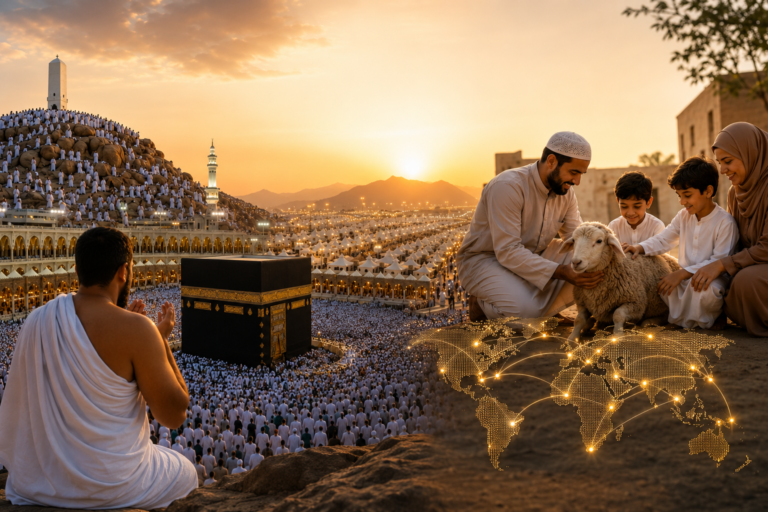
Every year, as Dhul Hijja approaches, two of Islam’s greatest events intertwine in the Muslim calendar and in Muslim minds: Hajj and Eid al-Adha. For many, the connection seems obvious — they happen at the same time, they both reference the same prophet, they both involve sacrifice. But how many Muslims could actually articulate the depth of that connection? Why does Eid al-Adha coincide with the pilgrimage? What do these two acts of worship share at the spiritual, ritual, and symbolic level?
This article offers a complete and accessible exploration — grounded in the Quranic text and Prophetic tradition — to help you understand what truly unites Hajj and Eid al-Adha, beyond the calendar.
The most visible link between Hajj and Eid al-Adha is temporal. Both unfold within the same lunar month: Dhul Hijja — the twelfth and final month of the Islamic Hijri calendar. And not just anywhere in that month.
The Hajj pilgrimage itself is concentrated around the 8th to the 13th of Dhul Hijja, reaching its apex on the 9th — the Day of Arafah. Eid al-Adha falls on the 10th. Precisely the day after Arafah. This is not a calendar coincidence; it is a deliberate and meaningful spiritual architecture.
While pilgrims in Makkah descend from the plain of Arafah during the night of the 9th, make their way to Muzdalifa for a night of prayer, and then gather at Mina for the sacrifice at dawn — Muslims around the world perform the same act symbolically: they pray the Eid prayer, they recite the takbirat, and they offer a sacrifice.
The entire Muslim world lives the same spiritual day, at the same moment, on two simultaneous planes: the physical plane of the pilgrim at Mina, and the symbolic plane of the believer wherever they stand on earth.
Hajj is the fifth pillar of Islam. It is obligatory once in a lifetime for every Muslim who possesses the physical and financial ability to undertake it. It is a pilgrimage to Makkah, Saudi Arabia, that brings millions of believers from every corner of the world together each year.
The rites of Hajj are a living reenactment of the journey of Ibrahim ﷺ and his family. The walk between Safa and Marwa recalls Hajar’s desperate search for water for her infant son Ismail. The standing at Arafah is the supreme station of supplication. The casting of pebbles at Mina recalls Ibrahim’s resistance to the Shaytan, who sought to turn him from Allah’s command. And the sacrifice at Mina recalls — this is the heart of the connection — the founding act commemorated by Eid al-Adha.
The Quran captures the universality of Hajj in a verse of remarkable beauty:
“And proclaim to the people the Hajj; they will come to you on foot and on every lean camel; they will come from every distant pass.” (Al-Hajj, 22:27)
Hajj is not religious tourism. It is a symbolic death and a rebirth — a dissolution of the ego into the white-robed crowd, where no distinction of rank or wealth exists, where every pilgrim wears the same two pieces of cloth.
Eid al-Adha — the “Feast of Sacrifice” — is the universal commemoration of Ibrahim’s ﷺ founding act: his submission to Allah, his willingness to sacrifice Ismail, and the divine mercy that sent a ram in his son’s place.
But here is what is truly remarkable: Eid al-Adha was not designed only for those who are in Makkah. It was specifically conceived so that those who are not performing Hajj this year — the vast majority of Muslims on earth — could participate, from wherever they are, in the same spiritual act.
It is as though Allah said: Hajj is an obligation for those who have the means, but the day of the 10th of Dhul Hijja belongs to the entire ummah. Every believer has a place in it. Every believer has a role.
On the morning of the 10th of Dhul Hijja, pilgrims at Mina perform the ritual sacrifice — one of the obligatory acts of Hajj. At that very same time, in London, in Casablanca, in Dakar, in Jakarta, Muslims around the world perform the Eid sacrifice — the udhiyya, the voluntary sacrifice for those who have not performed Hajj.
Same gesture. Same intention. Same recitation of the Basmala. Same division of the meat into three portions. The geographical distance does not erase the spiritual unity.
From the evening of the 9th of Dhul Hijja through the 13th, the takbirat of Eid resound across the entire Muslim world. These same formulas — Allahu Akbar, Allahu Akbar, la ilaha illallah, Allahu Akbar, Allahu Akbar wa lillahil hamd — echo simultaneously from the exhausted and luminous pilgrims at Mina and from the apartment buildings of Paris and Manchester, the mosques of New York and the streets of Nairobi.
This may be the most powerful image of this connection: an invisible, planetary, synchronized chorus rising toward the same Lord.
The connection between Hajj and Eid al-Adha converges most powerfully around the Day of Arafah — the 9th of Dhul Hijja — which falls directly before the celebration.
For the pilgrims, this day is the pinnacle of Hajj. They gather on the plain of Arafah in a state of total supplication, from midday until sunset. The Prophet ﷺ summarised it with rare concision:
“Hajj is Arafah.” (Tirmidhi, Nasa’i)
For Muslims not performing Hajj, this day is far from meaningless. It is strongly recommended to fast on the Day of Arafah — a single day’s fast which, according to an authentic hadith, earns the expiation of sins from the previous year and the coming year:
“Fasting on the Day of Arafah — I hope that Allah will expiate thereby the sins of the year before it and the year after it.” (Muslim)
This fast is an invisible bridge between the pilgrim and the believer who remains at home. The pilgrim does not fast (they are travellers), but they are absorbed in intense supplication at Arafah. The believer at home fasts and supplicates in their own space. Both converge toward the same Allah, on the same day, with the same humility.
If Hajj and Eid al-Adha are inseparable, it is because they share the same source: Ibrahim ﷺ, called Khalilullah — the Friend of Allah.
It was Ibrahim who was commanded to build the Ka’bah, to call humanity to the pilgrimage, to leave Hajar and Ismail in the barren valley, and to accept the sacrifice of his son. Every rite of Hajj is a revivification of his journey. And Eid al-Adha is its global echo.
The Quran preserves his supplication for posterity:
“My Lord, make me an establisher of prayer, and [also] from my descendants. Our Lord, and accept my supplication.” (Ibrahim, 14:40)
What we do every year — the Eid prayer, the sacrifice, the takbirat — these are the fruits of Ibrahim’s supplication. In a very real sense, we are the answer to his invocation.
It is instructive to map the rites of Hajj against the specific moments in Ibrahim’s ﷺ life they commemorate:
Hajj is a physical immersion in the story of Ibrahim. Eid al-Adha is its worldwide resonance.
The bond between Hajj and Eid al-Adha reveals something essential about Islam’s vision of faith: no one is excluded from divine grace.
Hajj is reserved for those who have the means this year. But Allah has ensured that the most sacred day of the pilgrimage radiates outward to the entire ummah. The fast of Arafah, the takbirat, the Eid prayer, the sacrifice — these are open doors for every believer, regardless of financial or geographical circumstances.
This is a divine generosity embedded in the very structure of the Islamic calendar. The person who cannot afford Hajj can nevertheless live the 10th of Dhul Hijja with a spiritual fullness equal to that of the pilgrim standing at Mina — if their heart is truly present.
Understanding the connection between Hajj and Eid al-Adha is one thing. But to go further — to read the surahs that speak of Ibrahim in their original language, to grasp the meaning of the Hajj supplications, to understand what you recite in the Eid prayer — you need to enter the language of the Quran.
Quranic Arabic is not a barrier. It is a door. And that door can open at any age, at any level, with the right method and the right teachers.
If you want to experience the next Islamic celebrations with a deeper understanding of what you are reciting and what you are commemorating, the Arabic courses for adults at Al-Dirassa are built for exactly this: structured progression, qualified native-speaking teachers, and flexible online classes designed to fit around your life.
And to give your children the keys to this language from an early age — so they grow up understanding what they recite, and living Hajj and Eid with full awareness of their meaning — explore the Quran courses for children at Al-Dirassa: a pedagogy adapted to young learners, patient and dedicated teachers, and online classes that integrate naturally into family life.
Hajj and Eid al-Adha are not two parallel events that happen to coincide. They are the two dimensions — one physical and one universal — of the same act of faith, the same commemoration, the same belonging to the community of Ibrahim ﷺ.
When you see images of pilgrims at Mina on the morning of the 10th of Dhul Hijja, know that you are part of that moment. Your Eid prayer, your sacrifice, your takbirat, your fast of Arafah the day before — all of these connect you, invisibly but truly, to each of those millions of believers.
The ummah is not an abstraction. It is this simultaneous experience, this shared breath, this Allahu Akbar rising at the same moment from every corner of the earth.
Taqabbal Allahu minna wa minkum.
This is not a coincidence — it is a deliberate structure of the Islamic calendar. The Day of Arafah (9th of Dhul Hijja) is the spiritual peak of Hajj: pilgrims spend the afternoon in supplication on the plain of Arafah. The following day, the 10th of Dhul Hijja, they perform the sacrifice at Mina — and on that same day, the entire ummah celebrates Eid al-Adha. This simultaneity carries a profound message: the most sacred day of the pilgrimage belongs also to those who are not performing Hajj this year. Allah designed it so that no believer would be excluded from this moment of collective grace.
No — fasting on the Day of Arafah does not replace Hajj, which remains a distinct and separate obligation for those who are physically and financially capable. But this fast holds exceptional spiritual merit for those not performing pilgrimage that year. The Prophet ﷺ said that it expiates the sins of the year before and the year to come. It is a way of participating spiritually in the sacredness of this day, from home, with humility and sincerity. The two are not mutually exclusive — they are complementary, each serving its own purpose in the architecture of worship.
Both share the same symbolic root — the sacrifice of Ibrahim ﷺ — but they differ in their legal nature and context. The Hadiy is the sacrifice performed by the pilgrim as part of Hajj, at Mina, on the 10th of Dhul Hijja. It is obligatory for certain types of pilgrimage (specifically Hajj al-Tamattu’ and Hajj al-Qiran). The Udhiyya, by contrast, is the voluntary sacrifice performed by Muslims who are not on Hajj, on the occasion of Eid al-Adha. The majority of scholars consider it a sunna mu’akkadah — a confirmed and strongly recommended act. In both cases, the meat is shared according to the same principle: one third for the family, one third for relatives and friends, one third for the poor.
Don’t want to go through the translation anymore?
30 free minutes with your qualified Egyptian teacher.
Al-dirassa Institute offers you a gift to help you begin your journey to being fluent in Arabic and learning the Quran.
Al-dirassa Institute offers you a gift to help you begin your journey to being fluent in Arabic and learning the Quran.