
Among all the narratives the Quran has given us, the story of Ibrahim and Ismail holds a singular place. It is not simply a story about prophets — it is a story about a father and a son, about absolute trust, about the courage to face what cannot be fully understood. And this is precisely what makes it an ideal narrative to share with our children: it speaks to their hearts before it ever reaches their minds.
But how do you tell it without diminishing it? How do you explain the sacrifice without frightening a five-year-old, while doing justice to everything that moves a teenager? This practical guide, written for parents, walks you through the process — from early childhood to adolescence — so that this Quranic story becomes a living, lasting transmission rather than a one-time telling.
Before talking about method, it is worth understanding why this story deserves a central place in our children’s Islamic education.
The story of Ibrahim and Ismail is not a distant past event frozen in an ancient text. It is, in the truest sense, alive: every year at Eid al-Adha, every pilgrimage to Makkah, every sacrifice performed in Muslim families around the world is its direct echo. A child who knows this story no longer experiences these moments as incomprehensible rituals — they understand them, they recognise themselves in them, they belong to them.
At a deeper level, this story transmits values children can begin to internalise early: trust in Allah even when you do not understand everything, the courage to do what is right, the love between a father and his son, and the divine generosity that responds to sincere hearts.
These values are not taught in theology classes. They are transmitted through stories — and this one is among the most beautiful Islam has given us.
To transmit well, you must first know well. Here are the key episodes of the story of Ibrahim and Ismail as the Quran and tradition report them, in their logical order.
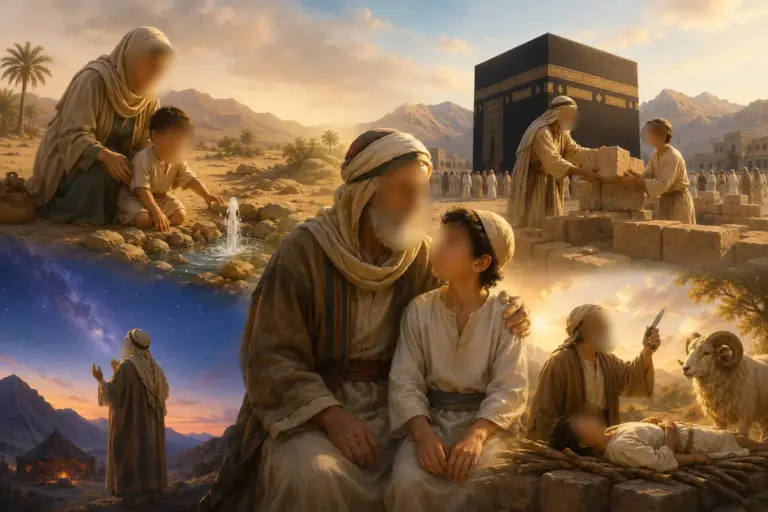
Ibrahim ﷺ is already old when he asks Allah for a righteous descendant. This supplication, found in Surah As-Saffat (37:100), is the starting point. Allah grants him a son — described as halim, meaning gentle and patient. This is Ismail.
At Allah’s command, Ibrahim leads Hajar and the infant Ismail to the valley of Makkah — a barren land with no water and no vegetation. He leaves them with a waterskin and a few dates. Hajar, understanding this to be a divine command, accepts. Her trust will be rewarded: the spring of Zamzam will burst forth beneath Ismail’s feet.
This episode resonates deeply with children: the water springing from the desert, the concrete miracle, the faith that precedes the reward.
Later, Ibrahim returns to Makkah. He finds Ismail now grown, and together they receive the command to build the Ka’bah — the House of Allah. The Quran (Al-Baqarah, 2:127) preserves their supplication as they build:
“Our Lord, accept this from us. Indeed, You are the Hearing, the Knowing.”
(Al-Baqarah, 2:127)
The image of a father and son building together the House of Allah carries a rare beauty. It says something profound about the transmission between generations.
This is the central moment. Ibrahim sees in a dream that he is slaughtering his son. In the Prophetic tradition, the dreams of prophets carry the weight of revelation. Ibrahim tells Ismail — he hides nothing, he does not impose, he asks his son’s opinion.
And Ismail responds, in one of the most moving verses in the entire Quran:
“O my father, do what you have been commanded. You will find me, if Allah wills, among the patient.”
(As-Saffat, 37:102)
At the very moment Ibrahim is ready to carry out the act, Allah calls out to him. He tells him he has confirmed the vision — and sends a ram in Ismail’s place. This is the sign of divine mercy: Allah did not want the sacrifice of the son, but the sincere submission of the heart.
At this age, children are receptive to wondrous stories, vivid images, simple emotions, and characters they can relate to. The episode of Hajar and the spring of Zamzam is perfect for a first telling: a courageous mother, a baby, the desert, and water appearing from nowhere.
Do not speak about the sacrifice yet at this age. Focus instead on:
Illustrated books about the prophets are excellent tools. Read them at bedtime, in a calm and affectionate setting. Stories take root more deeply when a child is relaxed and close to someone they love.
From around age seven, children can receive the story of the sacrifice — as long as it is framed correctly. This is not a violent story: it is a story of love and trust.
Emphasise these key points:
You can also draw the connection to Eid: “That is why every year, Muslims perform a sacrifice — to remember this story.” The abstract celebration suddenly takes on concrete meaning.
In adolescence, children need to be treated as real conversation partners. They may ask unsettling questions — and that is a good sign. “Why would Allah ask for something like that?” is a genuine philosophical question that deserves a genuine answer.
Open the Quran with them. Read together the verses of Surah As-Saffat (37:100-111). Discuss the meaning of the word tawakkul — complete trust in Allah. Talk about what it means to “submit” freely — not out of fear, but out of love and certainty.
You can also:
This is the age at which Quranic Arabic begins to make real sense as a learning goal — and when the desire to understand what they recite can become a genuine motivation.
Transmission does not happen through words alone. Here are concrete ideas to help the story of Ibrahim and Ismail become a real anchor in your child’s life:
Telling the story is a first step. But for your child to truly enter this narrative — to one day read the verses of As-Saffat in their original language, to feel the force of Ismail’s words in Arabic, to understand the Hajj without needing a translation — they need the linguistic tools.
Learning Quranic Arabic in childhood is one of the most lasting gifts a parent can offer. A child who learns Arabic young enters the Quran with a fluency and ease that takes adults years to build. And that ease transforms their relationship with faith — for life.
The Quran courses for children at Al-Dirassa offer a warm and progressive pedagogy designed for young learners: qualified native-speaking teachers, engaging methods, and flexible online classes that fit naturally around family life.
And if you want to deepen your own Arabic so you can better accompany your child on this journey — reading the story of Ibrahim in the Quran with them, understanding what you recite together — the Arabic courses for adults at Al-Dirassa are designed for you: structured progression, patient teachers, and the freedom to learn at your own pace from home.
The story of Ibrahim and Ismail is not a tale from the past. It is a founding narrative, alive and present, that resonates in Muslim life every time Eid returns, every time a pilgrim circles the Ka’bah, every time a believer drinks a glass of Zamzam water.
By transmitting it to your children — with the right words, at the right moment, in the right spirit — you are not just telling a story. You are giving them a key. A key to understanding who they are, where their faith comes from, and why the acts of worship they perform are not empty gestures — but the echoes of a prophetic submission that changed the course of human history.
That may be the most meaningful gift a parent can give.
There is no universal age, because every child differs in sensitivity and emotional maturity. As a general guide, before the age of six or seven, it is better to focus on the uplifting episodes of the narrative: Hajar’s trust, the miracle of Zamzam, the building of the Ka’bah. The sacrifice episode can be introduced from around age seven to eight, provided the emphasis is placed firmly on its spiritual meaning — trust in Allah and divine mercy — rather than on its physical dimension. What matters most is preparation and accompaniment: a child who has been gently introduced to the subject will experience this story very differently from one who encounters it without any context.
This is an excellent question, and it deserves an honest, non-dogmatic answer. You can explain that Allah did not truly want the sacrifice of Ismail — He wanted to see whether Ibrahim loved Him more than anything else. It was a test of love, not an act of cruelty. And the proof that it was a test of love is that Allah stopped everything at the very last moment and sent a ram instead. You can add: Allah knows what is in our hearts better than we know ourselves. When Ibrahim and Ismail showed their sincerity, Allah responded with His mercy. For older children, you can go further: in Islam, the trial is not a punishment — it is an elevation, a way of drawing the believer closer to Allah.
Several strong options are available in English for different ages. For children aged four to ten, illustrated collections of prophet stories work beautifully — look for editions from reputable Islamic publishers that balance visual appeal with faithfulness to the text. For older children, more complete versions of “Stories of the Prophets” (including the classic work attributed to Ibn Kathir) offer unmatched depth. Listening to a beautiful Quranic recitation of Surah As-Saffat is also highly valuable for familiarising children with the Arabic original. And nothing replaces a parent’s own voice — however imperfect — telling the story with presence, warmth, and love.
Don’t want to go through the translation anymore?
30 free minutes with your qualified Egyptian teacher.
Al-dirassa Institute offers you a gift to help you begin your journey to being fluent in Arabic and learning the Quran.
Al-dirassa Institute offers you a gift to help you begin your journey to being fluent in Arabic and learning the Quran.