
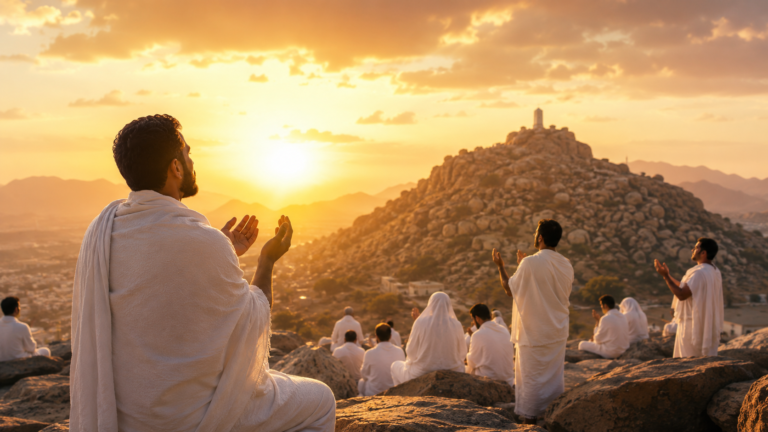
In the Islamic calendar, some days are more than just days. They are windows of divine grace — moments when Allah’s mercy descends upon His servants with a particular and extraordinary intensity. The Day of Arafah is one of these days — perhaps the greatest day of the entire year for the Muslim who is not performing Hajj. And yet, for many believers, it passes almost unnoticed, swallowed up by the excitement of Eid preparations.
This article is an invitation to change that. To understand what this day truly represents, what the Prophet ﷺ said about it, and how to make it a genuine moment of spiritual renewal — whether you are standing on the plain of Arafah or sitting in your living room in London or New York.
The Day of Arafah is the 9th of Dhul Hijja — the day before Eid al-Adha in the Hijri calendar. In 2026, it falls on Tuesday, 26 May.
The day takes its name from the plain of Arafah, located roughly 20 kilometres east of Makkah. This is where the central act of Hajj takes place: pilgrims gather on the plain from midday on the 9th of Dhul Hijja and remain there in prayer and supplication until sunset. This standing is called the wuquf, and it is so foundational that the Prophet ﷺ said:
“Hajj is Arafah.”
(Tirmidhi, Nasa’i — authenticated hadith)
In other words: a pilgrimage without Arafah is not a Hajj. This day is its soul.
In Surah Al-Ma’idah (5:3), Allah revealed a verse considered among the most significant in the entire revelation:
“This day I have perfected for you your religion and completed My favour upon you and have approved for you Islam as religion.”
(Al-Ma’idah, 5:3)
According to the vast majority of Quranic scholars, this verse was revealed on the Day of Arafah during the Prophet’s ﷺ Farewell Pilgrimage. This speaks to the immense spiritual weight of this day: it is the day the Islamic revelation was declared complete — the day the entire edifice of faith was sealed.
The Prophet ﷺ said about fasting on this day:
“Fasting on the Day of Arafah — I hope that Allah will expiate thereby the sins of the year before it and the year after it.”
(Muslim)
This is one of the most beloved hadiths in the entire Islamic tradition. A single voluntary fast — two years of sins expiated. There is no other day in the year for which such a reward is reported.
An important clarification: this fast is recommended for Muslims who are not performing Hajj this year. The pilgrims themselves do not fast on this day — they are travelling, and the Sunnah of Hajj does not include fasting at Arafah, so that energy is preserved for supplication.
In an authentic hadith reported by Muslim, the Prophet ﷺ said:
“There is no day on which Allah frees more people from the Fire than the Day of Arafah. He draws near, then boasts of them before the angels, saying: ‘What do they want?'”
(Muslim)
This is an image of rare power. Allah Himself, before His angels, takes pride in His servants gathered on the plain — and in those who are fasting and supplicating from their homes around the world. It is an invitation to be fully conscious of this moment. Not to let it pass.
The beauty of the Day of Arafah is that it does not belong only to the pilgrims. Allah has made this day accessible to every believer — from any city on earth, from any circumstance.
For those not performing Hajj, fasting on the 9th of Dhul Hijja — Tuesday, 26 May 2026 — is the most recommended act of the day. It is its cornerstone.
There is no specific niyyah (intention) to pronounce aloud. A sincere intention in the heart to fast this day for Allah, hoping for expiation, is sufficient. The fast begins at Fajr (dawn) and ends at sunset, like any fast.
The Prophet ﷺ described the best dhikr as:
“La ilaha illa Allah, wahdahu la sharika lah, lahu al-mulku wa lahu al-hamd, wa huwa ‘ala kulli shay’in qadir.”
“There is no deity but Allah, alone, with no partner. To Him belongs the dominion and to Him belongs all praise. And He is over all things competent.”
This dhikr, repeated throughout the Day of Arafah with genuine presence of heart, is among the most meritorious. The takbirat of Eid — Allahu Akbar, Allahu Akbar, la ilaha illallah, Allahu Akbar, Allahu Akbar wa lillahil hamd — officially begin from the evening before Eid and should be recited abundantly on this day as well.
The Day of Arafah is above all the day of dua. The pilgrims spend the entire afternoon supplicating on the plain. Those who are not on Hajj can do exactly the same from wherever they are — after Dhuhr or Asr prayer, or at any moment throughout the day.
This is the moment for sincere, deeply personal prayer. Ask for yourself, for your family, for those who have passed, for the ummah. The supplication of the Day of Arafah is among the most answered of the entire year — do not underestimate it.
Dedicating part of this day to reciting or listening to the Quran is a meaningful way to honour it fully. If you have been wanting to deepen your relationship with the Book of Allah — to understand what you recite and feel the force of its verses in their original language — the Day of Arafah is also the perfect moment to make a lasting resolution in that direction.
The Day of Arafah and the First Ten Days of Dhul Hijja
The Day of Arafah does not arrive in isolation. It is the apex of the first ten days of Dhul Hijja, which the Prophet ﷺ identified as the most meritorious days of the entire year:
“There are no days on which righteous deeds are more beloved to Allah than these ten days.”
The companions asked: “Not even striving in the cause of Allah?”
He said: “Not even striving in the cause of Allah, except for the man who goes out with his life and his wealth and returns with nothing.”
(Bukhari)
These ten days — from the 1st to the 10th of Dhul Hijja — are a period of intensified worship recommended for every Muslim, entirely independent of Hajj. Fasting the first nine days (or at least the Day of Arafah) is recommended; takbirat are multiplied; charity is given more generously.
The Day of Arafah is the climax of all of this. Everything planted in good deeds since the 1st of Dhul Hijja finds its fullest expression on this ninth day.
There is something profoundly beautiful in the structure of the Day of Arafah: Allah has designed it so that the most sacred moment of Hajj — the standing on the plain where Adam and Eve were reunited, where Ibrahim ﷺ prayed, where the Prophet ﷺ delivered his Farewell Sermon — can be shared by all of Islam, from anywhere on earth.
This says something fundamental about the Islamic vision of faith: no one is excluded from divine grace. The person who cannot afford Hajj this year can live the 9th of Dhul Hijja with as much spiritual fullness as the pilgrim standing at Arafah — if their heart is sincerely present.
This is a divine generosity woven into the very fabric of the Islamic calendar.
The Day of Arafah is also a beautiful teaching opportunity for families. Explaining to your children what happens on this day, having them recite the takbirat, describing the pilgrims gathered on the plain of Arafah at this very moment — this gives them a concrete anchor in faith, a vivid image that will stay with them.
For older children, reading together from Surah Al-Ma’idah and explaining why verse 3 was revealed on this day is a lesson in faith and Islamic history that few school textbooks can offer.
If you want to go further and give your children the tools to read and understand the Quran in its original language, the Quran courses for children at Al-Dirassa are a serious and caring resource: native-speaking teachers, progressive methodology, and flexible online classes.
And for you, as a parent wishing to better understand the texts you read on the Day of Arafah and throughout the year, the Arabic courses for adults at Al-Dirassa will give you direct, living access to the language of the Quran.
The Day of Arafah comes once a year. It does not announce itself with fanfare. It does not impose itself. It is simply there — quiet, immensely generous — and when the sun sets, it departs, carrying with it its promise of expiation for those who used it well.
This year, the 9th of Dhul Hijja falls on Tuesday, 26 May 2026. Mark it in your calendar. Set your intention to fast the night before. Reserve time for supplication after the Dhuhr prayer. And let this day do what it was created to do: draw your heart closer to Allah.
Taqabbal Allahu minna wa minkum.
No, the fast of the Day of Arafah is not obligatory — it is strongly recommended (considered a confirmed Sunnah by many scholars) for Muslims who are not performing pilgrimage that year. It remains one of the most meritorious acts a believer can perform on this day, with the promise of expiation of two years’ worth of sins reported in an authentic hadith from Muslim. If you have a valid reason not to fast (illness, pregnancy, breastfeeding, travel…), you can still honour this day through dhikr, personal supplication, and Quran recitation — the door of grace remains fully open.
The best invocation specifically reported for the Day of Arafah is the one the Prophet ﷺ himself described as the finest dhikr: La ilaha illa Allah, wahdahu la sharika lah, lahu al-mulku wa lahu al-hamd, wa huwa ‘ala kulli shay’in qadir. Beyond this formula, the Day of Arafah is above all the day of heartfelt personal dua — a sincere supplication made in your own words, in whichever language comes from your heart. Allah hears every language and responds to sincerity above all else. It is also recommended to recite abundant takbirat, tahlil (la ilaha illallah), and salawat upon the Prophet ﷺ throughout the day.
Yes, absolutely. The fast of the Day of Arafah (9th of Dhul Hijja) and the Eid al-Adha prayer (10th of Dhul Hijja) are two entirely distinct and complementary acts. The fast of Arafah ends at sunset on the 9th of Dhul Hijja — the evening before Eid. The following morning, you perform the Eid prayer as normal, having broken your fast the night before. A reminder worth stating clearly: fasting on Eid day itself (the 10th of Dhul Hijja) is forbidden (haram) — it is a day of celebration and generosity, not of fasting.
Don’t want to go through the translation anymore?
30 free minutes with your qualified Egyptian teacher.
Al-dirassa Institute offers you a gift to help you begin your journey to being fluent in Arabic and learning the Quran.
Al-dirassa Institute offers you a gift to help you begin your journey to being fluent in Arabic and learning the Quran.