
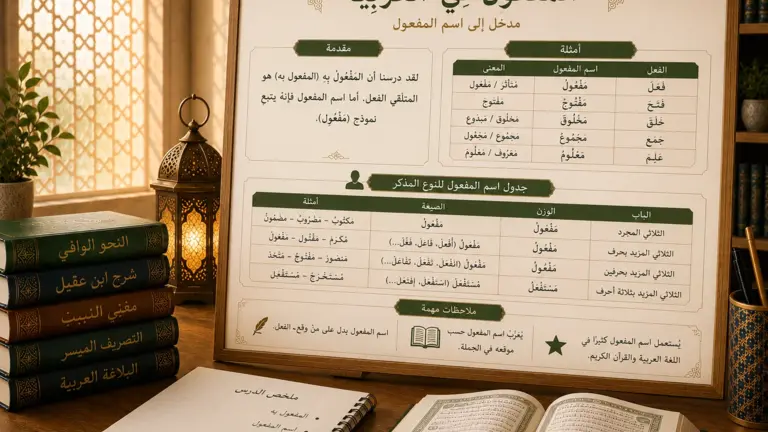
1. Introduction
In Arabic grammar, the term for the noun representing the doer of an action, also known as the subject, is اسم الفاعل (active participle). It is constructed by adding an ألف (alif) after the first radical of the verb (فعل), giving the middle letter a kasrah (ِ) and the last radical a tanween, resulting in the pattern فَاعِلٌ.
Examples:
سَجَدَ / سَاجِدٌ
One who prostrates / to prostrate
حَمِدَ / حَامِدٌ
One who praises / to praise
كَفَرَ / كَافِرٌ
A disbeliever / to disbelieve
Masculine Gender Active Participle Table
Nominative Case – حَالَةُ الرَّفْعِ
Singular: فَاعِلٌ – A doer
Dual: فَاعِلَانِ – Two doers
Plural: فَاعِلُونَ – Doers
Accusative Case – حَالَةُ النَّصْبِ
Singular: فَاعِلًا – A doer
Dual: فَاعِلَيْنِ – Two doers
Plural: فَاعِلِينَ – Doers
Genitive Case – حَالَةُ الْجَرِّ
Singular: فَاعِلٍ – A doer
Dual: فَاعِلَيْنِ – Two doers
Plural: فَاعِلِينَ – Doers
Feminine Gender Active Participle Table
Nominative Case – حَالَةُ الرَّفْعِ
Singular: فَاعِلَةٌ – A doer
Dual: فَاعِلَتَانِ – Two doers
Plural: فَاعِلَاتٌ – Doers
Accusative Case – حَالَةُ النَّصْبِ
Singular: فَاعِلَةً – A doer
Dual: فَاعِلَتَيْنِ – Two doers
Plural: فَاعِلَاتٍ – Doers
Genitive Case – حَالَةُ الْجَرِّ
Singular: فَاعِلَةٍ – A doer
Dual: فَاعِلَتَيْنِ – Two doers
Plural: فَاعِلَاتٍ – Doers
Examples of Active Participles in the Holy Quran
قُلْ يَا أَيُّهَا الْكَافِرُونَ
Say, “O disbelievers,” (109:1)
وَلَا أَنَا عَابِدٌ مَّا عَبَدتُّمْ
Nor will I be a worshipper of what you worship. (109:4)
وَلَا أَنتُمْ عَابِدُونَ مَا أَعْبُدُ
Nor will you be worshippers of what I worship. (109:5)
فَيُصْبِحُوا عَلَىٰ مَا أَسَرُّوا فِي أَنفُسِهِمْ نَادِمِينَ
And they will become, over what they have been concealing within themselves, regretful. (5:52)
وَلَهُمْ فِيهَا أَزْوَاجٌ مُّطَهَّرَةٌ وَهُمْ فِيهَا خَالِدُونَ
And they will have therein purified spouses, and they will abide therein eternally. (2:25)
2. Hamzated and Assimilated Verbs
Hamzated and assimilated verbs such as أَكَلَ, سَأَلَ, قَرَأَ, وَعَدَ, and يَسِرَ form their active participles using the pattern فَاعِلٌ.
Examples:
أَكَلَ / آكِلٌ
One who eats
سَأَلَ / سَائِلٌ
Questioner
قَرَأَ / قَارِئٌ
One who reads
وَعَدَ / وَاعِدٌ
One who promises
يَسِرَ / يَاسِرٌ
One who becomes easy
Quranic Example:
سَأَلَ سَائِلٌ بِعَذَابٍ وَاقِعٍ
A supplicant asked for a punishment bound to happen. (70:1)
Certain active participles follow the pattern فَعِيلٌ. These participles often function as adjectives describing eternal or constant qualities.
Examples:
عَظِيمٌ – Great
حَسِينٌ – Good
كَبِيرٌ – Big
قَالَ فَاخْرُجْ مِنْهَا فَإِنَّكَ رَجِيمٌ
[Allah] said, “Then get out of it, for indeed, you are expelled.” (15:34)
إِنْ هَٰذَا إِلَّا مَلَكٌ كَرِيمٌ
This is none but a noble angel. (12:31)
الرَّحْمَـٰنِ الرَّحِيمِ
The Entirely Merciful, the Especially Merciful. (1:3)
3. Hollow Verbs
When the second radical of a verb is a weak letter (و or ى), the active participle follows the pattern فَاعِلٌ.
Examples:
قَالَ / قَائِلٌ
One who speaks
بَاعَ / بَائِعٌ
One who sells
4. Defective Verbs
When the third radical is a weak letter (و or ى), as in دَعَا and رَمَى, the active participle follows the pattern فَاعِلٌ but with a slight morphological adjustment.
دَعَا = دَاعٍ – One who calls
رَمَى = رَامٍ – One who throws
لَقِيَ = لَاقٍ – One who meets
This occurs because when و or ى bear a tanween dammah and are preceded by a kasrah, the weak letter is dropped, and the previous letter receives a tanween kasrah.
5. Double-Lettered Verbs — الْمُضَاعَفُ
According to the pattern فَاعِلٌ, the active participle of doubled verbs like ظَنَّ should theoretically be ظَانِنٌ. However, Arabic simplifies the form by merging the two identical radicals, resulting in a shaddah (ّ) and producing ظَانٌّ.
Examples:
ظَنَّ = ظَانٌّ – One who suspects
ضَلَّ = ضَالٌّ – One who goes astray
صِرَاطَ الَّذِينَ أَنْعَمْتَ عَلَيْهِمْ غَيْرِ الْمَغْضُوبِ عَلَيْهِمْ وَلَا الضَّالِّينَ
The path of those upon whom You have bestowed favor, not of those who have evoked [Your] anger or of those who are astray. (1:7)
Active Participle Table — Masculine Form (ظَنَّ)
Nominative Case — حَالَةُ الرَّفْعِ
Singular: ظَانٌّ – One who suspects
Dual: ظَانَّانِ – Two who suspect
Plural: ظَانُّونَ – Those who suspect
Accusative Case — حَالَةُ النَّصْبِ
Singular: ظَانًّا – One who suspects
Dual: ظَانَّيْنِ – Two who suspect
Plural: ظَانِّينَ – Those who suspect
Genitive Case — حَالَةُ الْجَرِّ
Singular: ظَانٍّ – One who suspects
Dual: ظَانَّيْنِ – Two who suspect
Plural: ظَانِّينَ – Those who suspect
Active Participle Table — Feminine Form (ظَنَّ)
Nominative Case — حَالَةُ الرَّفْعِ
Singular: ظَانَّةٌ – One who suspects
Dual: ظَانَّتَانِ – Two who suspect
Plural: ظَانَّاتٌ – Those who suspect
Accusative Case — حَالَةُ النَّصْبِ
Singular: ظَانَّةً – One who suspects
Dual: ظَانَّتَيْنِ – Two who suspect
Plural: ظَانَّاتٍ – Those who suspect
Genitive Case — حَالَةُ الْجَرِّ
Singular: ظَانَّةٍ – One who suspects
Dual: ظَانَّتَيْنِ – Two who suspect
Plural: ظَانَّاتٍ – Those who suspect
Examples of Active Participles in the Holy Quran
تَنزِيلُ الْكِتَابِ مِنَ اللَّـهِ الْعَزِيزِ الْحَكِيمِ
The revelation of the Qur’an is from Allah, the Exalted in Might, the Wise. (39:1)
أَمَّنْ هُوَ قَانِتٌ آنَاءَ اللَّيْلِ سَاجِدًا وَقَائِمًا يَحْذَرُ الْآخِرَةَ وَيَرْجُو رَحْمَةَ رَبِّهِ
Is one who is devoutly obedient during the night, prostrating and standing in prayer, fearing the Hereafter and hoping for his Lord’s mercy, like one who does not? (39:9)
وَأَرْضُ اللَّـهِ وَاسِعَةٌ إِنَّمَا يُوَفَّى الصَّابِرُونَ أَجْرَهُم بِغَيْرِ حِسَابٍ
And the earth of Allah is spacious. Indeed, the patient will be given their reward without account. (39:10)
التَّائِبُونَ الْعَابِدُونَ الْحَامِدُونَ السَّائِحُونَ الرَّاكِعُونَ السَّاجِدُونَ الْآمِرُونَ بِالْمَعْرُوفِ وَالنَّاهُونَ عَنِ الْمُنكَرِ وَالْحَافِظُونَ لِحُدُودِ اللَّـهِ وَبَشِّرِ الْمُؤْمِنِينَ
[Such believers are] the repentant, the worshippers, the praisers, the travelers for His cause, those who bow and prostrate in prayer, those who enjoin what is right and forbid what is wrong, and those who observe the limits set by Allah. And give good tidings to the believers. (9:112)
Conclusion
We have learned the various forms and meanings of the Arabic active participle (اسم الفاعل). It describes the doer of the action and adapts to the verb’s pattern—strong, hamzated, hollow, defective, or doubled. In the next lesson, we will study the passive participle (اسم المفعول).
Book your free trial of 30 minutes
Registration form





No Comments
No comments yet.
No comments yet.