
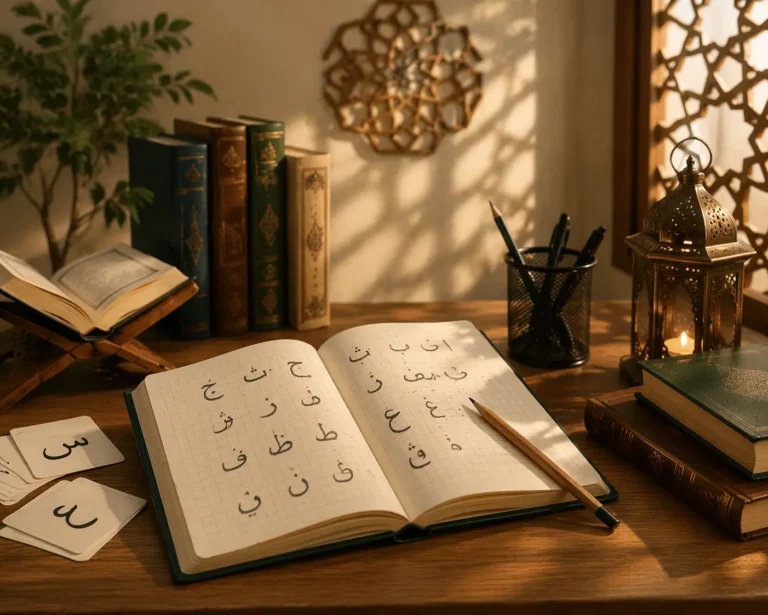
Learning Arabic is a goal shared by many French-speaking Muslims and learners alike, whether they want to understand the Quran, deepen their Islamic culture, or acquire a new language. One question almost always comes up at the beginning: is it really possible to learn Arabic on your own, without a teacher?
With so many apps, videos, and free online resources available today, this question is completely understandable.
Yet learning Arabic is more complex than it may first appear. Some stages can indeed be approached independently, but others require serious guidance to avoid mistakes and make steady progress. This article offers a clear, realistic, and reassuring answer to that question.
Yes, it is absolutely possible to begin learning Arabic independently, especially in the early stages. This first step helps learners discover the language and become familiar with the way it works.
A beginner can learn alone:
This phase can be very useful for building confidence and understanding the logic of Arabic writing. It also helps learners identify their main difficulties before moving further. However, this independence has its limits.
Even with strong motivation, learning Arabic alone quickly reaches a point where progress becomes difficult.
Arabic contains sounds that do not exist in French or English. Without correction, learners naturally adopt approximate pronunciations. These mistakes can quickly turn into habits that are difficult to fix later.
In Arabic, a single mispronounced letter can change the meaning of a word. Without outside feedback, it becomes very hard to know whether a sound is truly correct.
Learning alone often means jumping from one resource to another without a clear progression: a video today, an app tomorrow, a PDF the next day. This fragmented approach slows progress considerably.
Arabic requires structured learning: alphabet, reading, pronunciation, grammar, then comprehension. Without a clear framework, the learning process becomes confusing.
Arabic grammar is logical, but it is very different from French and English grammar. Without suitable explanations, many learners memorize rules without really understanding them, which often leads to frustration and discouragement.
Without guidance or clear goals, consistency tends to decline over time. Many learners do not stop because they lack ability, but because they lack structure and support.
When the goal is to read the Quran, self-learning shows its limits even more quickly. Quranic reading requires precise pronunciation, respect for letters and vowels, and careful attention to the rules of recitation.
A repeated mistake can affect the meaning of words and weaken the quality of recitation. Without a teacher, it is very difficult to verify whether one’s reading is correct. That is why learning Arabic or Quran reading entirely alone is not sufficient for a serious religious objective.
Being supported by a teacher makes it possible to:
Contrary to what some people think, being guided does not slow learning down. On the contrary, it helps avoid months of mistakes, confusion, and unnecessary discouragement.
The most effective method is based on balance:
This approach helps strengthen the foundations, correct mistakes, and build lasting progress, whether the goal is general Arabic or learning to read the Quran properly.
This is precisely the approach offered by Al-Dirassa, with qualified teachers and a teaching method specially adapted to non-Arabic speakers.
In front of the limits of self-study, a clear and structured method becomes essential. This is exactly where the Al-Dirassa method stands out. It was designed to respond to the real difficulties faced by learners, especially beginners.
One of the main challenges in learning Arabic is the gap between many existing methods and the specific needs of learners coming from a French- or English-speaking background. The Al-Dirassa method takes into account:
Each stage follows a logical structure: alphabet, reading, pronunciation, essential grammar, then comprehension.
The method is built around human support from qualified teachers who are experienced in teaching Arabic to non-Arabic speakers. This guidance helps learners:
This is especially important for those who want to learn Arabic in order to read and understand the Quran correctly.
Unlike disorganized learning, the Al-Dirassa method is based on measurable progress. The learner knows:
This clarity helps maintain motivation and allows learners to see their progress in a concrete way.
The Al-Dirassa method is suitable both for those who want to learn general Arabic and for those whose goal is Quran reading. The care given to pronunciation and reading helps build solid foundations that respect both the language and its meaning.
It is this balanced approach, between personal effort and guided learning, that allows students to progress calmly and consistently.
To discover this method and assess your level, you can benefit from a free 30-minute trial and evaluation with Al-Dirassa.
Yes, it is possible to discover the basics on your own. But without a teacher, it becomes difficult to correct pronunciation and progress properly over the long term.
Apps can be useful for revision and practice, but they do not replace human guidance, especially for pronunciation and real understanding.
Usually, a few weeks may be enough to discover the basics. Beyond that, guidance becomes strongly recommended.
No. Reading the Quran requires precise pronunciation and regular correction in order to avoid mistakes.
It is very difficult. People do not always hear their own mistakes accurately. A teacher is essential for effective correction.
A structured and progressive method, with a teacher and regular practice.
Very often, yes, because mistakes become habits and slow progress over time.
Ideally from the beginning, or as soon as the basics are in place, such as the alphabet and first reading skills.
Learning Arabic on your own is possible for discovering the basics, but it is not enough for lasting and accurate progress. Without correction and structure, mistakes settle in and motivation weakens. With proper guidance, learners save time, avoid obstacles, and move forward with confidence.
Don’t want to go through the translation anymore?
30 free minutes with your qualified Egyptian teacher.
Al-dirassa Institute offers you a gift to help you begin your journey to being fluent in Arabic and learning the Quran.
Al-dirassa Institute offers you a gift to help you begin your journey to being fluent in Arabic and learning the Quran.