
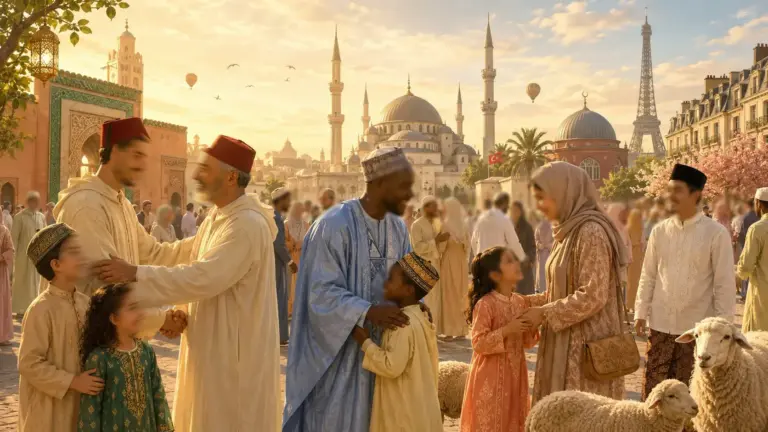
The anticipation is building. Eid al-Adha 2026 is here, and with it comes that unmistakable spiritual atmosphere that settles over Muslim households across the globe. For many, this is the most meaningful celebration of the Islamic year — deeper than Eid al-Fitr, more rooted in prophetic history, more charged with collective emotion. Whether you are in the UK, the United States, North Africa, or beyond, this guide covers everything you need: the now-confirmed date, how the prayer unfolds, traditions observed across different communities, and how to approach this blessed day with full awareness.
No more waiting. Following the official sighting of the Dhul Hijjah crescent moon by the Saudi Supreme Court on Sunday 17 May 2026, the date of Eid al-Adha 2026 is confirmed as Wednesday, 27 May 2026 — corresponding to the 10th of Dhul Hijja 1447 AH. This same date has been confirmed in the vast majority of Muslim-majority countries, as well as by Islamic bodies in the West.
In the United Kingdom, Eid al-Adha 2026 falls on Wednesday, 27 May 2026. The celebration begins on the evening of Tuesday 26 May, with the first day of Eid on Wednesday 27 May and the festivities continuing through Friday 29 May. The Day of Arafah — the most sacred day of the Hajj pilgrimage and a day of fasting for those not on pilgrimage — is Tuesday 26 May 2026.
UK Muslims who follow local moon-sighting committees may wish to check with their local mosque for any last-minute confirmation, though the overwhelming majority of British Muslim communities are aligned on 27 May. Major Islamic organisations including Islamic Relief UK have confirmed this date.
In the United States, Eid al-Adha 2026 is confirmed as Wednesday, 27 May 2026. The Islamic Society of North America (ISNA) and the Fiqh Council of North America (FCNA), which both follow astronomical calculation, have confirmed this date. The celebration lasts three days: 27, 28, and 29 May.
A practical note for American Muslims: Eid al-Adha is not a federal public holiday in the United States. However, a growing number of school districts in cities with large Muslim populations — including New York City, which officially recognises both Eids — close on this day. The US President traditionally issues a formal Eid greeting, and the White House may mark the occasion as well. If you need the day off, speak to your employer or school in advance.
The Islamic calendar is lunar, counting 354 to 355 days per year — around 10 to 11 days shorter than the Gregorian calendar. This means Eid al-Adha moves back by approximately 10 days each year in the civil calendar. On top of this, some countries follow astronomical calculations (like the FCNA in North America and Turkey), while others wait for an actual visual sighting of the crescent moon. This year, the exceptional unanimity between countries — East and West — is a remarkable and welcome sign of unity across the ummah.
Before logistics and traditions, it is worth pausing on what this celebration is truly about.
Eid al-Adha — the “Feast of Sacrifice” — commemorates one of the most profound moments in prophetic history: the trial of Ibrahim ﷺ. Commanded by Allah in a dream to sacrifice his son Ismail, he prepares to carry out the act. At the very last moment, Allah sends a ram in Ismail’s place — a sign of His acceptance of Ibrahim’s complete and unwavering submission.
Allah says in the Quran (Surah As-Saffat, 37:103-107): “When they had both submitted and he laid him down on his forehead, We called out to him: ‘O Ibrahim! You have fulfilled the vision.’ Indeed, this is how We reward those who do good. That was truly a revealing test. And We ransomed his son with a great sacrifice.”
And elsewhere, the Quran cuts to the heart of what the sacrifice really means:
“Neither their flesh nor their blood reaches Allah, but what does reach Him is the piety from you.” (Al-Hajj, 22:37)
This feast is not merely a family celebration. It is a yearly reminder of what sincere submission to Allah looks like — and of the divine mercy that responds to it. The question it puts to every believer is deeply personal: what am I holding too tightly, that needs to be released into Allah’s hands?
The prayer of Eid al-Adha is one of the most distinctive features of the celebration. Here is everything you need to know.
The Eid prayer consists of two rak’at, with additional takbirat: seven in the first rak’a (after the opening takbir) and five in the second (before al-Fatiha). It is followed by a khutbah (sermon), which should be listened to attentively. In the UK, most mosques hold multiple prayer sessions between around 7:30am and 10:30am to accommodate large congregations — check your local mosque’s schedule in advance.
It is also a Sunnah to return home by a different route from the one taken to the prayer — a practice scholars have connected to bearing witness to as many places as possible on this blessed day, and to the opportunity for more encounters and greetings along the way.
From the evening of Tuesday 26 May (the eve of Eid) through to the evening of Saturday 30 May (the end of the days of Tashreeq, 13th Dhul Hijja), Muslims are encouraged to repeat frequently:
Allahu Akbar, Allahu Akbar, la ilaha illallah, Allahu Akbar, Allahu Akbar wa lillahil hamd.
Recite them on your way to the mosque, in the car, at home with your family. Let the morning of 27 May sound different from any other morning of the year.
The spiritual core of Eid al-Adha is universal. But the way it is lived varies beautifully from one community to the next — and this diversity is one of the most striking expressions of Islam’s reach across every culture on earth.
The British Muslim community — estimated at over 3.9 million people — marks Eid al-Adha with morning prayers at mosques and community centres across the country. In London, Birmingham, and Manchester, multiple prayer sessions rotate throughout the morning to accommodate large congregations. This year, the Mayor of London’s annual Eid al-Adha event is set to return to Trafalgar Square on 30 May, with family activities, food stalls, and community celebration open to all Londoners. The qurbani (sacrifice) is typically arranged through certified halal butchers or Islamic charities, with the meat distributed locally and internationally to those in need.
For the estimated 3.5 million Muslims across the US, Eid al-Adha is a community-centred celebration. Large Eid prayers are held in mosques, parks, and convention centres — in cities like New York, Dearborn (Michigan), Houston, and Los Angeles, thousands gather for outdoor prayers at dawn. The qurbani tradition is widely upheld through Islamic organisations and charities that carry out the sacrifice on behalf of donors, often directing the meat to communities facing food insecurity both domestically and abroad. Children receive gifts and Eidi, and the day is spent visiting family and friends.
In Morocco, Eid al-Adha — simply known as l’Aid — is the most important day of the year. Every family that can sacrifices a sheep. Preparations begin weeks in advance. The entire country comes to a standstill: transport, shops, public services. The meat is traditionally divided into three portions — one for the family, one for relatives and neighbours, one for those in need.
In Turkey, the celebration is called Kurban Bayramı and is a national public holiday of four and a half days, running from Tuesday 26 May through Saturday 30 May. Families reunite, visits are made to the graves of ancestors, and meat is distributed widely to the poor. The spirit of communal solidarity is particularly strong.
Known as Tabaski, this is perhaps the most emotionally charged celebration in the West African Muslim calendar. Every family, regardless of means, makes every effort to have their sheep. Women dress in vibrant traditional outfits, children receive new clothes, and the day overflows with music, joy, and abundant meals shared across the community.
Indonesia, the world’s most populous Muslim-majority country, marks Eid al-Adha with massive open-air prayers, sometimes gathering tens of thousands in a single space. The sacrifice includes cows and buffalo alongside sheep, and meat is distributed at scale to underprivileged neighbourhoods. The public holiday runs from 27 to 29 May.
Eid al-Adha and the Hajj pilgrimage are inseparable. The feast falls on the 10th of Dhul Hijja — the culminating day of the pilgrimage at Makkah. This year, the Day of Arafah is Tuesday 26 May 2026: the day when pilgrims gather on the plain of Arafah in the most spiritually charged moment of the entire pilgrimage, and when fasting and supplication are particularly recommended for those who are not on Hajj.
While millions of pilgrims perform their sacrifice at Mina on the morning of 27 May, Muslims in London, New York, Lagos, and Kuala Lumpur will be standing in their own prayer rows at the same moment. This synchronicity is one of the most powerful expressions of the unity of the ummah: the same intention, the same direction of the heart, regardless of where on earth you stand.
Eid al-Adha is often a moment when many Muslims feel a renewed desire to grow closer to their faith — to understand what they recite in their prayers, to read the Quran with comprehension rather than phonetics alone, to connect more directly with the words that Allah revealed.
Understanding Surah As-Saffat in its original Arabic, grasping the meaning of the takbirat you repeat throughout the day, reading the story of Ibrahim ﷺ in the language it was revealed in — all of this becomes attainable through structured, committed Arabic learning. Explore our online Arabic courses with native-speaking teachers, adapted to all levels — adults, children, and complete beginners — with flexible scheduling that fits around your life.
And if you want to give your children this gift, know that there is no better time than now. A child who learns Arabic early enters the Quran with a fluency and ease that takes adults years to build. Book a free trial lesson — for yourself or your child — and take that first step toward a deeper, living connection with the Book of Allah.
Eid al-Adha 2026 is officially confirmed for Wednesday, 27 May 2026 in the United Kingdom, the United States, and the vast majority of countries around the world. The Day of Arafah falls on Tuesday 26 May. The celebration continues through Friday 29 May.
This year, the remarkable convergence of the date across virtually every Muslim community on earth is a reminder that, beneath all the cultural colour and regional tradition, the ummah shares one story, one act of faith, and one direction of the heart.
May this Eid bring you peace, barakah, and a renewed sense of what truly matters. May the sacrifice of Ibrahim ﷺ inspire, in every household, a renewed trust in Allah.
Taqabbal Allahu minna wa minkum — may Allah accept from us and from you.
Eid al-Adha 2026 is confirmed as Wednesday, 27 May 2026 in both the United Kingdom and the United States. In the UK, the celebration begins on the evening of Tuesday 26 May; in the US, most communities follow the ISNA/FCNA astronomical calculation confirming the same date. The Day of Arafah — ideal for fasting for those not on Hajj — is Tuesday 26 May. The three days of celebration run from 27 to 29 May. Always check with your local mosque for prayer times specific to your area.
In neither country is Eid al-Adha an official public holiday. In the UK, employees may request the day as annual leave — most employers are accommodating with reasonable advance notice. In the US, it is not a federal holiday, but several school districts with large Muslim populations — most notably New York City — officially recognise Eid al-Adha and close schools for the day. If you need time off, request it as soon as possible and cite the date clearly: Wednesday 27 May 2026.
No. The sacrifice can be performed on your behalf by a trusted halal butcher, a certified Islamic organisation, or a registered charity — which is the most common arrangement for Muslims in the UK and US. The important thing is that the intention is made sincerely, and that the sacrifice is carried out according to Islamic guidelines: a healthy animal, slaughtered correctly, with the name of Allah invoked. Many UK and American Muslims donate through organisations that carry out the Qurbani in regions where the meat is most needed, combining the fulfilment of this ibadah with meaningful charity.
Don’t want to go through the translation anymore?
30 free minutes with your qualified Egyptian teacher.
Al-dirassa Institute offers you a gift to help you begin your journey to being fluent in Arabic and learning the Quran.
Al-dirassa Institute offers you a gift to help you begin your journey to being fluent in Arabic and learning the Quran.