
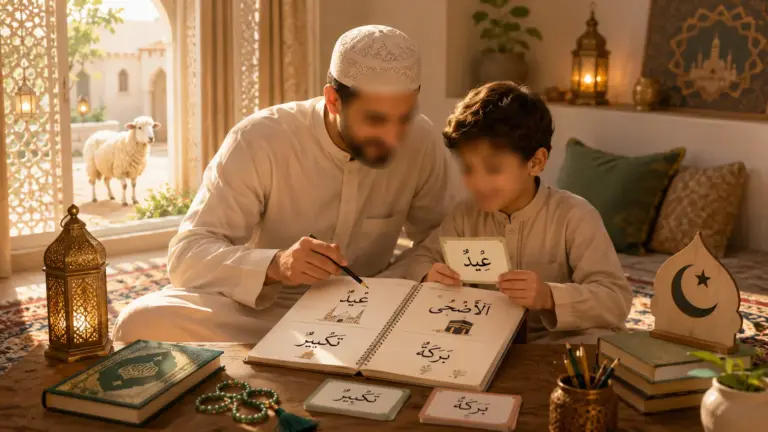
Eid al-Adha is one of the richest celebrations in Islam — rich in meaning, in traditions, and in Arabic vocabulary. Every word spoken on this day carries a history, a root, a depth that is not always immediately apparent. Whether you want to better understand what you hear at the mosque, explain the celebration to your children in Arabic, or simply deepen your relationship with the language of the Quran, this article gives you the essential words — with their Arabic script, pronunciation, and real meaning.
It is easy to forget, but Arabic is not an ordinary language for a Muslim. It is the language in which Allah revealed His message. Every Islamic term — whether a greeting formula, a ritual name, or the word for an animal of sacrifice — carries precise semantics, rooted in centuries of tradition and scholarship.
Learning the vocabulary of Eid is therefore a two-for-one investment: you immerse yourself in the celebration while laying the first bricks of a broader linguistic journey. Many adult learners report that it was words heard at Eid or during Ramadan that first sparked their desire to study Arabic more seriously.
The word عِيدٌ (Eid) comes from the root عَوْدَ — “to return.” Eid is that which returns, that which repeats: a cyclical celebration, a recurring moment of joy and gratitude. In Arabic, this word designates any major Islamic feast.
The official name in Classical Arabic is عِيدُ الأَضْحَى (Eid al-Adha). The word Adha derives from أَضْحَى, referring to the time of the morning sacrifice — the hour after sunrise when the immolation is traditionally performed.
كَبِيرٌ (Kabir) means “great” in the sense of grandeur, importance, and nobility. The name used in the Maghreb and among Francophone communities — “Aïd al-Kébir” — therefore translates as “the great celebration,” as distinct from Eid al-Fitr, often informally called “the small Eid” in some cultures.
[CTA_REGISTER]
The sacrifice is at the heart of this feast. Here are the essential Arabic terms to understand all its dimensions.
أُضْحِيَّة (Udhiyya) is the technical term for the animal sacrificed during Eid al-Adha. This is the word you will hear in khutbas, fiqh classes, and scholarly discussions. It should not be confused with Hady, which refers specifically to the animal sacrificed by a pilgrim at Mecca during Hajj.
ذَبْحٌ (Dhabh) refers to the act of slaughtering the animal according to Islamic rules: invoking the name of Allah, with a swift, precise cut that severs the throat. It is the root of the word Dhabiha, widely used in the context of halal meat.
The formula pronounced at the moment of the sacrifice is:
بِسْمِ اللهِ، اللهُ أَكْبَرُ
Bismillah, Allahu Akbar — In the name of Allah, Allah is the Greatest.
This formula is obligatory for the sacrifice to be valid according to the consensus of Islamic scholars.
خَرُوفٌ (Kharuf) is the standard Arabic word for a sheep or young ram. It is the most commonly sacrificed animal during Eid al-Adha, particularly in France, the Maghreb and West Africa.
بَقَرَةٌ (Baqara) means “cow” — a word Quran readers will instantly recognise as the title of the second surah, Al-Baqara. A cow may be sacrificed on behalf of seven people, making it a practical option for several families who wish to share the sacrifice.
إِبِلٌ (Ibil) refers to the camel — a noble animal in Arabic and Islamic tradition. Like the cow, a camel may be sacrificed on behalf of seven people. This practice remains more common in the Arabian Peninsula and parts of sub-Saharan Africa.
صَلاةُ الْعِيدِ (Salat al-Eid) is the specific prayer performed on both Eids. It consists of two rak’at with additional takbirat, followed by a sermon (khutba).
تَكْبِيرٌ (Takbir) comes from the root كَبُرَ — “to be great.” It is the act of saying Allahu Akbar. In the days surrounding Eid, takbirat are repeated frequently — especially after every obligatory prayer, from Fajr on the day of Arafah to Asr on the last day of Tashreeq.
خُطْبَةٌ (Khutba) is the sermon delivered by the imam after the Eid prayer. Listening to the khutba is considered strongly recommended by the vast majority of scholars.
مُصَلَّى (Musalla) designates an outdoor prayer space — often a park, stadium, or large rented hall. In many cities with significant Muslim populations, the Eid prayer takes place in a musalla to accommodate the large number of worshippers.
The most authentic Eid greeting:
تَقَبَّلَ اللهُ مِنَّا وَمِنْكُمْ
May Allah accept from us and from you.
The verb تَقَبَّلَ (taqabbala) comes from the root قَبِلَ — “to accept, to receive.” This is a supplication, not a simple pleasantry.
دُعَاءٌ (Du’a) refers to personal supplication addressed to Allah — distinct from the salat (ritual prayer). Eid is a blessed day on which du’as are particularly answered, according to several narrations from the prophetic tradition.
بَرَكَةٌ (Baraka) is one of the most beautiful words in the Arabic language. It denotes divine blessing — a grace that spreads, that multiplies, that increases the good wherever it touches. To say “Eid Mubarak” (عيد مبارك) is to wish that the celebration be filled with baraka.
صَدَقَةٌ (Sadaqa) refers to voluntary giving, distinct from zakat (obligatory almsgiving). Eid is a time of intense generosity: distributing the meat of the sacrifice to the poor, sharing with neighbours, helping families in need — all of these acts fall under sadaqa.
لَحْمٌ (Lahm) simply means “meat.” On the day of Eid, tradition holds that the meat of the sacrifice is divided into three portions: one for the family, one for friends and neighbours, one for those in need. This division embodies the profound social dimension of the celebration.
أَقَارِبُ (Aqarib) refers to one’s close relatives — parents, cousins, aunts, uncles. Eid is above all a time of family visits, reconciliations, and the strengthening of bonds. In Arabic, this is called silat al-rahim (صِلَةُ الرَّحِمِ) — literally “maintaining the ties of the womb” — a practice that Islam deeply values.
Eid al-Adha is an extraordinary pedagogical opportunity for children. The smells, the sounds, the distinctive atmosphere of the day create powerful memory anchors — exactly the right context for new words to take root and last.
A few simple ideas:
If your child shows curiosity about the Arabic language, that is a signal they are ready to learn. A child who starts early gains a significant head start — not only in the language, but in their relationship with the Quran and with prayer.
The Eid vocabulary you have just explored is not an end in itself. It is a doorway. Each of these words belongs to a broader lexical field — that of fiqh, Islamic spirituality, and the Quran. And what you have just learned here already represents the first solid bricks of an edifice you can build methodically.
The good news is that Arabic — despite what people often say — is not an impossible language. Its trilateral root system is actually deeply logical: when you know the root قَبِلَ (to accept), you instantly grasp dozens of derived words. When you understand the root ذَبَحَ (to slaughter), the entire vocabulary of the sacrifice opens up before you.
This is precisely the logic that Al-Dirassa’s native teachers convey — with patience and method — to hundreds of French and English-speaking learners every week. Discover our online Arabic courses and see how a structured programme can transform scattered words into a genuine linguistic skill.
Mastering the Arabic vocabulary of Eid al-Adha means understanding the celebration from the inside — not just living it, but reading it in its own language. It means hearing Allahu Akbar and knowing exactly what you are proclaiming. It means saying Taqabbal Allahu minna wa minkum with the full awareness that you are making a supplication, not a polite social gesture.
And if these words have lit a spark in you — the desire to truly learn, to understand the Quran in its language, to pass this on to your children — then do not let this window close. Book your free trial lesson and take the first step. The Arabic language is waiting for you — and it is far more accessible than most people think.
Both names refer to the same celebration. Eid al-Kébir (“the great feast”) is the popular name used mainly in the Maghreb and among Francophone Muslim communities. Eid al-Adha (“the feast of the morning sacrifice”) is the classical Arabic and official name found in Islamic texts, khutbas and Arabic-language media. Both are correct — the difference is cultural and geographical, not religious.
The Arabic alphabet consists of 28 letters and is generally learned within 2 to 4 weeks with consistent daily practice. The most effective approach is to start with the isolated form of each letter, then its connected forms (initial, medial, and final positions). Learning with a native teacher significantly accelerates this process, as real-time pronunciation correction prevents bad habits from forming early on. Many adult learners report being able to read Arabic script within a month of structured lessons.
Yes — and this is one of the most natural and motivating approaches to Quranic understanding. The vocabulary of prayer, Islamic celebrations and supplications constitutes what linguists call “high-frequency Quranic vocabulary”: words that appear repeatedly throughout the sacred text. Research on Quranic frequency shows that mastering the 500 most common words in the Quran allows a learner to understand over 70% of the text. Starting with Eid vocabulary is already building solid foundations for that understanding.
Don’t want to go through the translation anymore?
30 free minutes with your qualified Egyptian teacher.
Al-dirassa Institute offers you a gift to help you begin your journey to being fluent in Arabic and learning the Quran.
Al-dirassa Institute offers you a gift to help you begin your journey to being fluent in Arabic and learning the Quran.