
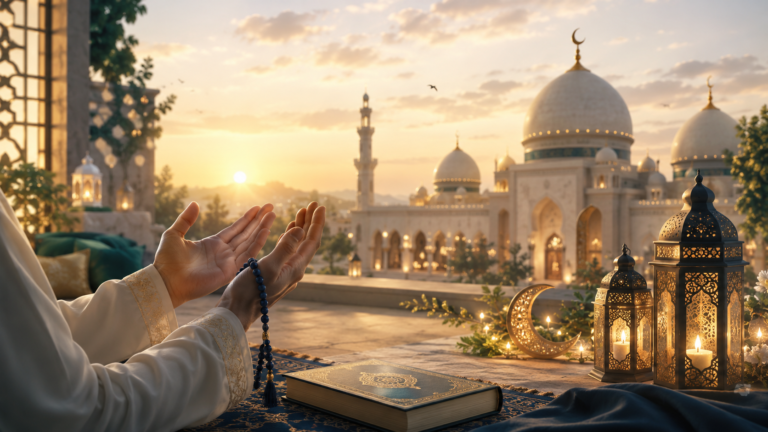
Eid is unlike any other day in the Muslim calendar. It is a moment when joy and worship intertwine naturally — hearts open wide, gratitude rises effortlessly, and the soul is unusually receptive to the divine. In this sacred atmosphere, Eid duas are not mere formalities; they are genuine conversations with Allah, whispered (or spoken aloud) at one of the most spiritually charged moments of the year.
But which supplications are recommended? When exactly should you recite them? And how can you make this day truly meaningful, spiritually speaking? This guide walks you through what the Prophetic tradition teaches — practically, clearly, and with heart.
Islamic tradition identifies specific times and circumstances when duas are more likely to be answered. Eid falls into this category naturally, because it comes directly after an intense period of worship: after a full month of fasting for Eid al-Fitr, or after the blessed first ten days of Dhul Hijja for Eid al-Adha.
The Prophet ﷺ said:
“There are three whose supplication is not rejected: […] the fasting person until he breaks his fast.”
(Tirmidhi). The days surrounding Eid al-Fitr, as a spiritual extension of Ramadan, carry this energy of answered prayer. Similarly, the dawn of Eid al-Adha follows nights of dhikr, takbir, and heightened worship — making it a window of closeness to Allah.
The scholars have long emphasized: do not let these hours slip by in distraction. Use them well.
Eid Duas from the Sunnah: What the Prophetic Tradition Teaches
Before the celebration begins, the night preceding Eid carries its own spiritual weight. Scholars have recommended reviving it with prayer, remembrance of Allah, and sincere supplication. Among the practices for this night:
These simple formulas, repeated with an attentive heart, prepare the soul to receive the day of Eid in a state of inner purity.
One of the most distinctive features of Eid morning is the recitation of takbirat. More than a ritual, they are a form of dua — a declaration of Allah’s greatness that orients the heart before the day even begins.
The most widely known formula is:
Allahu Akbar, Allahu Akbar, la ilaha illa Allah, Allahu Akbar, Allahu Akbar, wa lillahi al-hamd.
“Allah is the greatest, Allah is the greatest, there is no deity but Allah, Allah is the greatest, Allah is the greatest, and all praise belongs to Allah.”
These takbirat are recited from the announcement of Eid until the prayer, while walking to the mosque, with family, in a measured but present voice. Let them fill the morning air of your home.
The Eid prayer itself is a space for dua. Between each set of additional takbirat, it is recommended to recite a brief glorification in silence — or simply allow a heartfelt personal request to rise within. The collective prayer does not preclude personal supplication; it provides its sacred container.
After the prayer, during the khutba, a spirit of recollection is fitting. Many find this a natural moment for a quiet, personal dua — in Arabic, or in their own language, if Arabic is not yet fluent.
The traditional exchange between Muslims on Eid day is itself a supplication:
Taqabbal Allahu minna wa minkum.
“May Allah accept from us and from you.”
Some add: Taqabbal Allahu minna wa minkum salih al-a’mal — “May Allah accept from us and from you our righteous deeds.” This expression is among the most authentically transmitted in the tradition, reported by Companions of the Prophet ﷺ. When said sincerely, it is a genuine gift — a dua offered to someone you love.
Beyond the transmitted formulas, Eid is the ideal time for a sincere, deeply personal supplication. Allah loves when His servants turn to Him with their real needs, their honest fears, their deepest hopes.
Here are themes especially suited to the spirit of Eid:
This last point is often overlooked. Eid marks a transition. One of the most sincere duas you can make is to ask Allah to preserve the spiritual elevation of Ramadan or the days of Dhul Hijja — to carry that light forward into ordinary days.
Both celebrations share the same general structure of supplication, but their spiritual context differs meaningfully.
After a month of fasting and night prayers, the believer’s heart is in an unusual state of closeness to Allah. Duas on Eid al-Fitr naturally focus on gratitude, asking for the acceptance of the fast, and seeking forgiveness for shortcomings during Ramadan.
A fitting supplication:
Allahumma taqabbal minna siyamana wa qiyamana wa ruku’ana wa sujudana wa tama’na wa naqsana.
“O Allah, accept from us our fasting, our night prayers, our bowing, our prostrations, our perfection, and our shortcomings.”
The Feast of Sacrifice recalls Ibrahim’s ﷺ absolute submission to Allah’s command. Duas on Eid al-Adha can focus on asking for tawfiq (divine guidance toward goodness), strength to follow Allah’s path through difficulty, and remembrance of the pilgrims performing Hajj in those very hours.
A fitting supplication:
Allahumma inna nas’aluka al-huda wa al-tawfiq wa al-‘afiya fi al-dunya wa al-akhira.
“O Allah, we ask You for guidance, success toward goodness, and wellbeing in this life and the next.”
One of Islam’s great gifts is that every day is woven with moments of supplication: upon waking, before eating, after prayer, at nightfall. Learning to recite these duas consistently is how the spirit of Eid extends across the entire year — not just for one morning, but as a way of living.
For families wishing to pass this practice on to their children, or for adults who are learning Arabic, understanding the meaning of the duas you recite is a transformative step. Praying in a language you understand moves the heart differently — you pray with full awareness, not only with lips.
If you’d like to deepen your understanding of Quranic Arabic so your supplications feel truly alive, explore the Arabic courses for adults at Al-Dirassa: native-speaking teachers, flexible online classes, and a methodology adapted to every level.
To guide your children from an early age in the recitation and understanding of duas and Quranic surahs, discover the Quran courses for children at Al-Dirassa — designed with warmth, patience, and the needs of young learners in mind.
The duas of Eid are not empty ritual. They are living bridges between the servant and the Lord — moments when language, heart, and intention converge in sincere reach toward Allah. Whether you are surrounded by family, at the mosque amid the crowd, or sitting quietly in a room far from loved ones, these supplications are entirely yours.
Use this Eid to renew your bond with Allah. Ask Him what truly weighs on your heart. And offer those you love the most precious gift a day of celebration can hold: a sincere dua made in their name.
Taqabbal Allahu minna wa minkum. May Allah accept from us and from you.
There is no single dua that the Sunnah makes obligatory for Eid day. What is strongly recommended is making the most of this blessed occasion through sincere and varied supplications: takbirat, the traditional greeting (Taqabbal Allahu minna wa minkum), and personal duas after the prayer. The essential ingredient is presence of heart — not the mechanical recitation of a fixed formula.
Yes, absolutely. The scholars agree that personal duas outside of the ritual prayer can be made in any language. Allah hears all languages and responds to sincerity before anything else. Arabic remains the language of the Quran and learning it is deeply rewarding — but this should never hold you back from supplicating right now, today, in the language that comes from your heart.
Several moments stand out as especially receptive: the eve of Eid (revived with dhikr and prayer), the early morning before the Eid prayer, the silent pauses between the additional takbirat during the prayer itself, and immediately after the congregation disperses. The evening before Eid is also cited by some scholars as a time when supplications are answered. In short: keep your heart open throughout the entire day — every sincere moment is a valid one.
Don’t want to go through the translation anymore?
30 free minutes with your qualified Egyptian teacher.
Al-dirassa Institute offers you a gift to help you begin your journey to being fluent in Arabic and learning the Quran.
Al-dirassa Institute offers you a gift to help you begin your journey to being fluent in Arabic and learning the Quran.