
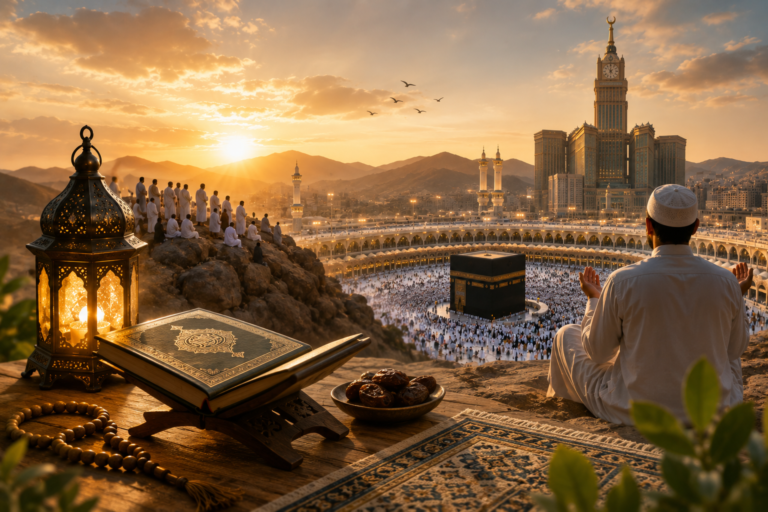
Some moments in the Islamic year deserve our full attention — not out of obligation, but out of genuine desire to draw closer to Allah. The first 10 days of Dhul Hijja are among the most extraordinary of those moments. They precede Eid al-Adha, they frame the Hajj pilgrimage, and they carry a remarkable promise: they are described as the days most beloved to Allah across the entire year.
Not the most solemn. Not the most sacred. The most beloved. That distinction is worth sitting with.
The spiritual weight of these ten days is not rooted in secondary tradition or scholarly opinion. It comes from an explicit hadith narrated by Ibn Abbas and recorded in Sahih al-Bukhari:
“There are no days during which righteous deeds are more beloved to Allah than these ten days.” The Companions asked: “Not even jihad in the path of Allah?” He replied: “Not even jihad in the path of Allah, except for a man who goes out with his life and his wealth and does not return with either.”
This is a striking text. The Prophet ﷺ places good deeds performed during these ten days above every other form of worship — including the highest form of sacrifice. It is a direct invitation not to let this season pass without awareness and intentional effort.
The Quran itself makes reference to these days in Surah Al-Fajr:
“By the dawn. And by the ten nights.” (Al-Fajr, 89:1-2)
The vast majority of Quranic commentators, including Ibn Kathir, agree that these “ten nights” refer specifically to the first ten days of Dhul Hijja.
What makes these ten days singular is that they bring together within themselves all the major pillars of Islam. Ibn Hajar al-Asqalani, in his commentary on Sahih al-Bukhari (Fath al-Bari), explains this with remarkable clarity:
These are the only days of the entire year during which prayer, fasting, charity, and Hajj can all be performed simultaneously. No other period allows for this convergence. That is precisely what gives them an unmatched spiritual weight.
For the pilgrim in Makkah, these days mark the fulfillment of Hajj. For the Muslim who has remained at home, they are an opportunity to multiply acts of worship in a spirit of solidarity with the entire ummah.
At the heart of these ten days lies the 9th of Dhul Hijja — the Day of Arafat. For pilgrims, it is the central moment of Hajj itself, the one without which the pilgrimage is not valid. For Muslims who are not performing Hajj that year, it is the foremost day for fasting.
The Prophet ﷺ said about fasting on this day:
“I count on Allah that fasting on the Day of Arafat will expiate the sins of the previous year and the coming year.” (Muslim)
Two years of sins expiated for a single day of fasting. This is an immense mercy — and it is available to every Muslim, wherever in the world they may be.
These days are also deeply connected to Ibrahim ﷺ — his journey to Makkah, his willing sacrifice, his absolute submission to Allah’s command. Each year, pilgrims retrace his footsteps. And each year, even those who stay home are invited to renew that same internal commitment: to trust Allah beyond what reason can fully grasp.
Once we understand the value of these days, the natural next question is: how do we actually make the most of them, in the context of an ordinary life?
The takbirat — Allahu Akbar, Allahu Akbar, la ilaha illa Allah, Allahu Akbar, Allahu Akbar wa lillahi al-hamd — are to be recited abundantly throughout these days, including in public spaces, markets, and streets. This is explicitly mentioned in the Prophetic texts. Returning to dhikr throughout the day — on the commute, between tasks, before sleep — is one of the most accessible ways to inhabit these days with full awareness.
It is recommended to fast the first nine days of Dhul Hijja — or as many as possible — the tenth being Eid al-Adha itself, on which fasting is forbidden. The fast of the 9th (Arafat) is especially emphasized, but fasting the other days remains a praiseworthy Sunnah.
Reviving the nights of this period through prayer, Quran recitation, and supplication is strongly encouraged. These days lead up to Eid — they call for inner preparation just as much as outward preparation.
Giving in charity, offering help, reaching out to someone you have neglected, repairing a relationship — all these actions, performed with spiritual awareness, take on a particular depth during these ten days.
For those who intend to sacrifice an animal at Eid, it is recommended not to cut hair or nails from the 1st of Dhul Hijja until the sacrifice has been carried out. This is a symbolic way of aligning oneself with the state of the pilgrim.
This question comes up often, and it deserves a nuanced answer. Ibn Hajar and other scholars have explained clearly that the days of Dhul Hijja are considered superior to the days of Ramadan in terms of the value of deeds performed — but that the nights of Ramadan (particularly Laylat al-Qadr) surpass the nights of Dhul Hijja.
In other words, these two seasons are complementary, and their preciousness is of a different nature. Ramadan is the month of night, of revelation, of forgiveness. Dhul Hijja is the month of day, of movement, of sacrifice, and of converging acts of worship.
Both deserve our total engagement. What is clear is that many Muslims know Ramadan well and under-invest in Dhul Hijja — even though the texts place both at the very summit of the Islamic year.
These days are also a wonderful opportunity for spiritual education within the family. Talking to children about Hajj, about the pilgrims who are at this very moment performing the rites in Makkah, about the meaning of Ibrahim’s sacrifice — all of this builds a living, embodied Islamic consciousness.
It is also an ideal moment to begin or renew the learning of Quran or Arabic. Understanding what you recite in your duas, being able to read Surah Al-Fajr in the original text, following the Friday khutba with comprehension — these skills transform the practice of Islam from the inside out.
To accompany your children in this learning with a structured method and qualified teachers, discover the Quran courses for children at Al-Dirassa: online classes designed for young learners, taught by patient and dedicated native-speaking teachers.
And if you yourself want to deepen your understanding of Quranic Arabic — to fully inhabit these ten days and the prayers that punctuate them — the Arabic courses for adults at Al-Dirassa are built to fit into a busy life, with concrete results from the very first weeks.
The first 10 days of Dhul Hijja are one of those opportunities that Islam places on our path with breathtaking generosity. Allah multiplies the value of our deeds, He opens the doors of forgiveness, He welcomes repentance, He answers supplications — and all of this, for ten days accessible to every Muslim on earth, whether they are in Makkah or in a quiet apartment elsewhere in the world.
Knowing their value is the first step. The second is deciding, right now, not to let them drift by in distraction. A dhikr during the commute. A fast on the Day of Arafat. A surah recited with a present heart. A charity given with intention. These small acts, carried by awareness of their season, are worth infinitely more than we might think.
May Allah grant us the ability to live these days fully, to find forgiveness within them, and to draw closer to Him through them. Ameen.
No, fasting during these days is not obligatory — it is strongly recommended (Sunnah). The only day on which fasting is actually forbidden is the 10th of Dhul Hijja, which is Eid al-Adha. The fast of the 9th (the Day of Arafat) is the most emphasized in Prophetic texts, carrying the promise of expiation of sins for two consecutive years. Fasting the other days remains a rewarding act, but each person adjusts according to their capacity and circumstances.
Scholars make a precise distinction: the days of Dhul Hijja are considered superior to the days of Ramadan in terms of the reward attached to good deeds, while the nights of Ramadan — especially Laylat al-Qadr — surpass the nights of Dhul Hijja. Both seasons are therefore precious, but in complementary ways. Ibn Hajar al-Asqalani developed this analysis in his commentary on Sahih al-Bukhari. Practically, this means that Dhul Hijja should not be neglected on the assumption that Ramadan already “covered it.” Both deserve our full engagement.
For the person who intends to perform an animal sacrifice (udhiya / qurbani) at Eid al-Adha, it is recommended to refrain from cutting hair and nails from the 1st of Dhul Hijja until the sacrifice has been completed. This is a Sunnah, not an obligation, and it applies only to the person who is sacrificing — not necessarily to other family members. For those who are not offering a sacrifice, there is no restriction in this regard.
Don’t want to go through the translation anymore?
30 free minutes with your qualified Egyptian teacher.
Al-dirassa Institute offers you a gift to help you begin your journey to being fluent in Arabic and learning the Quran.
Al-dirassa Institute offers you a gift to help you begin your journey to being fluent in Arabic and learning the Quran.