
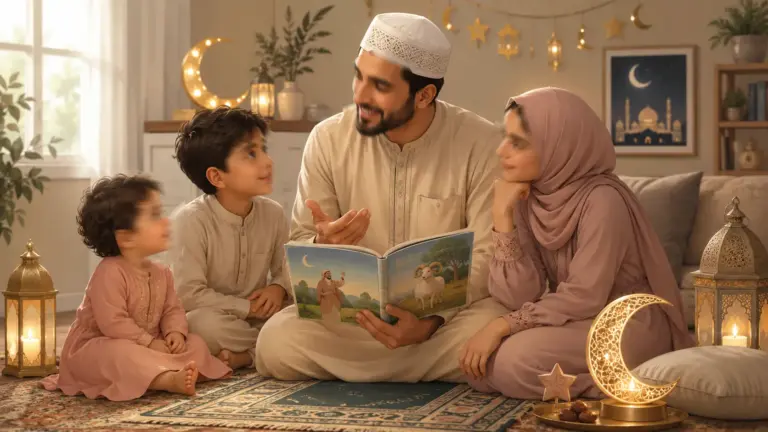
Every year, the same question comes up in Muslim households — usually a few days before the celebration: how do you explain Eid al-Adha to your child in a way that is honest, age-appropriate, and spiritually meaningful? It’s a question that deserves far more than a rushed answer, because it sits at the intersection of religious education, child development, and the living transmission of faith.
Eid al-Adha — also known as Eid al-Kébir, the Greater Eid, or the Feast of Sacrifice — is one of Islam’s two major celebrations. It commemorates the story of Ibrahim ﷺ, his absolute trust in Allah, and the divine mercy that replaced the sacrifice with a ram at the very last moment. It is a rich, powerful narrative — one that, when transmitted with care and clarity, can become a genuine spiritual anchor in a child’s life.
Here is how to approach this conversation based on your child’s age, with the right words, adapted frameworks, and a pedagogy rooted in kindness.
We tend to underestimate children’s capacity to receive spiritual narratives. Children are naturally open to the symbolic, the invisible, the profound. The great stories of the prophets — Ibrahim, Ismail, Maryam, Musa — do not frighten them; they fascinate them, as long as these stories are told with warmth and clarity.
Explaining Eid al-Adha to your child is not about delivering a theology lesson. It is about offering them a founding story — a true story that speaks of courage, love, and trust in Allah. It also gives them the keys to understand why the adults around them pray, gather, and experience this day differently from all others.
Beyond intellectual understanding, this is a transmission of the heart. Children who grow up knowing the meaning behind Islamic celebrations develop a relationship with their religion that is grounded, alive, and far more resilient when adolescence arrives.
Explaining Eid al-Adha to a Child Aged 2 to 5
At this stage, children operate primarily through the concrete, the emotional, and repetition. Abstract concepts like sacrifice or submission are beyond their reach — but they perceive emotions with remarkable precision: joy, celebration, the presence of beloved people around them.
It is unnecessary — and counterproductive — to discuss the sacrifice of the animal in any detail. That is not where the message lives for a toddler, and doing so risks creating a fear or aversion that will color their relationship with the celebration for years.
For children aged 2 to 5, the conversation centers on celebration, family, and Allah:
The story of Ibrahim can be told like a bedtime story — simply, in a child’s language. The emphasis should be on the love between Ibrahim and Allah, and on the joy Allah feels when His servants trust Him.
Illustrated books about the prophets, read together before sleep, are wonderful tools at this age.
From around age six, children enter a phase of active questioning. They ask “why” in chains, they seek the logic behind things, and they begin to compare what they experience at home with what their classmates do. It is often at this age that children ask the inevitable question: “But why do we slaughter an animal?”
It is a legitimate question, and it deserves an honest, reassuring answer.
At this age, you can tell the story of Ibrahim ﷺ in more detail, highlighting the emotions and the moral lessons it carries:
On the question of the animal sacrifice, you can explain simply:
“We offer an animal to Allah as a way of thanking Him for everything He gives us. We keep some of the meat, and we give a large share to people who are hungry. It’s a way of being generous, just like Ibrahim was.”
The emphasis on sharing and solidarity resonates immediately with children of this age, who have a strong, instinctive sense of fairness and generosity.
This is also a perfect time to teach them a few Arabic words connected to the celebration: Eid Mubarak, Allahu Akbar, Alhamdulillah. This reinforces their sense of belonging and nurtures a healthy pride in their faith.
The pre-teen is capable of abstract reasoning, nuance, and deeper empathy. They can grasp concepts like tested faith, the meaning of sacrifice, and the relationship between an act and the intention behind it. They may also begin to feel a degree of self-consciousness around non-Muslim classmates — especially when the topic of animal sacrifice comes up at school.
At this age, it is important to go to the heart of things — honestly and without condescension. You can explore with them:
This conversation can also be an invitation to open the Quran together, to read the passage about Ibrahim, and to have a real discussion about what trusting Allah means in their own daily life.
Regardless of age, certain approaches do more harm than good:
Eid al-Adha can become far more than an annual celebration. It is a doorway into learning Arabic, discovering the Quran, and building a Muslim identity that is solid, serene, and truly their own.
Many parents realize around this time that their children are asking questions they themselves struggle to answer in Arabic or in Quranic terms. That is completely natural — and it is a beautiful invitation to learn together.
If you would like to give your child a structured, supportive framework for learning Arabic and Quran — with qualified teachers and a method designed for young learners — explore the Quran courses for children at Al-Dirassa. Classes take place online with patient, native-speaking teachers, at a pace designed to fit around family life.
And if you, as a parent, want to better understand what you are transmitting — to read the Quran with comprehension, to know the meaning of the duas you recite — the Arabic courses for adults at Al-Dirassa will help you accompany your children with far greater confidence and depth.
Explaining Eid al-Adha to your child is about so much more than a sheep and a prayer. It is about offering them a founding narrative in which they can recognize themselves — values they can embody: trust, generosity, gratitude — and a connection to Allah that begins to take root in childhood.
Every age has its own words, its own images, its own entry points. The essential thing is not to wait until your child is “old enough” to understand. Children understand far more than we give them credit for — as long as we take the time to speak to them with love and sincerity.
May this celebration be, for your family, a moment of transmission, joy, and closeness. Taqabbal Allahu minna wa minkum. May Allah accept from us and from you.
There is no universal age, because every child differs in sensitivity and emotional maturity. Generally speaking, pediatricians and educators recommend waiting until the child is capable of understanding the meaning behind the act — typically around age 8 to 10 — and crucially, only after having talked to them about it clearly beforehand. A child who is prepared and accompanied will experience it very differently from a child who encounters it unexpectedly. Parental presence and conversation before and after are essential.
Fear is a normal and healthy response. Never minimize it or dismiss it. Start by acknowledging their emotion: “It’s natural that this moves you — it shows you have a big heart.” Then explain the meaning: this is not violence, it is an act of gratitude to Allah, carried out with respect for the animal. Clarify that Islam has strict rules in place so the animal does not suffer. Above all, bring the conversation back to generosity: the meat is shared with those in need. This perspective of giving often helps sensitive children find a positive meaning in what initially felt shocking.
This is an excellent question, and it deserves concrete preparation. Help your child build a simple, confident, and clear answer: “We celebrate Eid — it’s one of Islam’s two major holidays. We remember the story of Ibrahim, a prophet who had incredible faith in God. We pray together as a family, share a meal, and give food to people in need.” This equips them to respond without being caught off guard, without downplaying who they are, and without over-explaining. A child who knows and understands their celebration is proud of it — and that pride comes through in how they speak.
Don’t want to go through the translation anymore?
30 free minutes with your qualified Egyptian teacher.
Al-dirassa Institute offers you a gift to help you begin your journey to being fluent in Arabic and learning the Quran.
Al-dirassa Institute offers you a gift to help you begin your journey to being fluent in Arabic and learning the Quran.