
Introduction
In the previous lessons on Quranic elongations, we learned that madd letters are recited differently when followed by the Arabic letter Hamza (ء), a sukun, or a shadda.
In this new Tajweed lesson, we will discover other cases in which an elongation of two counts or more must be applied.
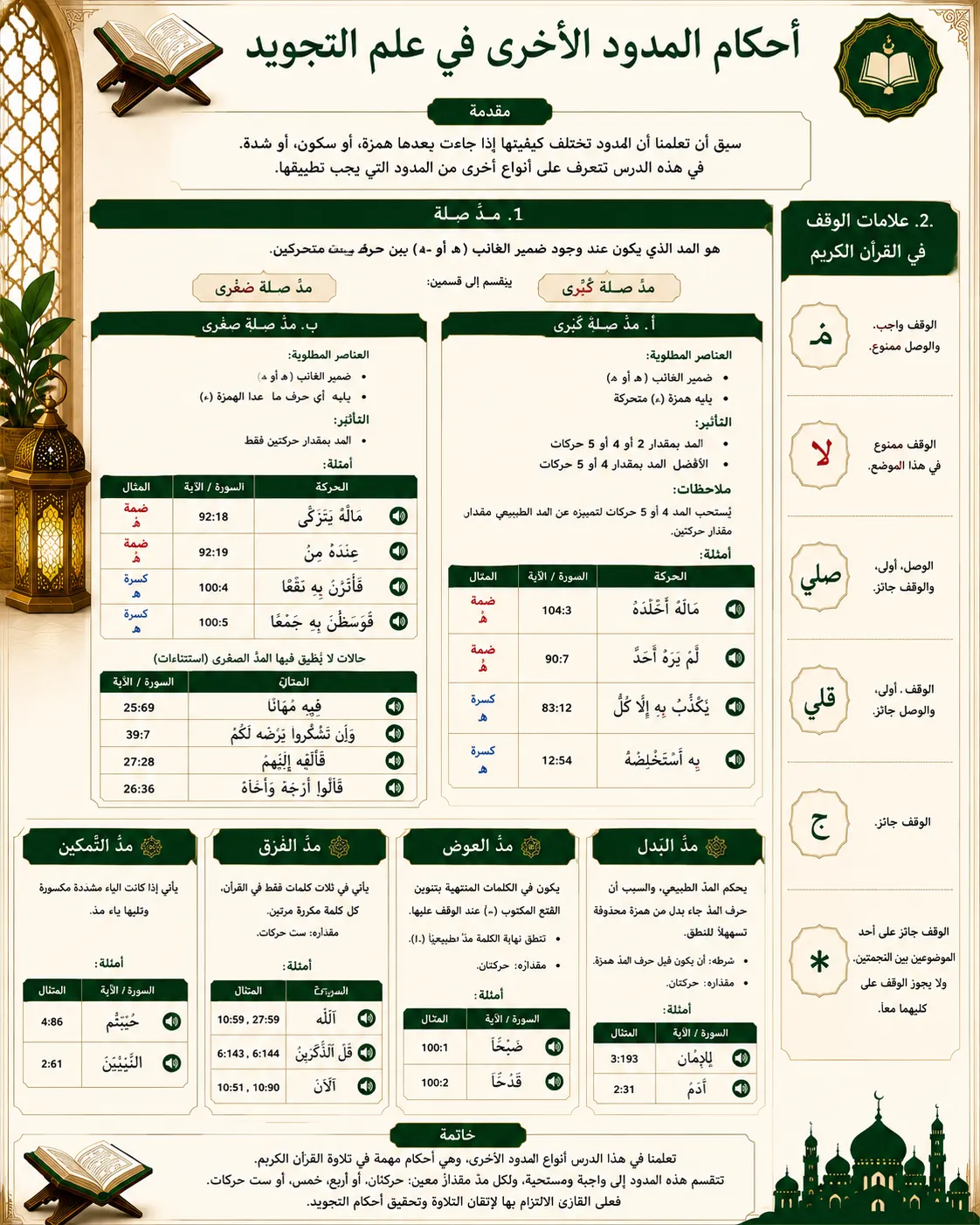
1. The Connecting Elongation — مَدُّ صِلَةٍ
This occurs when the third-person masculine singular pronoun (ه or ـه) appears between two vowelled letters.
This elongation is divided into two categories:
- The major form — كُبْرَى
- The minor form — صُغْرَى
A. The Major Connecting Elongation — مَدٌّ صِلَةٌ كُبْرَى
Required elements:
- The presence of the possessive pronoun ه
- Followed by a vowelled Hamza (ء)
Effect:
- Elongation of 2, 4 or 5 counts
- It is preferable to elongate for 4 or 5 counts
Additional notes:
It is recommended to elongate for 4 or 5 counts in order to distinguish this rule from a natural elongation of 2 counts.
Examples:
| Vowel | Surah / Verse | Excerpt |
|---|---|---|
| Damma هُ |
104:3 | مَالَهُ أَخْلَدَهُ |
| Damma هُ |
90:7 | لَّمْ يَرَهُ أَحَدٌ |
| Kasra هِ |
83:12 | يُكَذِّبُ بِهِ إِلَّا كُلُّ |
| Kasra هِ |
12:54 | بِهِ أَسْتَخْلِصْهُ |
B. The Minor Connecting Elongation — مَدٌّ صِلَةٌ صُغْرَى
Required elements:
- The possessive pronoun ه
- Followed by any letter except Hamza (ء)
Effect:
- Elongation of 2 counts only
Examples:
| Vowel | Surah / Verse | Excerpt |
|---|---|---|
| Damma هُ |
92:18 | مَالَهُ يَتَزَكَّىٰ |
| Damma هُ |
92:19 | عِندَهُ مِن |
| Kasra هِ |
100:4 | فَأَثَرْنَ بِهِ نَقْعًا |
| Kasra هِ |
100:5 | فَوَسَطْنَ بِهِ جَمْعًا |
Exceptions:
This rule does not apply in the following four cases:
| Surah | Verse Excerpt |
|---|---|
| 25:69 | فِيهِ مُهَانًا |
| 39:7 | وَإِن تَشْكُرُوا يَرْضَهُ لَكُمْ |
| 27:28 | فَأَلْقِهْ إِلَيْهِمْ |
| 26:36 | قَالُوا أَرْجِهْ وَأَخَاهُ |
2. The Substitution Elongation — مَدُّ البَدَلِ
This follows the principles of natural elongation, but the elongation letter replaces a removed Hamza in order to make pronunciation easier.
- It occurs when the preceding letter is a Hamza.
- Duration: 2 counts
| Surah | Excerpt |
|---|---|
| 3:193 | لِلْإِيمَانِ |
| 2:31 | آدَمَ |
3. The Compensation Elongation — المدُّ العِوَض
This applies to words ending with a double fatha (ـً) written as اً. It occurs when the reader stops on this ending.
- The reader pronounces the end of the word as a natural elongation ـَا
- Duration: 2 counts
| Surah | Excerpt |
|---|---|
| 100:1 | ضَبْحًا |
| 100:2 | قَدْحًا |
4. The Differentiation Elongation — مَدُّ الفَرْقِ
This appears only in three words in the Quran, each of them occurring twice. It lasts for 6 counts.
| Surah | Excerpt |
|---|---|
| 10:59, 27:59 | آللَّهُ |
| 6:143, 6:144 | قُلْ آلذَّكَرَيْنِ |
| 10:51, 10:90 | آلْآنَ |
5. The Stabilization Elongation — مَدُّ التَّمْكِينِ
This occurs when the letter ي carries a shadda and a kasra and is followed by a Ya of elongation.
| Surah | Excerpt |
|---|---|
| 4:86 | حُيِّيتُم |
| 2:61 | النَّبِيِّينَ |
Conclusion
We have completed this Tajweed lesson on the different rules of elongation. They are divided into two types: obligatory and optional. Each type must be respected according to its measure of 2, 4, 5 or 6 counts, in accordance with the rules studied.
Insha’Allah, the next lesson will cover the rules for stopping during the recitation of the Holy Quran.
Réservez votre essai gratuit de 30 minutes
Formulaire d'inscription



Aucun commentaire
Aucun commentaire pour le moment.