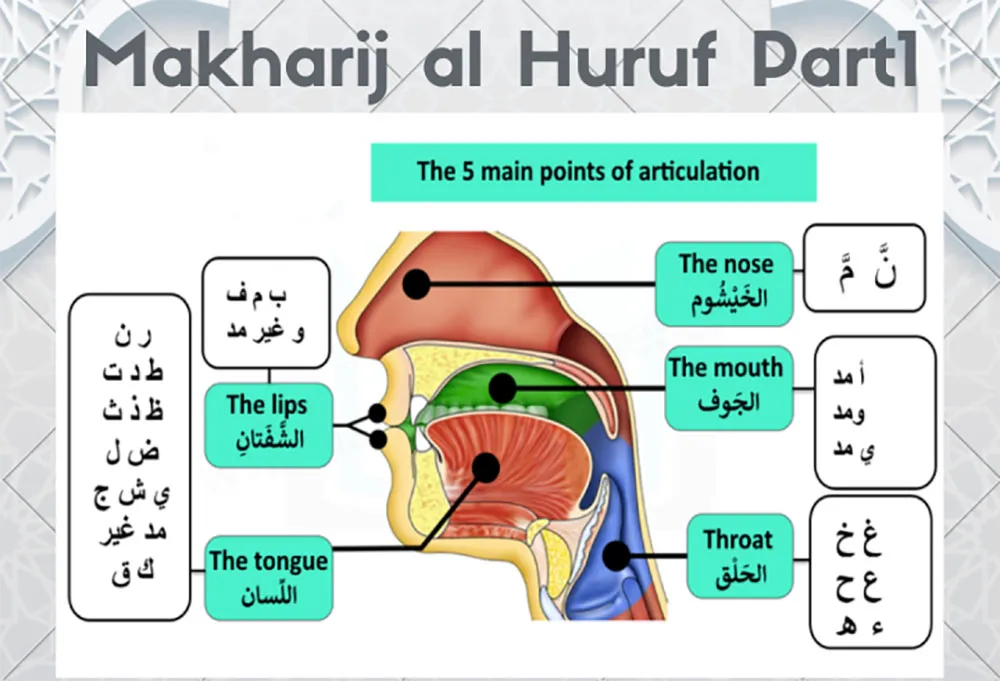
The points of articulation (makharij) are defined as the specific locations within the vocal tract—such as the mouth, throat, and nasal passage—where the airflow is modified to produce distinct speech sounds. Each Arabic letter has its distinct makhraj, Identifying the exact Makhraj is important for proper tajweed and pronunciation of the Quranic recitation (Maqamat).There are 17 distinct places of articulation, or makharij, from which letters are produced. These articulation points include areas such as the tip of the tongue, the throat, the lips, and the nasal cavity. A thorough understanding of this Maharaj is crucial for the accurate pronunciation of letters.Therefore, you should rely on a specialist to save your time and effort.
Al-Dirassa Institute offers specialized courses focused on the points of articulation (makharij), providing in-depth training to enhance your understanding of Arabic phonetics. These courses cover the exact locations and methods for articulating each letter, ensuring you achieve accurate pronunciation and mastery of Tajweed principles for flawless Qur'anic recitation.
What are the 5 main Makharij?
The Makharij groups categorize the points of articulation for Arabic letters into five main categories: tongue, lips, nasal cavity, oral cavity, and throat:
1. The Tongue (Al-Lisan):
The tongue is the primary articulator for most Arabic letters. It has ten specific points of articulation: The tip of the tongue near the upper teeth, produces the letter “ن” (noon).
The tip of the tongue with some back pressure, near the upper teeth, produces the letter “ر” (raa).
The tip of the tongue with contact from the roots of the upper incisors, produces the letters “ت” (taa), “د” (daal), and “ط” (taa).
The tip of the tongue with slight elevation above the lower incisors, creating a small gap between the tongue and the teeth, producing the letters “س” (seen), “ز” (zaa), and “ص” (saad).
The tip of the tongue with contact from the edges of the upper incisors, produces the letters “ث” (thaa), “ذ” (dhaal), and “ظ” (dhaa).
2. The Lips (Ash-Shafaataan):
The lips have two specific points of articulation: The inner surface of the lower lip with the edges of the upper incisors, produces the letter “ف” (faa).
The space between the lips with closure, produces the letters “ب” (baa), “م” (meem), and non-medial “و” (waaw).
3. The Nasal Cavity (Al-Khayshoom):
The nasal cavity between the top of the nose and the throat serves as the point of articulation for the letters “م” (meem) and “ن” (noon). The emission of “Ghunna” is inherent to these letters and varies in intensity based on the context of the letter.
4. The Oral Cavity (Al-Jawf):
Al Jawf, literally meaning “the oral cavity” in Arabic, refers to the entire space from the chest cavity up through the throat and mouth. This chamber acts as the origin for long vowels, also known as the “mad letters” (alif, waw, ya). Unlike most consonants and short vowels that have a defined endpoint in the mouth or throat, long vowels are produced by elongating the sound for two counts before stopping. There are three main madd letters: (Ya) “ى”: This long “ee” sound is created with open vocal cords and the middle of the tongue raised close to the position it would be in for a regular “ya” pronunciation.
(Waw) “و”: To produce the long “oo” sound, the vocal cords are open again, but this time the lips are rounded in a shape that mimics saying a regular “wow” sound.
5. The Throat (Al-Halaq):
The space between the throat and the tongue, starting from the chest and ending at the mouth, has three points of articulation: The farthest point in the throat, where the letters “ء” (hamzah) and “هاء” (haa) are produced.
The middle of the throat, closer to the tongue, is where the letters “ع” (ayn) and “ح” (haa) are produced.
The lowest part of the throat, close to the tongue and near the uvula, where the letters “غ” (ghayn) and “خ” (khaa) are produced.
How to Learn Makharij al-Huruf?
Learn from a Qualified Teacher:It is highly beneficial to learn from a qualified teacher who is experienced in Tajweed (the art of reciting the Qur'an with proper pronunciation). A teacher can provide personalized feedback and correct any mistakes in pronunciation. Online Courses: There are several online courses available that teach Makharij al Huruf. These courses can be a convenient way to learn at your own pace. Engage in Repetitive Practice: Consistent practice is key to mastering the pronunciation of Arabic letters. Focus on each letter individually, practicing its articulation repeatedly until it becomes natural. Listen to Expert Reciters: Listening to proficient Qur'anic reciters can help you understand the correct pronunciation of each letter. Pay close attention to how they articulate each sound and try to mimic their pronunciation.
Join Study Groups: Joining a study group or community of learners can provide additional support and motivation. Group members can practice together, share resources, and provide feedback to each other. In closing, a deep understanding of the points of articulation is essential for achieving accurate and effective pronunciation. So, enrolling in online courses is essential for gaining flexible, accessible, and effective learning opportunities that can significantly enhance your skills and knowledge from the comfort of your own home. Al-Dirassa Institute offers a premier program dedicated to the points of articulation (makharij), providing you with expert training and tailored resources to achieve precise Arabic pronunciation. To Know More about Tajweed Courses: Online Tajweed Courses
Essai offert
Réservez votre essai gratuit de 30 minutes






Aucun commentaire
Aucun commentaire pour le moment.