
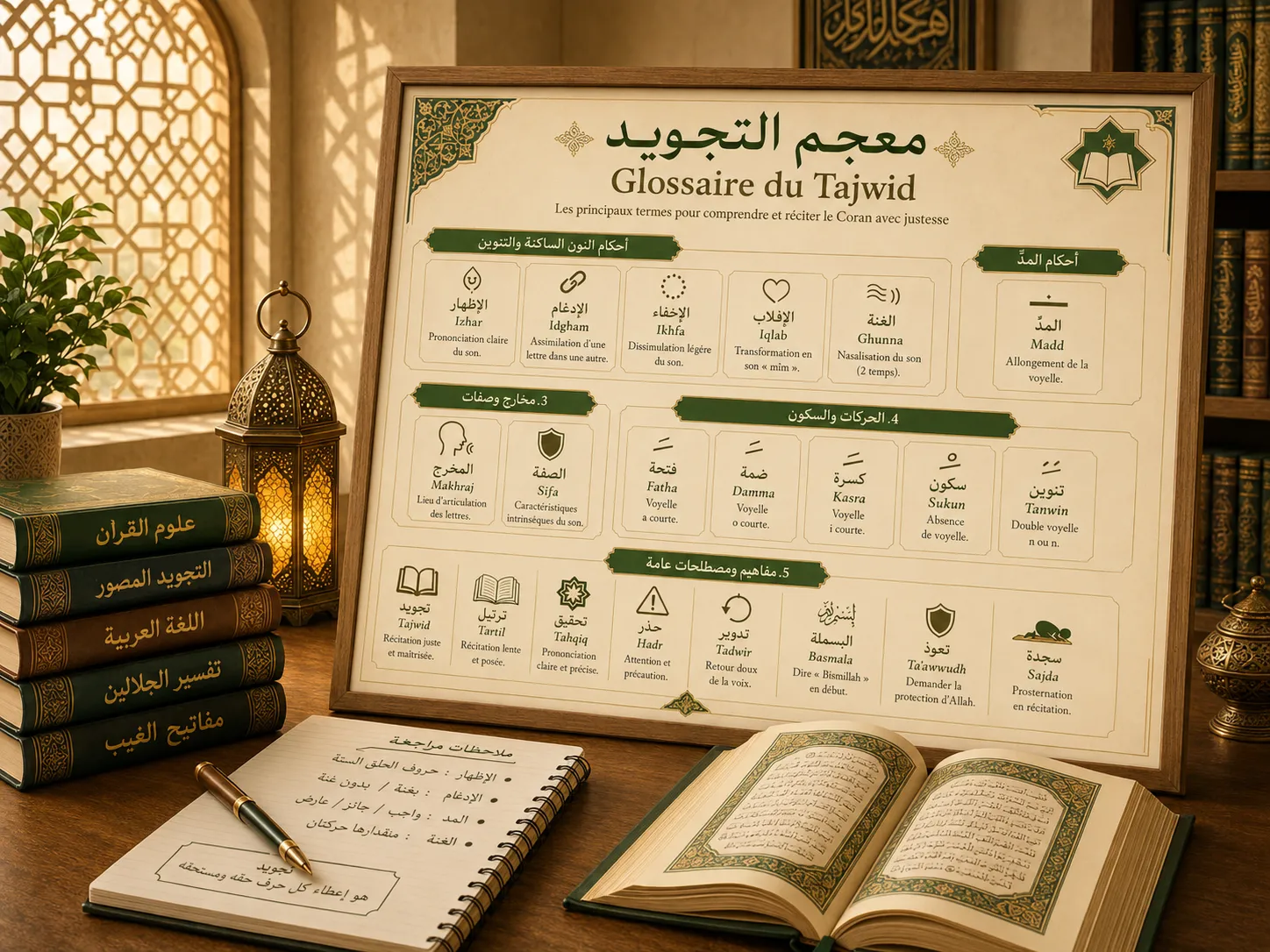
Tajweed Glossary: Key Terms and Definitions for Quranic Recitation
Introduction
We have now reached our final Tajweed lesson dedicated to learning the correct recitation of the Holy Quran.
Throughout approximately twenty Tajweed lessons, we have studied various rules and introduced precise Arabic vocabulary terms, each carefully explained in English.
Below you will find a glossary of most of the words used across these Tajweed rules. This will be a valuable reference whenever you encounter difficulty understanding a particular concept.
Glossary
Stop - وَقْفٌ: This refers to making a pause by cutting off one's breath at the end of a Quranic word.
Definite article - ال: Formed by adding the two prefix letters ال to a noun. It is the equivalent of the English definite article "the".
Assimilation - الإِدْغام: The merging of letters together during their pronunciation.
Basmala - البَسْمَلةُ: The formula meaning "In the name of Allah, the Most Gracious, the Most Merciful".
Characteristic - صِفَة: The manner in which an Arabic letter is articulated. It is these characteristics that produce a unique sound for each letter. (See: Tajweed lessons 6 and 7)
Substitution - الإِقْلاب: Corresponds to a change from the letter's original point of exit; the Noon Sakinah – نْ or the tanween is transformed into a Meem - م.
Shaddah - شَدَّة: The doubling of an Arabic letter, symbolized by the sign ـّ placed above the doubled letter.
Dammah - الضَمَّةُ: A short vowel in the Arabic language written above a consonant. It represents the short "u" sound and lasts one beat. It is symbolized as follows: ُ
Concealment - الإِخْفاء: The concealment of the sound of the Noon Sakinah – نْ, the tanween, or the letter Meem - م.
Fathah - الفَتْحَة: A short vowel in the Arabic language written above a consonant. It represents the short "a" sound and lasts one beat. It is symbolized as follows: ـَ
Hadr - حَدْرٌ: A fast and sustained recitation of the Holy Quran.
Supplication - دُعاء: The act of invoking Allah alone in order to worship Him and draw closer to Him.
Kasrah - كَسْرة: A short vowel in the Arabic language written below a consonant. It represents the short "i" sound and lasts one beat. It is symbolized as follows: ـِ
連ontinuation - وَصْلٌ: The opposite of a stop. It consists of joining two verses without interruption.
Nasalization - غُنَّة: The sound produced through the nose while the tongue is not used. Its duration is two beats. It is mainly present in the recitation of the Arabic letters Noon - ن and Meem - م.
Point of articulation - مَخْرَجٌ: The precise location from which the sound of an Arabic letter is produced.
Elongation - المَدُّ: The prolongation of a vowel sound.
Clear pronunciation - إَظْهار: The act of pronouncing an Arabic letter clearly, without nasalization.
Incorrect pronunciation - لَحْنٌ: The incorrect pronunciation of a letter.
Prostration - سَجْدَة: The act of prostrating oneself upon reciting certain verses of the Holy Quran.
Seeking refuge - تَعَوُّذٌ: The formula recited before important acts and before reading the Quran, by which one seeks Allah's protection.
Sukoon - سُكون: The absence of a vowel on an Arabic letter.
Tadweer - تَدْوير: An intermediate recitation pace between At-Tahqiq and Al-Hadr.
Tahqiq - تَحْقيق: A slow and precise recitation of the Holy Quran.
Tajweed - تَجْويد: Literally meaning "to improve" or "to make better". It refers to the correct pronunciation of the letters and words of the Quran.
Tanween - تَنْوين: The doubling of the final vowel of a word.
Tarteel - تَرْتيل: A measured and rhythmic recitation of the Holy Quran.
Vowel - حَرَكَة: There are three vowels in Arabic. They can be either short or long.
Réservez votre essai gratuit de 30 minutes
Formulaire d'inscription



Aucun commentaire
Aucun commentaire pour le moment.