
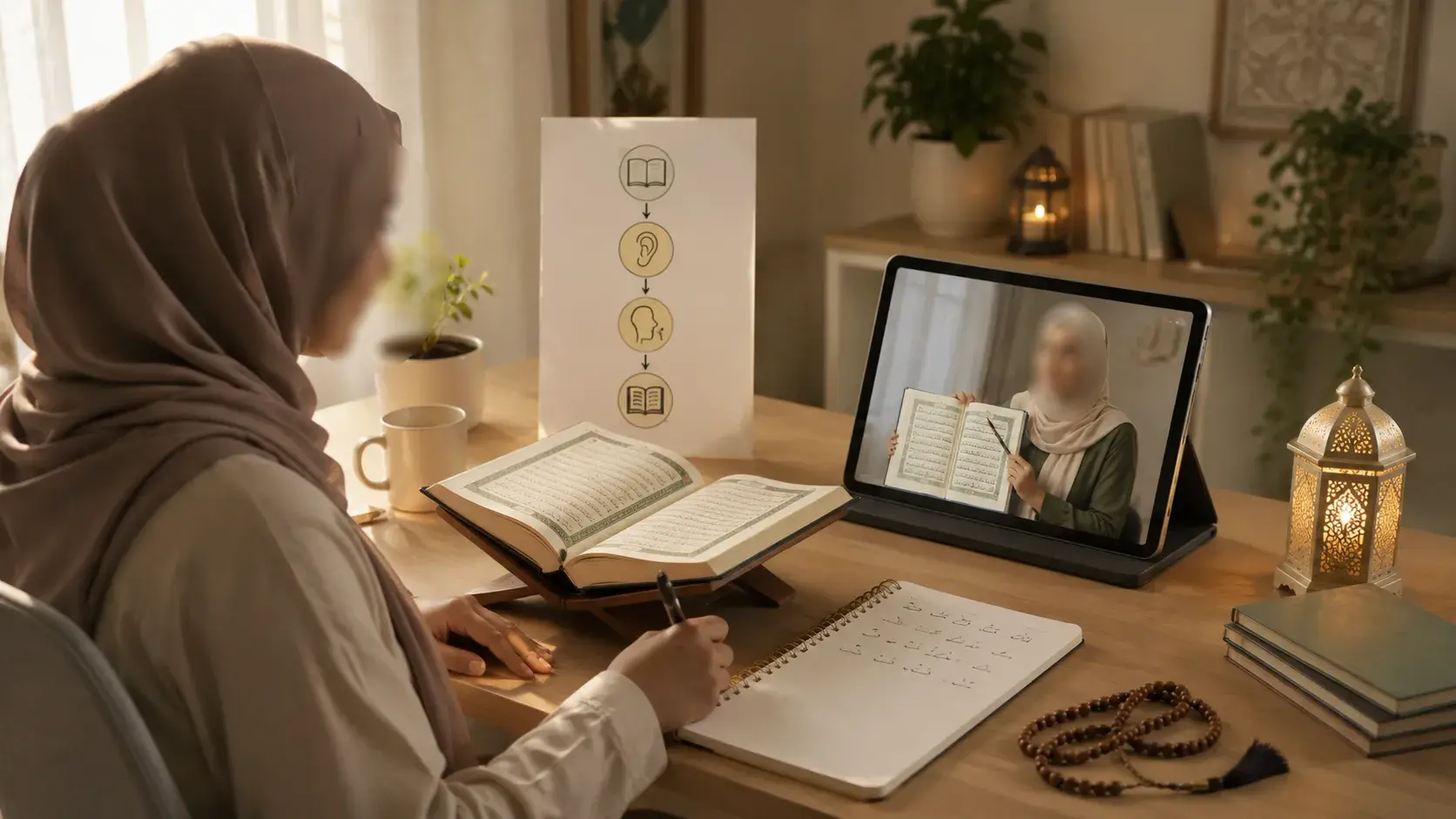
One of the most common questions among Muslim converts and non-Arabic-speaking Muslims worldwide is: how do you learn to read the Quran without knowing Arabic? Is it truly accessible, or does it require years of dedicated language study? The encouraging answer is that reading the Quran — meaning reciting its Arabic letters aloud — does not require you to understand Arabic. It is a skill in its own right, and one that can be acquired far more quickly than most people expect.
Reading the Quran and Understanding Arabic: Two Different Things
Many learners confuse two distinct skills. Understanding Arabic means grasping vocabulary, grammar, and the nuances of the language. Reading the Quran means recognizing the Arabic alphabet and pronouncing it correctly according to the rules of Quranic recitation.
Millions of Muslims around the world — in Indonesia, Turkey, Senegal, Iran, and beyond — recite the Quran daily without being native Arabic speakers. They have learned to decode the letters, respect the vowel markings, and follow the rules of Tajweed, all without mastering the Arabic language as a whole.
This distinction is fundamental. It completely changes how you approach the learning process. You are not learning a language — you are learning an alphabet and a method of reading.
Where to Start When You Don't Know a Single Word of Arabic
Step 1: Learn the Arabic Alphabet
The Arabic alphabet has 28 letters. Each letter can take up to four different forms depending on its position in a word. This sounds more daunting than it is: with a structured method and consistent practice, most adults memorize the core letters within a few weeks.
At this stage, the focus is on visual recognition and correct pronunciation. A good teacher or well-designed platform will guide you letter by letter, without overwhelming you with theory.
Step 2: Learn the Vowel Markings
The Quran is a fully vocalized text. Unlike standard written Arabic, every vowel is indicated by small markings placed above or below the letters. This is actually an advantage for learners — there is no ambiguity in how to read the text.
These markings are called harakat (short vowels), and the essential ones include the fatha (a), kasra (i), damma (u), sukun (no vowel), and shadda (doubled consonant). Mastering these is what enables you to actually "read" the Quran in the literal sense.
Step 3: Begin the Rules of Tajweed
Tajweed refers to the rules governing the correct recitation of the Quran — how certain letters are pronounced, how sounds are elongated, how particular syllables are nasalized. A beginner does not need to master all of these rules at once. They are integrated gradually through practice and repetition.
The Prophet ﷺ said: "The one who is skilled in the Quran will be with the noble and righteous scribes, and the one who recites it while finding it difficult will have a double reward." (Muslim). This hadith is a profound source of encouragement for every beginner, however imperfect their recitation may be at the start.
Online Quran Learning: A Pedagogical Revolution
Twenty years ago, learning to read the Quran without Arabic meant finding a teacher at your local mosque, attending at fixed times, and navigating a teaching style not always suited to adult learners. Today, that has changed entirely.
Online Quran courses allow you to progress from home, at your own pace, guided by trained and patient teachers. This is especially suited to busy adults, converts who lack an established religious network, and parents who wish to learn alongside their children.
At Al-Dirassa, we offer a structured learning program from beginner to advanced, led by qualified native Arabic-speaking teachers. Whether you are starting from absolute zero or looking to strengthen shaky foundations, there is a pathway designed for you.
Réservez votre essai gratuit de 30 minutes
Formulaire d'inscription
How Long Does It Take to Learn to Read the Quran?
This question comes up constantly, and the honest answer is: it depends. It depends on your consistency, the quality of your guidance, and how much time you can dedicate each day.
In practice, here is what motivated adult learners typically experience:
- 6 to 8 weeks to master the Arabic alphabet and basic vowel markings
- 3 to 6 months to read a fully vocalized Quranic text with confidence
- 1 to 2 years to integrate the key Tajweed rules and recite with genuine fluency
These timelines can be shortened significantly with individualized instruction and regular sessions. Consistency matters more than intensity: 20 minutes every day is more effective than one hour on weekends.
Common Mistakes When Learning on Your Own
Relying on Transliteration
Transliteration — writing Arabic words in Latin script, such as "Bismillah ir-Rahman ir-Rahim" — may seem like a useful shortcut, but it creates pronunciation habits that are very difficult to unlearn. It is not a substitute for learning the Arabic letters themselves.
Attempting to Learn Without a Teacher
The Quran is an oral transmission before it is a written text. The rules of Tajweed cannot be self-taught from a book alone — they must be heard, corrected, and refined through listening to a qualified reciter. A teacher, even online, is essential to avoid cementing mispronunciations early on.
Rushing the Process
Early enthusiasm sometimes leads learners to skip ahead before they have solidified the basics. It is far better to consolidate each skill before moving forward. The language of the Quran deserves a respectful, methodical approach.
What if I Also Want to Understand What I'm Reading?
Learning to read the Quran is a beautiful first step. But many learners naturally want to go further and understand what they are reciting. This is the realm of Quranic Arabic study — an entirely different journey that gives you direct access to the meaning of the text, without relying on a translation.
If you want to explore that path, our online Arabic course is designed specifically for non-Arabic speakers who want to understand the language of the Quran step by step. And for those looking to deepen their recitation, our Tajweed courses are taught by ijaza-certified instructors.
Conclusion: Learning to Read the Quran Without Arabic Is Within Everyone's Reach
If you have been carrying the desire to learn to read the Quran without knowing Arabic for years, know that it is never too late. The alphabet, the vowel markings, the first surahs — all of this is learnable, step by step, with the right method and the right support. It is not a matter of talent or intellectual ability. It is a matter of intention and consistency.
Allah says in the Quran: "And We have certainly made the Quran easy for remembrance, so is there any who will remember?" (Surah Al-Qamar, 54:17). That ease begins with the very first step — and you can take that step today.
FAQ — Frequently Asked Questions
Can I learn to read the Quran if I have never studied Arabic at all?
Yes, absolutely. Reading the Quran does not require understanding Arabic. You simply need to learn the Arabic alphabet, the vowel markings specific to the Quranic script (harakat), and the basics of Tajweed. Millions of non-Arabic-speaking Muslims around the world recite the Quran daily. With the right method and a patient teacher, an English-speaking adult can begin reading the first surahs within a matter of weeks.
How long does it take to learn to read the Quran from scratch?
On average, a motivated adult learner can master the alphabet and Quranic vowels in 6 to 8 weeks and read a fully vocalized Quranic text with confidence within 3 to 6 months. Progress depends primarily on the regularity of practice and the quality of instruction. One-on-one lessons with a native teacher significantly accelerate results compared to self-study.
Is it okay to use transliteration (Latin script) to read the Quran?
Transliteration can help you memorize a few short phrases in a pinch, but it is not sufficient for correct Quranic recitation. It often leads to mispronunciations that are difficult to correct later. The right approach is to learn the Arabic letters directly — it is more reliable, more effective in the long run, and the only way to properly honor the rules of Quranic recitation.




Aucun commentaire
Aucun commentaire pour le moment.