
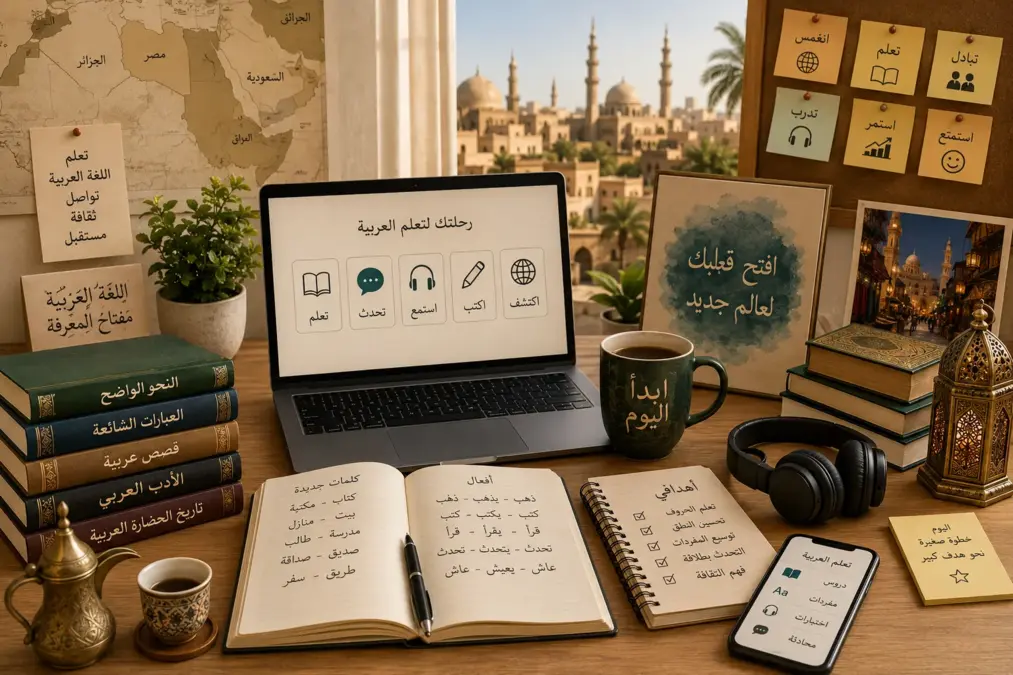
There is no single way to learn Arabic that works perfectly for everyone. Some students want to read the Quran, others want to speak with family, travel, understand Islamic texts or study Arabic for professional reasons. However, one principle applies in most cases: the best way to learn Arabic is to combine a clear method, regular practice and correction from a teacher.
Many beginners start with apps, videos or vocabulary lists. These tools can help you discover the language, but they are not always enough to make real progress. Arabic requires special attention to the Arabic alphabet, Arabic reading, Arabic pronunciation, Arabic grammar and the use of vocabulary in complete sentences.
In this article, you will discover a simple and progressive method to learn Arabic effectively, whether you are a beginner, an adult learner, a parent looking for Arabic classes for kids, or a student interested in Modern Standard Arabic or Quranic Arabic.
What is the best way to learn Arabic?
The best way to learn Arabic is not to memorize as many words as possible from the beginning. It is to build strong foundations, then use them regularly in reading, listening, speaking and writing.
An effective learning method is based on five essential elements:
- mastering the Arabic alphabet progressively;
- learning to read words and simple sentences;
- correcting Arabic pronunciation from the beginning;
- learning Arabic vocabulary in context;
- studying Arabic grammar step by step.
This progression helps students avoid bad habits. It also allows them to understand what they are learning instead of repeating sentences mechanically without knowing how they are built.
Step 1: Master the Arabic alphabet and reading
To learn Arabic, you should begin with the Arabic alphabet. Arabic letters change shape depending on their position in the word: isolated, initial, medial or final. Students also need to learn short vowels, long vowels and the basic signs used for correct reading.
This step may seem simple, but it is fundamental. If Arabic reading is not solid, students will later struggle with vocabulary, sentence comprehension and grammar.
A good reading method should include regular exercises: reading syllables, forming simple words, recognizing similar sounds and reading short sentences. For beginners, the priority is not speed, but accuracy.
Step 2: Work on Arabic pronunciation from the beginning
Arabic pronunciation is one of the most important parts of learning the language. Some Arabic letters do not exist in English, such as ع, ح, خ, ق or ص. If they are pronounced incorrectly from the beginning, these habits can be difficult to correct later.
This is why working with an Arabic teacher online is so useful. The teacher listens, corrects and shows the student how to use the tongue, throat or mouth to produce the sounds correctly. This correction is especially important for students who want to study Quranic Arabic or improve their Quran recitation.
Pronunciation should not be practiced only with isolated letters. It should also be practiced in words, sentences and short readings. This helps students develop more natural and fluent Arabic reading.
Step 3: Learn Arabic vocabulary in context
Arabic vocabulary should be learned gradually. Many students try to memorize long word lists, but quickly forget them because the words are not used in real sentences.
A more effective method is to learn vocabulary by topic: family, home, everyday objects, common verbs, numbers, days, places, emotions and simple actions. Each new word should then be used in a short sentence.
For example, learning the word “book” is useful, but learning how to say “I read a book,” “this book is easy” or “where is the book?” helps students actually use the language. This movement from isolated words to sentences is what creates real progress.
Step 4: Study Arabic grammar progressively
Arabic grammar can seem difficult at first, but it becomes much clearer when it is taught in the right order. Students do not need to begin with the most complex rules.
They should first understand the basics: nominal sentences, verbal sentences, masculine and feminine forms, singular and plural, pronouns, adjectives, common verbs and simple structures.
Grammar should always be connected to practice. A rule learned without examples is quickly forgotten. A rule used in sentences, exercises, readings and dialogues becomes much more useful.
For students who want to go deeper, Modern Standard Arabic offers a strong foundation for reading, writing and understanding more advanced texts.
Step 5: Practice regularly with an Arabic teacher
Consistency is one of the most important keys to learning Arabic. It is better to study several times a week in shorter sessions than to study intensely once and then stop for several days.
With a teacher, students receive personalized learning support. The teacher adapts the lessons to the student’s real level, corrects mistakes, explains difficulties and gives suitable exercises.
Online Arabic classes make this guidance available from home with a more flexible schedule. They are a practical solution for adults, children, families and students who want to learn Arabic online while keeping the structure of real lessons.
Learning alone, with an app or with a teacher: what is the difference?
Apps and videos can be useful for discovering Arabic, reviewing words or listening to the language. They have their place in the learning process, especially when they are used as complements.
However, they do not always correct pronunciation, answer personal questions or build a learning path adapted to the student’s level. Many learners move from one resource to another without knowing which step to follow next.
The limits of self-study
Self-study requires a lot of discipline. The risk is to memorize information without practicing it, pronounce certain letters incorrectly or become stuck when grammar becomes more complex.
Students may also spend too much time looking for resources instead of progressing through a clear program. This is one reason why many people start with motivation, then stop after a few weeks.
The role of private Arabic lessons
Private Arabic lessons help students move forward with more clarity. The teacher knows what the student already understands, what needs revision and what can be learned next.
This direct relationship is especially useful for correcting reading, improving pronunciation, explaining grammar and encouraging the student to speak. Learning becomes more active, precise and motivating.
Which method should you choose according to your goal?
The best method also depends on your objective. A complete beginner, a child, an adult who wants to read texts and a student who wants to understand the Quran do not have exactly the same needs.
Arabic for beginners
For Arabic beginners, the priority is to build strong foundations: alphabet, reading, sounds, basic vocabulary and first sentences. It is important not to move too fast, because early mistakes can slow down the entire learning process later.
A beginner program should be clear, reassuring and progressive. The goal is to give students confidence and show them that they can move forward step by step.
Modern Standard Arabic
Modern Standard Arabic is recommended for students who want to understand texts, read articles, access written resources or develop a solid grammar foundation.
It is also a good choice for learners who want to study a form of Arabic that is widely understood across the Arab world, especially in educational, religious, media and cultural contexts.
Quranic Arabic
Quranic Arabic is for students who want to better understand the vocabulary and structures of the Quran. This approach requires precision because the Quranic text has a unique linguistic richness.
For students who also want to improve their recitation, it is useful to combine this learning path with online Quran and Tajweed classes.
Arabic classes for kids
Children need a method adapted to their age. Arabic classes for kids should be progressive, interactive and encouraging. The goal is to develop a positive relationship with the language without overload or excessive pressure.
With a teacher, children can learn to read, repeat, understand and use simple sentences in a more engaging way than through worksheets or videos alone.
Learn Arabic with a teacher
Learning Arabic with a teacher helps students save time and avoid lasting mistakes. The teacher guides the learner, corrects pronunciation, explains rules and adapts the content to the student’s level.
At Al-Dirassa, lessons are designed to support different profiles: adults, children, beginners, students of Modern Standard Arabic, learners interested in Quranic Arabic and anyone who wants to learn Arabic online with personalized support.
Book your free trial of 30 minutes
Registration form
A free trial lesson allows you to discover the method, assess your level and understand which learning path best matches your goal. It is a good first step before starting a regular program with an Arabic teacher.
Conclusion
The best way to learn Arabic is based on a clear progression: Arabic alphabet, Arabic reading, Arabic pronunciation, Arabic vocabulary, Arabic grammar and regular practice. Free resources can help, but they give better results when they are part of a structured method.
To make long-term progress, students need consistency, suitable exercises and correction. An Arabic teacher can help learners avoid bad habits, better understand the rules and move forward with confidence.
This article helps you understand the method, but complete Arabic learning requires practice, patience and serious guidance. To go further, you can start with private Arabic lessons online adapted to your level.



No Comments
No comments yet.