Tajwid – تَجْوِيدٌ is a fundamental science of Qur’anic recitation. It is derived from the Arabic root ja-wa-da – جَوَدَ, which linguistically means “to improve,” “to perfect,” and “to beautify.” When applied to the Book of Allah, Tajwid refers to the set of rules that enable the Qur’an to be recited correctly, precisely, and in accordance with the prophetic transmission.
From a practical perspective, Tajwid consists of giving each letter of the Qur’an its full due by observing correct pronunciation, vowel movements (harakāt), points of articulation (makhārij), and the inherent characteristics of each letter (ṣifāt). This science ensures a clear, balanced, and accurate recitation that remains faithful to the Revelation.
The term Tartil – تَرْتِيلٌ is also used to describe the recitation of the Qur’an. It refers to a calm, deliberate, and measured reading. Allah explicitly mentions this in the Qur’an in Surah Al-Muzzammil (73), verse 4: “And recite the Qur’an slowly and clearly.” According to the scholar Ibn Kathir – may Allah have mercy on him – this verse emphasizes articulating the letters distinctly and with precision.
The free Tajwid courses offered on this website are based on the recitation of Hafs ‘an ‘Asim, transmitted through the Shatibiyyah path (حَفْص عَن عاصِم مِن طَرِيق الشَّاطِبِيَّة). This recitation is the most widely practiced in the Muslim world today. Other canonical Qur’anic recitations will be addressed, Allah willing, in dedicated courses.
Why were the rules of Tajwid established? When Islam spread beyond the Arabian Peninsula, many new Muslims were unfamiliar with the correct pronunciation of Arabic letters. As a result, mistakes began to appear in Qur’anic recitation, some of which could alter the meanings of the verses. Faced with this risk, scholars undertook the task of documenting the rules necessary to preserve the correct recitation of the Qur’an.
This effort gave rise to the science of Tajwid. Its rules were derived from the careful observation of Qur’an reciters who adhered strictly to the method taught by the Prophet ﷺ and transmitted it faithfully from generation to generation.
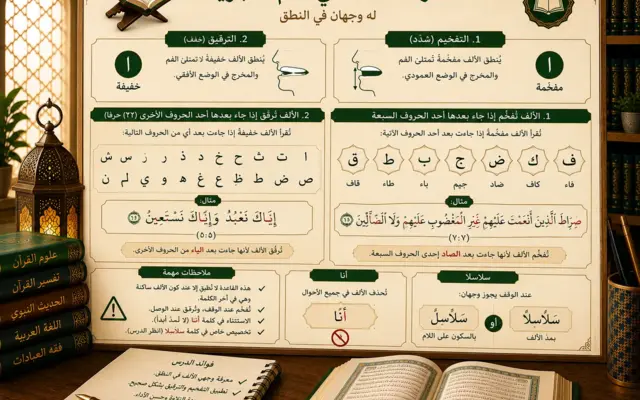
One of the most essential aspects of Tajwid is learning the correct placement of the vocal organs and the proper articulation of sounds. Incorrect pronunciation can alter the meaning of a word or even reverse it entirely. For example, in Arabic, kalb (كَلْب) means “dog,” while qalb (قَلْب) means “heart.” A minor articulation error can completely change the meaning.
For this reason, learning Tajwid is not limited to memorizing theoretical rules. It is a discipline that is acquired and refined through regular practice of Qur’anic recitation. Knowing how to read Arabic and knowing how to recite the Qur’an correctly are two distinct skills, each requiring its own method of learning.
When the rules of Tajwid are properly observed, the recitation becomes smooth, beautiful, and filled with tranquility. The reciter then draws closer to the authentic recitation of the Prophet ﷺ, as the Qur’an was revealed to him.
Neglecting Tajwid, on the other hand, can lead to incorrect recitation that distorts meanings. In some cases, this may unintentionally result in statements contrary to faith. Such mistakes are considered blameworthy and may deprive the reciter of reward, and Allah knows best.