Quranic Arabic is the language of the Quran. Learning it helps students better understand the verses, religious vocabulary, grammatical structures and depth of the revealed message. This category brings together free Quranic Arabic lessons and resources to help beginners and non-Arabic speakers progress step by step.
Unlike Arabic used for travel, conversation or work, Quranic Arabic requires a specific approach. The goal is not only to memorize words, but to understand the meaning of the verses, Quranic expressions and the linguistic foundations needed for a more conscious reading of the Book of Allah.
The resources offered here follow a clear, progressive and accessible method. They help students study Quranic vocabulary, essential Arabic grammar, sentence structure and common expressions found in the Quran.
These free lessons are designed for anyone who wants to learn Quranic Arabic in order to better understand the Quran, strengthen their connection with the revelation and progress with a method adapted to their level. To go further with structured guidance, you can also discover our Quranic Arabic online course.
30
Dec
Introduction
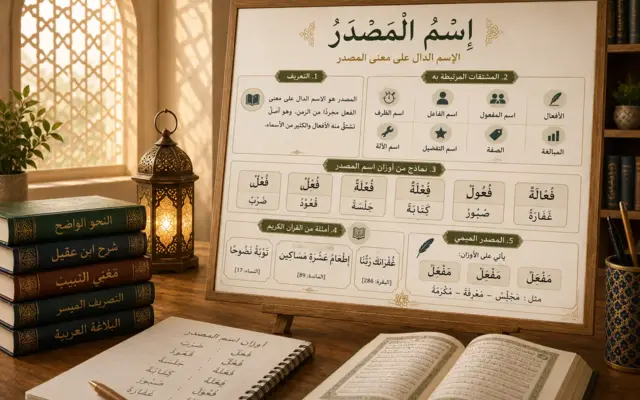
The foundational entity from which all nouns and verbs stem in Arabic is termed الْمَصْدَرُ. Functioning as a verbal noun, it can be prefixed with the article 'ال' or paired with tanween.…
Read more
30
Dec
Introduction
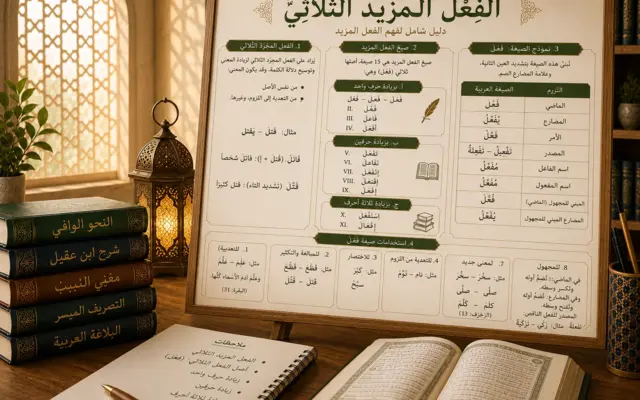
The verb that contains extra letters beyond its original triliteral root is called الْفِعْلُ الْمَزِيْدُ الثُلاثِي. These verbs originate from basic triliteral roots, enriching the Arabic…
Read more
30
Dec
Introduction
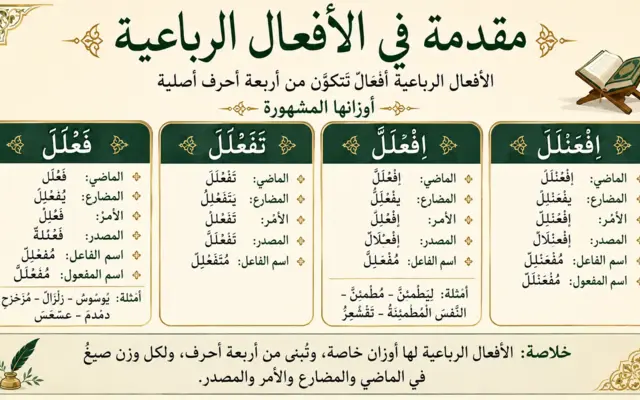
The four-lettered verbs in Arabic, distinct from the more common tri-literal form فَعَلَ, are uniquely constructed from a root of فَعْلَلَ. These verbs consist of four letters and follow …
Read more
30
Dec
Introduction
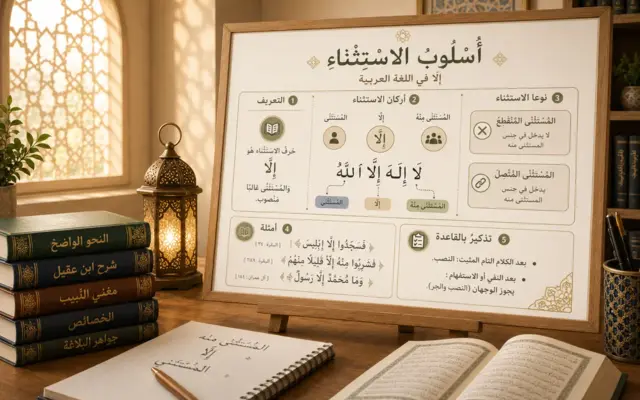
In Arabic, the particle 'إِلَّا' signifies an exception. The noun that succeeds 'إِلَّا' is commonly in the accusative case, known as الْمَنْصُوب.
Example:
لَا إِلَهَ إِلَّا اللَّهُ
Votre…
Read more
30
Dec
Introduction
Nouns Denoting Place and Time in Arabic: A Deeper Look
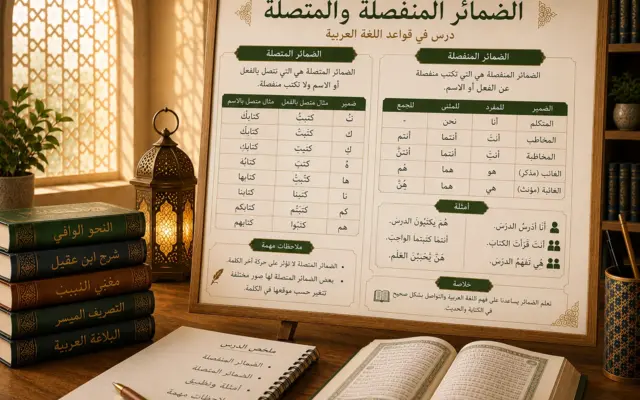
In Arabic grammar, nouns that express the place or time of an action rooted in a verb are a crucial component. These nouns are tradi…
Read more

30
Dec
Introduction
The noun of the instrument, known in Arabic as اِسْمُ الآلَةِ, specifically indicates the tool or means by which an action is executed. This noun often serves as an indicator of functiona…
Read more