
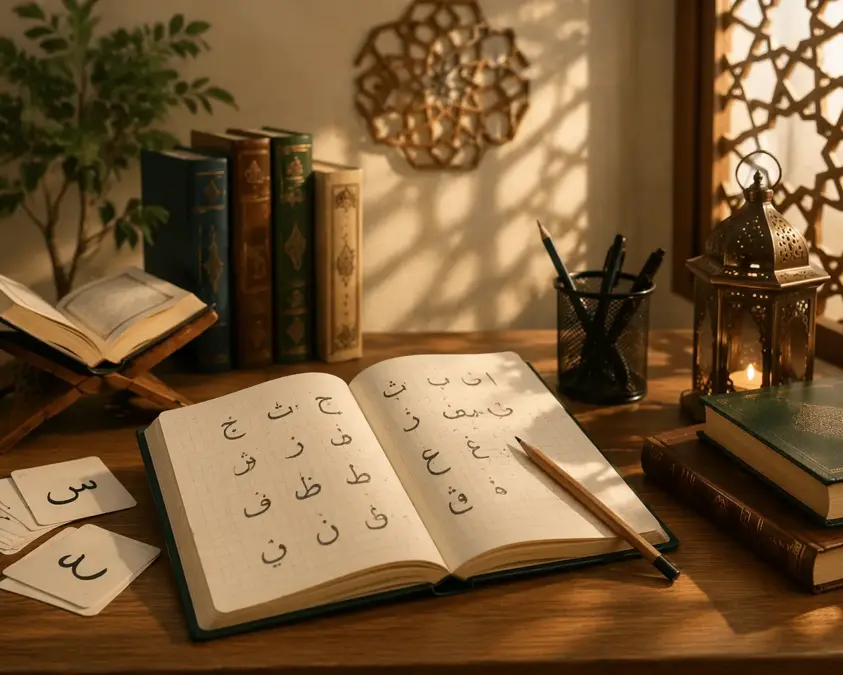
Can you learn Arabic on your own, without a teacher? Many beginners ask this question before they start. With apps, videos, free PDFs and online resources available everywhere, it can seem possible to learn almost any language independently.
The answer is nuanced. Yes, you can start learning Arabic on your own. You can discover the alphabet, memorize your first words and understand some basic rules. But if you want to progress correctly, especially in pronunciation, Quran reading and grammar, guidance from a teacher becomes very useful.
In this article, you will see what you can learn independently, where self-study reaches its limits, and when it becomes better to get proper guidance.
Can you really learn Arabic on your own?
Yes, it is possible to start on your own, especially at the very beginning. This first stage helps you discover the language, become familiar with Arabic script and understand the basic logic of the language.
A beginner can learn independently:
- the Arabic alphabet and its 28 letters;
- the different forms of letters depending on their position in a word;
- short vowels;
- how to read simple syllables;
- basic vocabulary;
- a few useful expressions.
This first step can be motivating. It helps you gain confidence and realize that Arabic is not impossible. But self-study also has limits, and it is better to know them from the beginning.
What you can learn independently
Studying alone can be useful for building the first foundations. You can use simple resources such as beginner books, alphabet videos, reading exercises, flashcards or pronunciation audio.
Self-study is especially helpful for:
- reviewing regularly;
- memorizing letters;
- copying Arabic words by hand;
- listening to sounds and recitations;
- learning frequent vocabulary;
- repeating exercises after a lesson.
The problem is not self-study itself. The problem appears when self-study becomes your only method, without correction, without a clear progression and without any real evaluation of your level.
The limits of self-study
Even with strong motivation, learning Arabic alone becomes difficult after a certain point. Arabic requires careful attention to pronunciation, reading, vowels and sentence structure.
Without a teacher, it is difficult to know whether you are reading correctly, pronouncing the letters properly or understanding a rule in the right way.
Many learners get stuck not because they lack motivation, but because they repeat the same mistakes without noticing them.
The problem of pronunciation
Pronunciation is one of the biggest limits of learning Arabic alone. Some Arabic letters do not exist in English, such as ع, خ, ح, غ and ق.
When you watch a video, you can hear the sound. But that does not always mean you are producing it correctly.
In Arabic, mispronouncing one letter can change the meaning of a word. The longer a mistake is repeated, the harder it becomes to correct.
This is why human feedback is very useful from the early stages, especially if your goal is to read the Quran correctly.
Can you learn to read the Quran on your own?
You can learn some reading basics on your own: recognizing letters, understanding vowels and reading simple syllables. But to read the Quran correctly, self-study is usually not enough.
Quran reading requires precise pronunciation, correct articulation of letters and attention to the rules of recitation. Without correction, it is difficult to notice your own mistakes.
A teacher can listen to your reading, correct your sounds, point out repeated mistakes and help you move forward with more confidence.
If your goal is religious, guidance is strongly recommended, not to make learning harder, but to help you avoid bad habits from the beginning.
The risk of using the wrong method
When you learn alone, it is easy to jump from one resource to another: an app, a video, a PDF, then another method. This can make you feel busy, but it often slows real progress.
Arabic needs a logical progression:
- alphabet;
- sounds;
- vowels;
- reading;
- vocabulary;
- simple sentences;
- basic grammar;
- gradual comprehension.
Without a clear framework, you may start with material that is too difficult, skip important steps or mix Modern Standard Arabic, Quranic Arabic and dialects too early.
How to organize self-study
If you want to begin on your own, keep the method simple. Do not try to learn everything at the same time.
Here is a realistic way to start:
- Weeks 1 to 4: alphabet, letter shapes and first sounds.
- Weeks 5 to 8: short vowels, syllables and simple words.
- Month 3: short sentences and frequent vocabulary.
- After that: reading correction, basic grammar and comprehension.
Study a little, but regularly. Fifteen to thirty minutes a day is often more effective than one long isolated session.
What resources can help?
Resources can help, as long as you use them as support and not as your only method.
You can use:
- a simple beginner textbook;
- videos to discover the alphabet;
- audio to listen to Arabic sounds;
- flashcards for vocabulary;
- writing exercises;
- fully vocalized texts for beginners;
- reliable Quran recitations to train your ear.
The most important thing is not to multiply resources. Choose one main method, then use other tools only to review or complete what you are learning.
When should you get a teacher?
A teacher becomes useful as soon as you want to go beyond discovery. Guidance is especially recommended when you begin reading, working on pronunciation or studying Arabic for the Quran.
It may be time to get guidance if:
- you are not sure whether you pronounce letters correctly;
- you keep reviewing the same lessons without progress;
- you are mixing several methods;
- you are losing consistency;
- you want to read the Quran correctly;
- you need a clear program.
If you feel that you are making some progress alone but need correction, online Arabic courses with a teacher can help you structure your learning and fix mistakes early.
Book your free trial of 30 minutes
Registration form
Learning alone or with a teacher: what is the difference?
Learning alone gives you freedom. You choose your rhythm, your resources and your study time. This is useful for discovering the language and reviewing between lessons.
But a teacher brings what resources alone cannot provide: personalized correction, adapted progression, answers to your questions and regular follow-up.
The best approach is often to combine both:
- personal study between lessons;
- independent revision;
- regular exercises;
- correction with a teacher;
- structured progression.
This combination allows you to keep the benefits of self-study while avoiding the most common blocks.
How Al-Dirassa supports students who started alone
Al-Dirassa supports students who want to learn Arabic online with a clear and progressive method. Lessons can be adapted to complete beginners as well as learners who have already started on their own.
Depending on your level, the teacher can review the foundations, correct your reading, work on pronunciation or build a program adapted to your goal: Quranic Arabic, reading, grammar, vocabulary or comprehension.
The aim is to help you move forward with method, while keeping the benefit of the personal work you have already done.
Conclusion
Learning Arabic on your own is possible for discovering the basics. You can start with the alphabet, vowels, a few words and simple exercises.
But to make lasting progress, correct your pronunciation and avoid bad habits, guidance from a teacher quickly becomes useful.
The most effective path is not to choose between self-study and a teacher. It is to combine both: study regularly on your own, while benefiting from correction and a clear framework.
Book your free trial of 30 minutes
Registration form
FAQ — Learning Arabic on Your Own
Can you learn Arabic without a teacher?
Yes, you can start without a teacher, especially with the alphabet, vowels and a few words. But to progress correctly, a teacher is recommended.
Are apps enough to learn Arabic?
Apps can help with revision and vocabulary. They are not always enough for pronunciation, Quran reading and structured progress.
How long can you learn Arabic on your own?
You can study alone during the first weeks to discover the basics. Once you begin reading or working on pronunciation, correction becomes useful.
Can you learn Arabic alone to read the Quran?
You can start the basics alone, but to read the Quran correctly, a teacher is strongly recommended to correct pronunciation and reading mistakes.
Can you correct your pronunciation by yourself?
It is difficult, because you do not always hear your own mistakes. Audio can help, but a teacher remains the best way to correct pronunciation precisely.
What is the best way to make progress quickly?
The best way is to combine regular personal practice with a teacher who can correct your mistakes and structure your progression.
Is learning Arabic alone slower?
Often, yes, especially if learning lacks structure or correction. With a good framework, personal study remains very useful.
When should you get guidance?
It is recommended to get guidance as soon as you begin reading, pronunciation or Quran study. This helps you avoid bad habits.



No Comments
No comments yet.