

Free Resources to Learn Arabic: Videos, PDFs, Apps and Exercises
Today, there are many free resources to learn Arabic online: videos, PDFs, apps, alphabet lessons, reading exercises, audio materials and Quranic Arabic content. For a beginner, they can be an excellent starting point.
But not all free resources are equal. Some help you begin properly, while others give the impression of learning without offering real progression. The most important thing is to know what to choose, how to use each resource and when to move toward a more structured learning path.
In this guide, you will discover how to compare free resources to learn Arabic, which materials to use according to your goal and what limits to keep in mind if you want to progress effectively.
Why compare free resources to learn Arabic?
Free resources are very useful for discovering Arabic without pressure. They help you test your motivation, become familiar with the Arabic alphabet, hear the first sounds and read your first words.
However, beginners can quickly become scattered if they move from a video to an app, then to a PDF, then to another method without a clear order. This is one of the most common difficulties in free learning: there is a lot of content, but not always a real progression.
To start with a broader structure, you can visit our page dedicated to the free online Arabic course. This article mainly helps you compare the different types of free resources.
Can you really learn Arabic for free online?
Yes, it is possible to start for free. Online resources allow you to discover the alphabet, sounds, first vowels, basic vocabulary and a few simple rules.
A beginner can learn for free:
- the letters of the Arabic alphabet;
- letter forms according to their position;
- short vowels;
- reading simple syllables;
- a few frequent words;
- the basics of pronunciation;
- introductory notions of Quranic Arabic or Tajweed.
These resources are useful for testing motivation and building first foundations. But they do not always replace guided lessons, especially when you need to correct pronunciation or progress regularly.
Comparison table of free Arabic learning resources
| Resource | Main use | Advantage | Limit |
|---|---|---|---|
| Free videos | Discovering letters, sounds and first rules | Easy visual and audio support | No personalized correction |
| PDFs and free books | Reviewing alphabet, reading, writing and exercises | Structured, printable and practical offline | No audio or direct correction |
| Apps | Memorizing vocabulary and keeping a routine | Useful for reviewing a few minutes a day | Sometimes mechanical or incomplete progression |
| Audio resources | Listening to sounds and improving pronunciation | Very useful for listening and repetition | Does not check your own pronunciation |
| Reading exercises | Reading syllables, words and simple sentences | Helps automate reading | Can become difficult without explanation |
| Free introductory courses | Discovering a method before committing | More structured than isolated resources | Often limited in duration and follow-up |
Free videos to learn Arabic
Videos are often the first contact with Arabic. They allow learners to see letters, hear sounds and follow a visual explanation.
They are useful for:
- discovering the Arabic alphabet;
- listening to letter pronunciation;
- understanding first rules;
- seeing reading examples;
- reviewing at your own pace.
Their limit is simple: a video does not correct your own pronunciation. You can hear the right sound without knowing whether you are reproducing it correctly.
Videos are therefore useful for discovery, but they should ideally be completed with reading exercises and, if possible, teacher correction.
PDFs and free Arabic books
Free PDFs can be very useful for organizing your learning. They allow you to review letters, copy words, read exercises and keep a written trace of your lessons.
They are especially practical for:
- learning letter forms;
- practising writing;
- reading syllables and simple words;
- reviewing vowels;
- following a progression away from the screen.
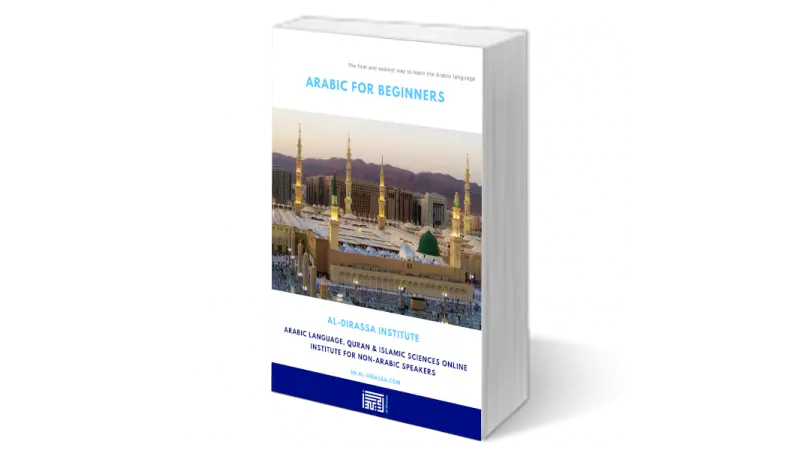
You can also use our free Arabic books for beginners to review the basics, practise reading and strengthen vocabulary.
But a PDF alone remains limited. It does not let you hear pronunciation or check whether your reading is correct. Ideally, it should be used with audio materials or guided lessons.
Apps to learn Arabic
Apps can help you review regularly. They are practical for memorizing vocabulary, revising letters or keeping daily contact with the language.
They are useful for:
- reviewing a few minutes per day;
- memorizing words;
- working with flashcards;
- testing your knowledge;
- keeping a light routine.
But apps are not always enough to learn Arabic correctly. They can encourage mechanical repetition without real understanding, especially if they are not connected to a structured method.
Audio and pronunciation resources
Audio resources are very useful for training the ear to Arabic sounds. They allow learners to listen to letters, syllables, words and sometimes simple sentences.
They are especially important for sounds that do not exist in English, such as certain emphatic or throat letters. Listening regularly helps distinguish sounds before trying to reproduce them.
However, audio is not always enough. You may repeat a sound thinking it is correct while an error becomes fixed. This is why human correction remains important, especially for Quran reading or Quranic Arabic.
Arabic reading exercises
Reading exercises are essential for moving from letter recognition to real reading. A good exercise should progress step by step: isolated letters, syllables, short words, simple sentences, then adapted texts.
If you are a beginner, start with the Arabic alphabet, then work on vowelized reading. Vowelized texts with short vowels are more suitable at the beginning.
Without progression, reading can become discouraging. It is therefore important not to move too quickly to long or unvowelized texts.
Free Quranic Arabic resources
Many students want to learn Arabic to better understand the Quran, supplications or religious texts. Free resources can help you discover frequent Quranic vocabulary and simple structures.
They can be useful for:
- recognizing frequent Quranic words;
- understanding recurring expressions;
- connecting reading, vocabulary and meaning;
- understanding the difference between recitation and comprehension.
To go further, it is better to follow a Quranic Arabic course. If your goal is mainly recitation, you can also explore our online Quran and Tajweed lessons.
How to choose a free resource according to your goal
The best free resource depends on what you want to learn. Before choosing, ask yourself whether your main goal is reading, pronunciation, vocabulary, Quranic Arabic or general discovery.
| Goal | Recommended free resource |
|---|---|
| Discovering the alphabet | Video + PDF worksheet + letter exercises |
| Reading first words | Vowelized reading exercises + audio |
| Improving pronunciation | Audio + repetition + correction if possible |
| Memorizing vocabulary | App + flashcards + simple sentences |
| Discovering Quranic Arabic | Frequent Quranic vocabulary + guided reading |
| Helping a child | Visual materials, games, songs and short activities |
For children, free resources can be useful as a complement, but they should remain simple and motivating. If you are looking for a regular framework, explore our Arabic classes for kids.
What a good free resource should contain
A good free resource should not only provide content. It should also offer a clear progression.
Before following a free resource, check whether it includes:
- a logical lesson order;
- simple explanations;
- concrete examples;
- audio to hear the sounds;
- reading exercises;
- regular revision;
- a precise goal: alphabet, reading, vocabulary, Tajweed or grammar.
If a resource begins directly with complex rules or word lists without method, it may make you lose time.
The limits of free resources
Free resources are useful for starting, but they have limits. It is important to know them so you do not become discouraged or believe you are progressing while some mistakes are becoming fixed.
The most common limits are:
- no personalized correction;
- unverified pronunciation;
- sometimes incomplete progression;
- lack of follow-up;
- risk of jumping from one resource to another;
- difficulty knowing what to learn next;
- little adaptation to the learner’s real level.
Free resources are therefore very useful for discovery and revision. But to progress sustainably, you often need a clearer framework.
When should you move to lessons with a teacher?
It is recommended to move to lessons with a teacher as soon as you start reading aloud, working on pronunciation or wanting to progress beyond the basics.
A teacher becomes especially useful if:
- you do not know whether you pronounce correctly;
- you confuse certain letters;
- you stagnate despite free resources;
- you lack regularity;
- you want to learn Quranic Arabic;
- you want to read the Quran with greater precision;
- you need a clear program.
After testing free resources, you can move to online Arabic courses with a teacher to correct pronunciation and follow a more structured progression.
Learning Arabic and Islam with a clear method
For some students, the goal is not only linguistic. They also want to better understand the Quran, supplications, religious texts or certain aspects of Muslim practice.
In this case, free resources can be a first step, but a more structured path quickly becomes necessary. You can complete your learning with online Islamic studies courses, Quranic Arabic lessons or Tajweed lessons according to your goal.
Conclusion
Free resources to learn Arabic are an excellent way to begin. Videos, PDFs, apps, audio materials and exercises can help you discover the alphabet, sounds, reading and first words.
But to choose the right resources, you need to look at their structure, progression, audio support, exercise quality and adaptation to your goal.
The most effective path is often to start for free, then move to guided learning when you need correction, regularity and a program adapted to your level.
Book your free trial of 30 minutes
Registration form
FAQ — Free resources to learn Arabic
Can you learn Arabic for free online?
Yes, you can start for free with videos, PDFs, apps, audio materials and introductory courses. These resources are useful for discovering the alphabet, sounds and first foundations.
What is the best free resource for beginners?
For a complete beginner, the best choice is often a combination: alphabet videos, PDF reading exercises and pronunciation audio.
Are apps enough to learn Arabic?
Apps can help with revision, but they are not always enough to correct pronunciation, understand grammar and follow a complete progression.
Can you learn Quranic Arabic for free?
You can discover the basics of Quranic Arabic for free, especially frequent vocabulary and reading. To progress correctly, a teacher is recommended.
When should you move to Arabic lessons with a teacher?
As soon as you begin reading aloud, working on pronunciation or wanting to progress beyond the basics. A teacher helps correct mistakes and structure learning.





No Comments
No comments yet.
No comments yet.