
Hajj is one of the five pillars of Islam. It is obligatory once in a lifetime for every Muslim who has the physical, financial and practical ability to perform it. For a beginner, this pilgrimage can feel overwhelming: there are several sacred places, precise rituals and intense days of worship.
This guide presents the main steps of Hajj in a simple order, so that first-time pilgrims can better understand the general structure of the pilgrimage before travelling. It does not replace the guidance of a qualified scholar, a reliable Hajj guide or a trusted organization, but it gives a clear foundation for preparation.
Before studying the rituals in detail, it is also useful to learn the basics of Islam, including the pillars of Islam, prayer, purification, Islamic belief and the essential rules of Islamic practice.
Why preparing for Hajj matters
Hajj is not a simple journey. It is a major act of worship that requires sincerity, patience, discipline and knowledge. Proper preparation helps the pilgrim avoid many mistakes, understand the meaning of the rites and focus more on supplication, repentance and remembrance of Allah.
A pilgrim should learn at least the main steps, the restrictions of ihram, the key locations and the essential rituals. This preparation is part of a step-by-step learning process in Islam, just as a Muslim learns purification, prayer, Quran, Sunnah, Fiqh and the other foundations of the religion.
The main steps of Hajj
The details of Hajj may vary depending on the type of Hajj performed and on individual circumstances. The following steps provide a general overview of the main rituals.
1. Ihram and the intention for Hajj
الإحرام ihram is the sacred state a pilgrim enters with the intention of performing Hajj. For men, this usually involves wearing two white unstitched cloths. Women wear modest clothing that follows Islamic guidelines, without having a specific uniform like men.
Ihram reminds the pilgrim of humility, equality before Allah and detachment from social appearances. During this state, certain actions become prohibited, such as using perfume, cutting hair or nails, and marital relations.
2. Tawaf around the Kaaba
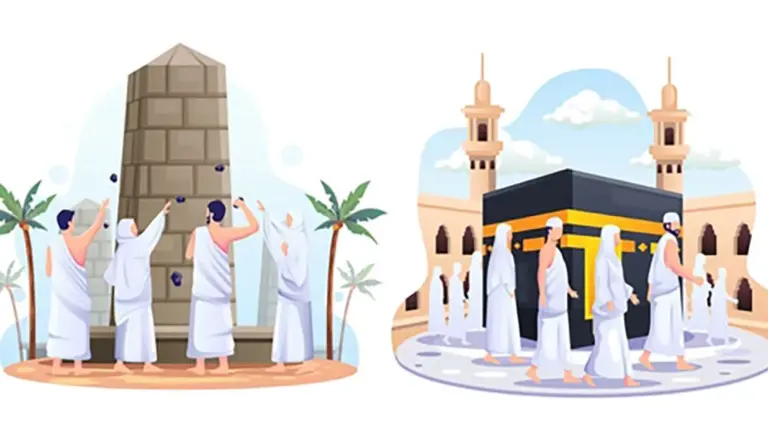
الطواف tawaf consists of walking seven times around the Kaaba. Muslims do not worship the Kaaba; they worship Allah alone. The Kaaba is the Sacred House toward which Muslims pray and around which specific rites have been prescribed.
Tawaf expresses the unity of believers, obedience to Allah and the deep connection between the Muslim and the sacred places of Islam.
3. Sa’i between Safa and Marwa
السعي sa’i consists of walking seven times between Safa and Marwa. This ritual recalls the story of Hajar, who searched for water for her son Isma’il until Allah caused the spring of Zamzam to appear.
Sa’i teaches effort, patience and trust in Allah. The believer acts, supplicates and places hope in the Lord.
4. The Day of Arafat
The Day of عرفة Arafat is one of the most important moments of Hajj. Pilgrims stand at Arafat, invoke Allah, seek forgiveness and increase their supplications.
This day reminds the believer of his complete need for the mercy of Allah. It is a day of humility, repentance and sincere return to the Lord.
5. Muzdalifah and Mina
After Arafat, pilgrims move to Muzdalifah, where they spend part of the night. They pray, rest and collect the pebbles that will be used for the symbolic stoning in Mina.
Then pilgrims go to Mina, where several important rites are performed during the days of Hajj.
6. The symbolic stoning of the pillars
The symbolic stoning, called رمي الجمرات, consists of throwing pebbles at the pillars in Mina. This ritual recalls the rejection of Shaytan and the believer’s determination to stay away from evil.
It is not about targeting a physical creature, but about performing a symbolic act of obedience to Allah and rejection of disobedience.
7. Sacrifice and gradually leaving ihram
The sacrifice recalls the story of Prophet Ibrahim and his son Isma’il, peace be upon them. It expresses obedience, gratitude and submission to Allah.
After certain rites, male pilgrims shave or shorten their hair. Women cut a small portion of their hair. This step marks a gradual exit from the state of ihram.
8. Tawaf al-Ifadah and the farewell tawaf
Tawaf al-Ifadah is one of the major rites of Hajj. It is performed after important stages of the pilgrimage. Before leaving Makkah, pilgrims usually perform the farewell tawaf, known as tawaf al-wada’.
This final tawaf marks the end of the stay in the sacred city and reminds the pilgrim of the spiritual value of this journey.
Simple timeline of the Hajj steps
| Step | Main place | Purpose |
|---|---|---|
| Ihram | Before entering Makkah according to the appointed stations | Enter the sacred state with the intention of Hajj |
| Tawaf | Kaaba | Walk around the Sacred House |
| Sa’i | Safa and Marwa | Remember the effort of Hajar and trust in Allah |
| Arafat | Plain of Arafat | Invoke Allah and seek forgiveness |
| Muzdalifah | Muzdalifah | Spend the night, pray and prepare for Mina |
| Mina | Mina | Perform the symbolic stoning and related rites |
| Sacrifice | Mina or through the appointed arrangement | Recall the obedience of Prophet Ibrahim |
| Farewell tawaf | Kaaba | Leave Makkah after a final tawaf |
Common mistakes to avoid during Hajj
- Travelling without learning the basic rites of Hajj.
- Confusing obligations, recommendations and cultural habits.
- Neglecting the rules of ihram, such as using perfume or cutting hair.
- Arguing, losing patience or disrespecting other pilgrims.
- Focusing only on logistics and forgetting supplication, repentance and sincerity.
- Making important religious decisions without asking a qualified person.
How to learn the rituals of Hajj before travelling
To prepare properly for Hajj, it is recommended to study the rites with a clear method. A pilgrim can read reliable guides, attend online Islamic classes, ask questions to an Islamic teacher online and review the basics of purification, prayer and the pillars of Islam.
At Al-Dirassa, the goal is to help students learn Islam online step by step, with a teacher, clear explanations and personalized learning. Our Islamic studies online can help adult beginners understand the basics of Islam, Islamic belief, Fiqh, prayer, purification and major acts of worship such as Hajj.
For families, children can also be introduced to the religion through an Islam course for children, adapted to their age and level of understanding.
Book your free trial of 30 minutes
Registration form
Frequently asked questions about Hajj
Who must perform Hajj?
Hajj is obligatory once in a lifetime for an adult Muslim of sound mind who has the physical, financial and practical ability to perform it.
How long does Hajj last?
The main rites of Hajj take place over several days during the month of Dhul-Hijjah. The total length of the journey depends on the travel organization, country of departure and chosen program.
Can Umrah replace Hajj?
No. Umrah is an important act of worship, but it does not replace the obligation of Hajj for the person who has the ability to perform it.
Do you need to learn Arabic to understand Hajj?
It is not obligatory to master Arabic in order to perform Hajj, but knowing key religious terms and understanding common supplications can help the pilgrim experience the journey more deeply. Studying Quranic Arabic can also help Muslims understand the Quran, Sunnah and texts related to worship.
Conclusion
Hajj is a major act of worship that requires spiritual, practical and educational preparation. Understanding the steps of the pilgrimage helps the Muslim perform the rites with more serenity and focus.
This article gives a useful overview for beginners, but complete learning about Hajj and other acts of worship requires method, consistency, reliable sources and guidance from a qualified teacher. To continue your progress, you can explore our resources to learn Islam or follow a structured online Islam course.



No Comments
No comments yet.
No comments yet.