
Starting Islamic studies online can help students understand Islam more clearly, organize their learning and progress with a structured method. For many beginners, the challenge is not only finding resources, but knowing where to start and in which order to study.
Islamic studies cover several fields, including Islamic belief, Fiqh, purification, prayer, Quran, Sunnah, Hadith, character and the foundations of daily Islamic practice. When these subjects are studied step by step, they help build a clearer and more balanced understanding of Islam.
In this article, we explain how to start Islamic studies online, which topics should be studied first, why learning with a teacher is helpful and how to organize your learning week by week.
Why Start Islamic Studies Online?
Learning Islam online allows students to study from home, with more flexible schedules and easier access to qualified teachers. This format is especially useful for adults, beginners, parents and students who want to restart their Islamic learning gradually.
Online Islamic classes can also help students who do not have an institute near them or who prefer personalized lessons with a teacher. The goal is not simply to collect information, but to understand the basics of Islam with clarity, regularity and method.
What Do Islamic Studies Include?
Islamic studies include several disciplines. Some are related to belief, others to worship, Quran, the Prophetic tradition and Muslim character. For beginners, it is important not to mix everything together, but to follow a clear and gradual learning path.
Islamic belief: Aqeedah
Aqeedah refers to Islamic belief. It covers the foundations of faith, including belief in Allah, His angels, His Books, His messengers, the Last Day and divine decree.
Starting with belief helps students understand the meaning of worship, faith and their relationship with Allah. It is an important foundation for anyone who wants to learn Islam seriously.
Islamic jurisprudence: Fiqh
Fiqh refers to the practical rulings of Islam. It helps students understand how to perform purification, prayer, fasting, zakat and other acts of worship according to structured rules.
For beginners, the first Fiqh lessons should remain simple and practical. It is better to start with daily topics such as ablution, prayer, what breaks purification, prayer times and the main obligations.
The Quran, Hadith and Sunnah
The Quran is central to Islamic learning. A student can begin by learning how to read correctly, improving recitation, studying short surahs and understanding their general meaning.
Hadith and Sunnah help students better understand the teachings of the Prophet and how they apply to daily life. For beginners, it is better to study short, authentic hadiths with clear explanations.
Purification and prayer
Purification and prayer are among the first subjects to study. A student should understand how to make ablution, when to renew it, how to perform the prayer and which common mistakes should be avoided.
These topics should be learned in a practical way. An online Islam course with a teacher allows students to ask questions and gradually correct their practice.
Where Should Beginners Start?
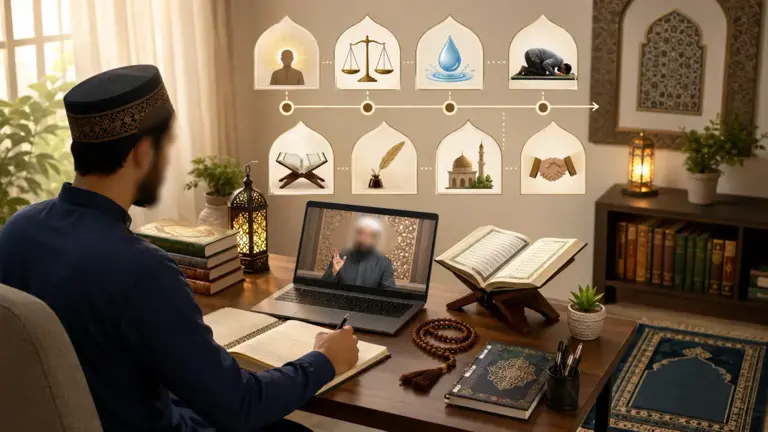
A beginner does not need to start with complex topics. The most important thing is to build a solid foundation. A simple learning path may follow this order:
- understand the pillars of Islam and the pillars of faith;
- study the basics of Islamic belief;
- learn purification and prayer;
- read and recite the Quran correctly;
- study short and useful hadiths;
- learn Islamic manners and character;
- then move gradually toward Fiqh, Sunnah and more detailed Islamic sciences.
This progression helps avoid confusion. It allows students to learn the basics of Islam before moving on to secondary or advanced topics.
Why Learn with a Qualified Teacher?
Online resources are numerous, but they do not always replace the guidance of a teacher. A teacher can explain concepts, correct mistakes, adapt the pace and answer the student’s questions.
In Islamic studies, the order of learning matters. Some topics should be studied carefully, especially when they relate to belief, Fiqh or the interpretation of religious texts. A teacher helps students remain within a clear, reliable and gradual learning framework.
Personalized guidance is also useful for adults returning to Islamic learning after a long break, new Muslims, parents and students who want to learn Islam online without getting lost in too many different resources.
Online Islamic Studies: Benefits and Limits
Online Islamic studies offer many benefits. They allow students to attend classes from different countries, follow more flexible schedules and learn at their own pace. They also make Islamic education more accessible for people with family, professional or geographic constraints.
However, online learning also requires discipline. Students need regularity, revision between lessons and a clear method. Without organization, a student may collect a lot of information without building strong understanding.
The best approach is to follow a clear program with simple goals and a progression adapted to the student’s level.
How to Organize Your Learning Week by Week
To progress in Islamic studies, it is better to study a little but regularly. A simple routine can be enough:
- one weekly lesson with a teacher;
- a short revision after each lesson;
- a few Islamic vocabulary words to memorize;
- one short surah or hadith to study gradually;
- one practical point to apply in prayer, worship or character.
This regularity helps turn information into real understanding. The objective is not to move fast, but to learn with seriousness and consistency.
Learning Islam as a Family or with Children
Islamic studies are not only for adults. Children can also learn the basics of Islam through lessons adapted to their age. The goal is to teach them Islamic belief, prayer, respect for the Quran, supplications and good manners gradually.
For children, learning should remain simple, engaging and progressive. Clear explanations, practical examples and an age-appropriate rhythm are important.
Parents can support this learning by revising with their children, asking simple questions and encouraging regular effort.
Continue with a Structured Program
If you want to learn Islam with method, you can follow our Islamic sciences online program. It helps students study the basics of Islam, Islamic belief, Fiqh, prayer, Quran and the essential concepts of daily Islamic practice step by step.
You can also explore our guide to learn Islam online, our Islamic classes for kids or our resources to learn Islam.
Book your free trial of 30 minutes
Registration form
Conclusion
Starting Islamic studies online is a practical way to learn Islam with more flexibility, especially when the learning path is structured and guided. The essential subjects to study include Islamic belief, purification, prayer, Quran, Hadith, Sunnah, Fiqh and Muslim character.
An article can provide a first direction, but complete Islamic learning requires method, regularity, reliable sources and guidance from a qualified teacher. By progressing step by step, students can build a stronger understanding of Islam and improve their religious practice with more clarity.




No Comments
No comments yet.
No comments yet.