
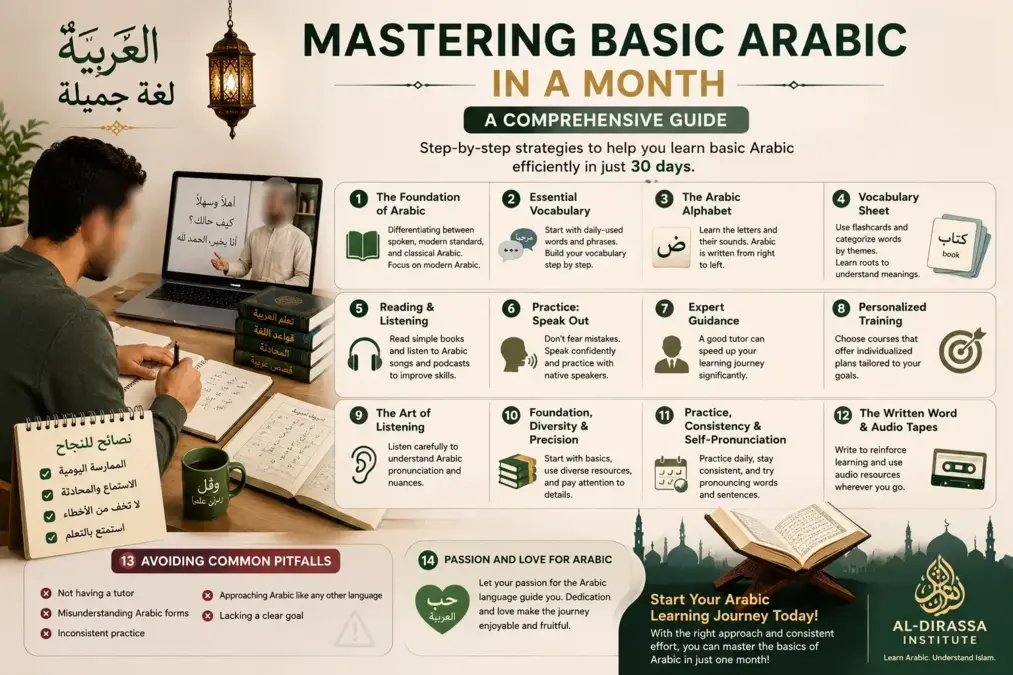
Learning basic Arabic in one month is possible if your goal is realistic. In 30 days, you will not become bilingual and you will not master all Arabic grammar. However, you can learn the alphabet, read simple words, recognize important sounds, memorize useful vocabulary and build your first sentences.
The key is to follow a clear plan. Many beginners lose time because they constantly change methods, mix dialects with standard Arabic or try to learn too much at the same time.
In this guide, you will discover a realistic 30-day plan to learn basic Arabic, avoid getting lost and build solid foundations for your next steps.
Can you really learn Arabic in one month?
Yes, you can learn useful foundations in one month. But you need to be precise about what “learning Arabic” means.
In 30 days, a motivated beginner can usually learn:
- the letters of the Arabic alphabet;
- short and long vowels;
- how to read simple words;
- greetings and polite expressions;
- daily vocabulary;
- a few short sentences;
- the basics of pronunciation;
- a first listening and reading routine.
However, speaking fluently, understanding all dialects or reading complex texts requires several months or more, depending on your rhythm.
What you can learn in 30 days
A good one-month goal is to build a stable foundation. This means being able to read slowly, recognize sounds, understand frequent words and produce simple sentences.
Here is a realistic goal:
| Area | Realistic goal in 30 days |
| Alphabet | Recognize letters and their shapes |
| Reading | Read simple words and sentences with vowels |
| Pronunciation | Identify difficult sounds and repeat them correctly |
| Vocabulary | Learn 150 to 250 useful words |
| Conversation | Introduce yourself and use simple phrases |
| Grammar | Understand a few basic structures |
Week 1: Alphabet, sounds and simple reading
The first week should focus on the Arabic alphabet. Learn the letters, their sounds and their different shapes depending on their position in the word.
Work every day on:
- 5 to 7 new letters;
- letters at the beginning, middle and end of a word;
- short vowels: fatha, kasra, damma;
- simple syllable reading;
- listening and repeating sounds.
The goal of this week is not speed. The goal is to recognize the letters and start reading correctly.
Week 2: Essential vocabulary and short sentences
The second week should introduce daily vocabulary. Choose useful words: greetings, family, home, food, numbers, days, common objects and simple verbs.
Do not memorize only isolated words. Use them in short sentences:
- I am a student.
- I am learning Arabic.
- Where is the book?
- I want to read.
- I understand a little.
This method helps you build real expression instead of collecting vocabulary without knowing how to use it.
Week 3: Basic grammar and simple conversation
The third week can introduce basic grammar. Do not try to learn everything. Focus on the most useful structures.
Work on:
- nominal sentences;
- simple verbal sentences;
- personal pronouns;
- masculine and feminine;
- singular and plural;
- common prepositions;
- a few frequent verbs.
Grammar should always be connected to examples. For a beginner, a rule without a practical sentence is difficult to remember.
Week 4: Reading, listening and guided practice
The fourth week should consolidate everything you have learned. Read very short texts, listen to simple audio and try to speak aloud every day.
You can organize your routine like this:
- 10 minutes of reading;
- 10 minutes of vocabulary;
- 10 minutes of listening;
- 10 minutes of spoken sentences;
- a few minutes reviewing mistakes.
If you have a teacher, this week is ideal for correcting reading and pronunciation errors.
Mistakes to avoid when learning fast
Wanting to progress quickly is motivating, but some mistakes can slow down your learning.
- expecting to speak fluently in 30 days;
- learning several dialects at the same time;
- neglecting the alphabet;
- memorizing vocabulary without sentences;
- not practising aloud;
- changing methods every week;
- not correcting pronunciation from the beginning.
Which resources should you use during the month?
To learn effectively, keep one main method and use complementary resources carefully.
- A structured course to follow a clear order.
- A teacher to correct pronunciation and reading.
- Vocabulary cards for daily revision.
- Short audio resources to train your ear.
- Free Arabic books for beginners to read and practise.
- A dedicated alphabet page to strengthen the basics.
Apps can help with revision, but they do not replace a structured method and personal correction.
Why learning with Al-Dirassa can speed up your progress
Al-Dirassa offers online Arabic classes adapted to beginners and non-Arabic speakers. With a teacher, you can follow a clear programme and receive correction from the first lessons.
For a 30-day goal, teacher support can help you:
- learn the alphabet in the right order;
- correct difficult sounds;
- build your first sentences;
- avoid pronunciation mistakes;
- keep a stable routine;
- choose between Modern Standard Arabic and more specific goals.
If your goal is religious, you can also complete your learning with Quranic Arabic.
Book your free trial of 30 minutes
Registration form
Frequently asked questions
Can you speak Arabic in 30 days?
You can learn to say simple sentences, introduce yourself and understand a few expressions. But speaking fluently requires more time and practice.
Which Arabic should I learn first?
For a strong foundation, Modern Standard Arabic is often the best starting point. You can later add a dialect according to your goal.
How long should I study each day?
To make progress in one month, aim for 30 to 45 minutes per day. Even a short daily session is more effective than one long session once a week.
Should I learn the Arabic alphabet from the beginning?
Yes. The alphabet is essential for reading correctly, understanding word structure and making long-term progress.
Conclusion: aim for solid foundations, not complete mastery
Learning basic Arabic in a month is possible if you follow a realistic plan. In 30 days, you can learn the alphabet, read simple words, memorize useful vocabulary and build your first sentences.
The key is not to seek complete mastery too quickly. Focus on foundations, practise every day and correct mistakes from the beginning.
With a clear method, adapted resources and the help of a teacher, one month can become an excellent starting point for continuing your Arabic learning journey with confidence.



No Comments
No comments yet.