
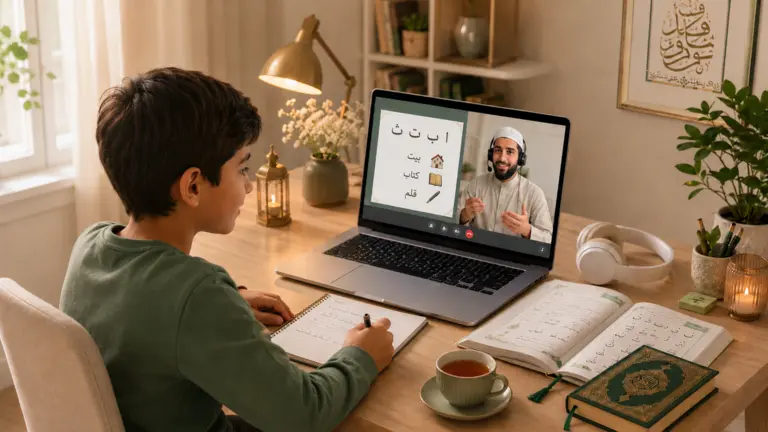
Do you want to learn Arabic with a teacher, but you are not sure whether private online lessons are the right choice? Maybe you have already tried apps, videos or free resources, but you still feel that something is missing: structure, correction and regular guidance.
Private Arabic lessons online can help you move forward with a dedicated teacher, a clear program and lessons adapted to your level. This format is especially useful if you are starting from zero, if you want to improve your pronunciation, or if you want to learn Arabic to read and understand the Quran more confidently.
What are private Arabic lessons online?
Private Arabic lessons online are one-to-one lessons between a student and a teacher, usually through video call. Unlike group classes, the teacher focuses only on your level, your mistakes and your personal goals.
You can work on reading, writing, pronunciation, grammar, speaking or Quranic Arabic depending on what you need. The main benefit is simple: the lesson moves at your pace, without the pressure of a group and without a program that is too general.
If you want to compare the different learning options available, you can also visit our page dedicated to online Arabic courses with a teacher.
Who are private online Arabic lessons for?
Private lessons are a good option if you want to learn Arabic seriously but need a clear framework. Many learners start alone, then realize that they need correction, regular practice and a teacher who can guide them step by step.
This format is especially suitable for:
- complete beginners who do not know the Arabic alphabet yet;
- adults who want to start again after a long break;
- children who need individual support;
- Muslims who want to read and understand the Quran better;
- students who want to improve their pronunciation;
- learners who progress better with a real teacher than with self-study only.
Why learn with a dedicated Arabic teacher?
The biggest difference between a private lesson and a free resource is correction. A video can explain a rule, but it cannot tell you if you are pronouncing a letter incorrectly, confusing two sounds or building a sentence the wrong way.
A dedicated teacher listens to you, corrects you and adapts the lesson. If you struggle with a grammar point, the teacher slows down. If you progress quickly, the teacher can move faster. If your goal is to read the Quran, the examples can be linked to Classical Arabic and Quranic vocabulary. If your priority is speaking, the lesson can include more oral practice.
This personal guidance is what makes private lessons effective. You are not following a fixed video course. You are learning with someone who can see where you are and help you take the next step.
What happens during a private Arabic lesson online?
Before you begin, a serious school should assess your level. This helps the teacher understand whether you are starting from zero, whether you can already read Arabic, or whether you need to strengthen specific foundations.
At Al-Dirassa, this first step is simple. The goal is not to test you under pressure, but to place you in the right program from the beginning.
A typical lesson structure
A 45 to 60-minute lesson may include:
- A short review: the teacher goes over what you studied in the previous lesson.
- A new lesson: alphabet, vocabulary, grammar, reading or speaking, depending on your program.
- Guided practice: reading aloud, exercises, sentence building or pronunciation correction.
- Personal work: a short task or revision exercise to prepare before the next lesson.
The lesson takes place online, usually through video call, with screen sharing when needed. You can learn from home, without travel, and choose a schedule that fits your routine.
Book your free trial of 30 minutes
Registration form
Private or group Arabic lessons: which is better?
Group lessons can be useful if you enjoy learning with other students and if the group level matches your own. They can also be more affordable.
Private lessons are better if you want faster feedback, more speaking time and lessons built around your own goals. They are also a better choice if you want to focus on a specific objective, such as Quranic reading, tajweed, Arabic grammar, conversation or starting from the very basics.
In short, group lessons give you a shared learning environment. Private lessons give you personal attention.
How long does it take to make progress?
You can usually notice the first signs of progress after a few weeks of regular lessons. A motivated beginner may start recognizing Arabic letters and reading simple words within the first stage of learning.
Reading more smoothly, understanding short sentences and studying simple texts takes more time. Your progress depends mainly on three things: regular lessons, personal revision between classes and the quality of the teaching.
It is usually better to take one or two lessons every week consistently than to start with too many lessons and stop after a short time.
How to choose a good online Arabic platform
Before signing up, take a moment to check how the platform works. A serious school should be clear about its teachers, its programs and the way students are supported.
Look for these points:
- a free trial lesson or an initial level assessment;
- qualified teachers who are used to teaching non-Arabic speakers;
- a program adapted to beginners, adults and children;
- the option to study Classical Arabic, Quranic Arabic or reading skills;
- regular follow-up and clear learning goals;
- flexible schedules that fit your availability.
These criteria matter more than price alone. A cheap lesson without structure may cost you more time in the long run.
Why learn Arabic with Al-Dirassa?
Al-Dirassa offers online Arabic, Quran and Islamic studies lessons for students who want a serious and structured way to learn. Lessons are taught by qualified teachers and adapted to the student’s level.
The aim is not only to attend lessons, but to make steady progress. Whether you are a complete beginner, a parent looking for Arabic lessons for your child, or an adult who wants to understand the Quran better, the program is organized around your real level and goals.
You can begin with a free trial lesson to assess your level, ask your questions and see whether private online lessons are the right format for you.
Conclusion
Private Arabic lessons online are not a magic solution. They require consistency, patience and some personal work between lessons. But they are one of the most effective ways to learn Arabic seriously, especially if you need a teacher to guide you, correct you and keep you on track.
If you are still unsure, start with a first lesson. You will understand your current level, see how the program works and decide whether this type of support matches your goals.
Book your free trial of 30 minutes
Registration form
FAQ — Private Arabic Lessons Online
Can I start private Arabic lessons if I do not know the alphabet?
Yes. Complete beginners can start from zero. The teacher introduces the Arabic letters, sounds, reading and basic rules step by step.
Are online Arabic lessons as effective as in-person lessons?
Online Arabic lessons can be just as effective as in-person lessons when the teacher is qualified and the student is consistent. The format allows live correction, oral practice and personal follow-up without the need to travel.
How many Arabic lessons should I take per week?
One or two lessons per week is a good rhythm for steady progress. Students who want to move faster can add more lessons, as long as they also make time to review between classes.
Can I learn Quranic Arabic in private lessons?
Yes. Private lessons can focus on Quranic Arabic, Quran reading, understanding basic meanings or the Arabic foundations needed to study tajweed more comfortably.
Can I change teacher if the lesson does not feel right?
Yes. In a serious learning structure, it should be possible to adjust the teacher if the match is not suitable. The relationship between the teacher and the student is important for long-term progress.




No Comments
No comments yet.
No comments yet.