
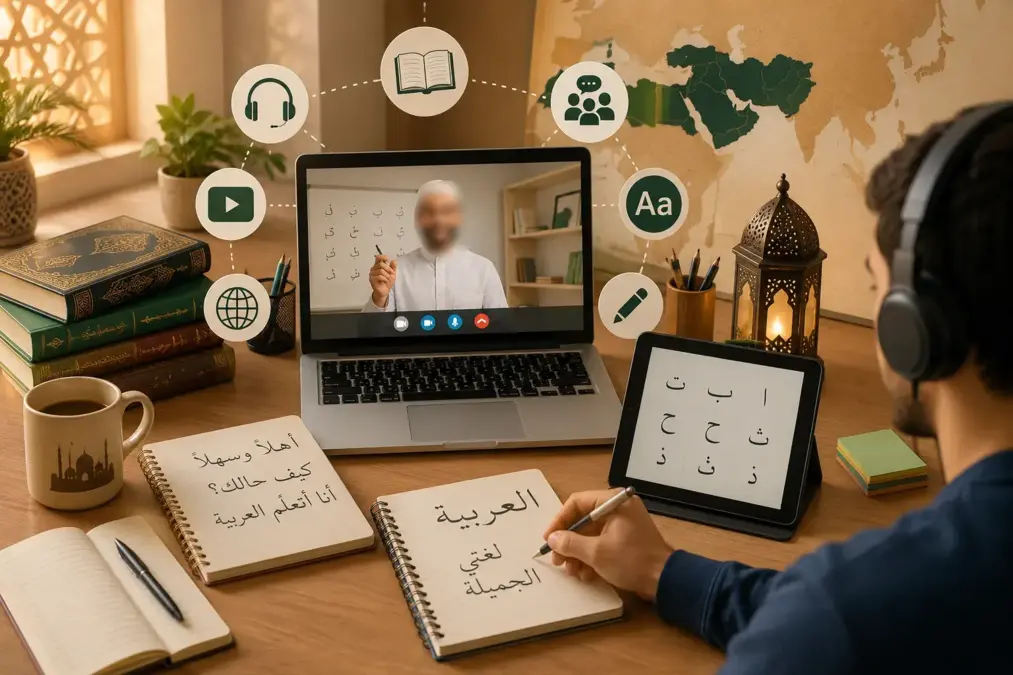
Learning Arabic online is now easier and more flexible than ever. Adults, children, complete beginners and advanced students can all study Arabic from home with a program adapted to their level and goals.
However, learning Arabic online successfully requires more than watching a few videos or downloading free resources. Arabic has its own alphabet, pronunciation, grammar and writing system. To make real progress, you need a clear method, regular practice and, ideally, correction from a qualified Arabic teacher online.
In this article, you will discover 9 practical tips to learn Arabic online effectively and build strong foundations step by step.
Book your free trial of 30 minutes
Registration form
1. Define your Arabic learning goal
Before starting online Arabic classes, take a moment to define your goal. Not every student learns Arabic for the same reason.
Some students want to communicate with Arabic-speaking relatives or travel with more confidence. Others want to understand the Quran, study Quranic Arabic, improve their Arabic reading or learn Modern Standard Arabic for academic or professional reasons.
Your goal will help you choose the right program. A complete beginner does not need the same approach as a student who already reads Arabic and wants to improve Arabic grammar, vocabulary or conversation skills.
2. Join structured online Arabic classes
Free resources can be helpful, but they are often scattered. To progress properly, you need a clear learning path.
Structured online Arabic classes help you study in the right order: Arabic alphabet, Arabic reading, Arabic pronunciation, vocabulary, grammar, comprehension and speaking practice.
The main advantage of learning online is flexibility. You can study from home, choose a schedule that suits your routine and learn at your own pace while receiving personalized support.
3. Start with the Arabic alphabet
The Arabic alphabet is the foundation of the language. Without it, it is difficult to read, write or memorize Arabic words correctly.
You need to learn more than the isolated letters. Arabic letters change shape depending on their position in the word: beginning, middle or end. Understanding these forms is essential for Arabic reading.
If you are a beginner, you can start with our guide to the Arabic alphabet to learn the letters, their shapes and their pronunciation.
4. Work on Arabic pronunciation with a teacher
Arabic pronunciation can be challenging because some sounds do not exist in English. This is why it is important to develop correct habits from the beginning.
A qualified Arabic teacher online can correct your pronunciation, help you distinguish similar sounds and prevent you from repeating the same mistakes for months.
Videos are useful for listening, but they cannot correct your own voice. This is where private Arabic lessons become especially valuable.
5. Practice regularly between lessons
To learn Arabic online effectively, consistency matters. It is better to study 15 to 20 minutes every day than to study for several hours only once a week.
Between lessons, you can review your notes, listen to Arabic words, repeat short sentences, revise the letters and memorize useful Arabic vocabulary.
Small daily efforts help your brain absorb the language gradually. Over time, reading, pronunciation and sentence structure become more natural.
6. Use free Arabic resources wisely
YouTube videos, podcasts, apps and PDF books can support your learning. They help you listen to Arabic, review grammar rules and discover new vocabulary.
However, many students make the mistake of jumping from one resource to another without a clear plan. This can create confusion and slow down progress.
Use free resources as a complement to your lessons, not as your only method. You can also download free Arabic books for beginners to revise between your classes.
7. Learn Arabic grammar step by step
Arabic grammar is important, but it should be learned progressively. Beginners should first understand simple structures: nominal sentences, verbal sentences, pronouns, gender, number and basic verbs.
After that, students can move toward more advanced grammar rules. The goal is not only to memorize theory, but to use grammar in reading, writing and speaking.
If your goal is to study formal Arabic, you can explore our Modern Standard Arabic online lessons.
8. Choose the right Arabic teacher online
A good Arabic teacher does more than explain lessons. The teacher adapts the course to your level, corrects your mistakes and guides you through a clear learning path.
For adult beginners, the teacher should explain the foundations clearly. For children, the lessons should be progressive, engaging and age-appropriate. For advanced students, the teacher can focus on grammar, texts, conversation or Quranic Arabic.
If you are looking for lessons for your child, you can discover our Arabic classes for kids.
9. Connect your learning to a clear result
Motivation becomes stronger when you connect your learning to a concrete result. For example, you may want to read your first Arabic words, understand short sentences, memorize useful vocabulary, improve Quran recitation or hold a simple conversation.
If your goal is religious, you can study Quranic Arabic or combine your Arabic learning with online Quran and Tajweed classes.
The key is to measure your progress. Even small improvements, when repeated consistently, lead to strong long-term results.
Learn Arabic with a teacher
Learning alone can help you discover the basics, but studying with a teacher helps you progress faster and more accurately. You receive direct correction, a structured program and personalized guidance.
At Al-Dirassa Institute, students can follow private Arabic lessons online with qualified teachers. The program can be adapted to your level and goals: Arabic for beginners, Arabic reading, pronunciation, grammar, vocabulary, Modern Standard Arabic or Quranic Arabic.
You can start with a free trial lesson to assess your level, ask your questions and choose the most suitable learning path.
Book your free trial of 30 minutes
Registration form
Conclusion
Learning Arabic online is a flexible and effective option, but success depends on the method you follow. You need to start with the foundations, practice regularly, work on pronunciation, build vocabulary and follow a clear progression.
Free resources, videos and books can support your learning, but they do not always replace correction from a qualified Arabic teacher. To build strong skills, it is better to combine independent practice with personalized learning.
With the right method and regular online Arabic classes, learning Arabic becomes a realistic, progressive and motivating journey.



No Comments
No comments yet.