
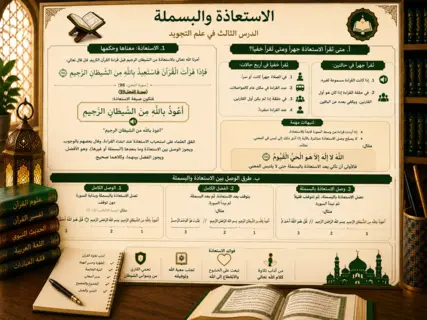
1. Al Isti’adha: Meaning, Importance and Usage
Before reciting the Holy Qur’an, Allah instructs believers to seek refuge in Him from the accursed Satan. This allows the reciter to begin with humility, protection and spiritual awareness.
فَإِذَا قَرَأْتَ الْقُرْآنَ فَاسْتَعِذْ بِاللَّـهِ مِنَ الشَّيْطَانِ الرَّجِيمِ
“So when you recite the Qur’an, seek refuge in Allah from Satan, the expelled.” (16:98)
The formula of Al Isti’adha is:
أَعُوذُ بِاللَّـهِ مِنَ الشَّيْطَانِ الرَّجِيمِ
“I seek refuge with Allah from Satan, the accursed.”
Scholars agree on the importance of reciting Al Isti’adha before beginning the recitation of the Qur’an. Most scholars consider it recommended, while some consider it obligatory.
It may be recited aloud or quietly depending on the situation.
When Al Isti’adha is Recited Aloud
- When the recitation is intended to be heard by others.
- In a study circle, when the reciter is the first person to begin reading.
Book your free trial of 30 minutes
Registration form
When Al Isti’adha is Recited Quietly
- During prayer, whether the recitation is audible or silent.
- When reciting Qur’an privately in a public place.
- In a group recitation, when the reader is not the first to begin.
- During individual recitation.
Important Notes About Al Isti’adha
- When starting from the middle of a surah, it is appropriate to begin with Al Isti’adha.
- However, Al Isti’adha should not be connected directly to a verse if doing so could distort the meaning.
For example, Ayat Al-Kursi begins with:
اللَّـهُ لَا إِلَـٰهَ إِلَّا هُوَ الْحَيُّ الْقَيُّومُ
Connecting the final word of Al Isti’adha directly to the name of Allah in this verse may create confusion. For this reason, Imam Ash-Shatibi recommended reciting the Basmala after Al Isti’adha in such cases.
2. Ways of Connecting Al Isti’adha with the Basmala
Complete Connection
This consists of connecting Al Isti’adha, the Basmala and the beginning of the surah without pausing.

Complete Separation
This consists of pausing after Al Isti’adha, then pausing again after the Basmala before beginning the surah. This is the most common method.
Connecting Al Isti’adha with the Basmala
In this method, Al Isti’adha is connected with the Basmala, then the reciter pauses before beginning the surah.

Pausing After Al Isti’adha and Connecting the Basmala with the Surah
In this method, the reciter pauses after Al Isti’adha, then connects the Basmala directly with the opening verse of the surah.

3. Al Basmala: Meaning, Importance and Usage
The Basmala refers to the phrase:
بِسْمِ اللَّـهِ الرَّحْمَـٰنِ الرَّحِيمِ
“In the name of Allah, the Entirely Merciful, the Especially Merciful.”
Scholars unanimously agree that the Basmala is part of Surah An-Naml, verse 30:
إِنَّهُ مِن سُلَيْمَانَ وَإِنَّهُ بِسْمِ اللَّـهِ الرَّحْمَـٰنِ الرَّحِيمِ
“Indeed, it is from Solomon, and indeed, it reads: In the name of Allah, the Entirely Merciful, the Especially Merciful.” (27:30)
Regarding the Basmala at the beginning of each surah, scholars and Qur’an reciters hold different opinions.
The reciters of Kufa and Mecca, along with Imam Ash-Shafi’i, considered it a separate verse at the beginning of every surah.
The reciters of Medina, Basra and Sham, supported by Imam Malik, considered it a separator between surahs and a blessing at the beginning of each surah.
According to the reading of Hafs, the Basmala is treated as a distinct verse at the beginning of each surah, except before Surah At-Tawbah.
4. Reading the Basmala Between Two Surahs According to Hafs
Complete Connection
This consists of connecting the end of one surah to the Basmala and then to the beginning of the next surah without pausing.

Complete Separation
This consists of pausing after the final verse of one surah, then reciting the Basmala, pausing again, and beginning the next surah.

Pausing After the Final Verse
This consists of pausing after the final verse of one surah, then connecting the Basmala directly to the beginning of the next surah.

Prohibited Connection
It is not permissible to connect the final verse of a surah with the Basmala and then pause before beginning the next surah. This is because the Basmala marks the beginning of a surah, not the end of the previous one.

Key Points to Remember
- The Basmala is recommended at the beginning of every surah except Surah At-Tawbah.
- When starting from the middle of a surah, reciting the Basmala is optional.
- If the Basmala is connected to a verse from the middle of a surah, the meaning must remain clear.
Conclusion
This lesson has explained the rules of Al Isti’adha and Al Basmala in Qur’anic recitation. These rules help the reciter begin correctly, preserve the meaning of the verses and follow the recognized methods of Tajweed.
In the next lesson, we will study the ghunna of the letters Noon and Meem.
At Al-Dirassa Institute, we help students learn Tajweed rules online with qualified teachers. To learn more, you can contact us.



No Comments
No comments yet.