
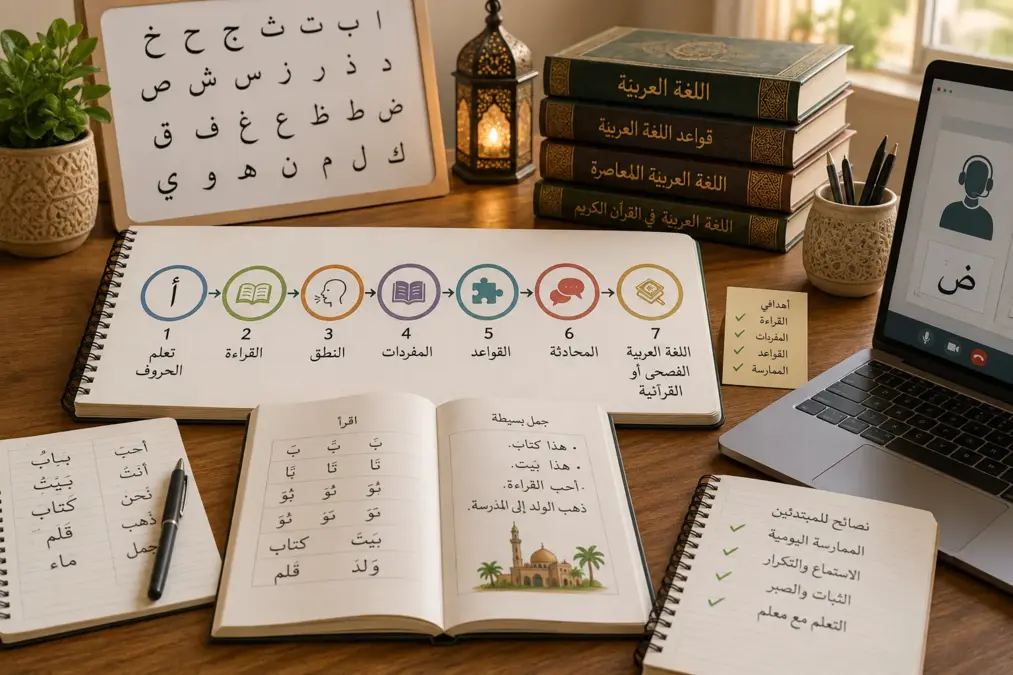
Many beginners want to learn Arabic but do not know where to start. Should they begin with speaking, grammar, vocabulary, pronunciation, reading, the Quran, Modern Standard Arabic or a dialect?
This confusion is normal. Arabic is a rich language with its own alphabet, sounds, writing system, grammar and different forms. If you start without a clear order, the language can quickly feel more difficult than it really is.
In this article, you will discover how to start learning Arabic step by step, what foundations to build first and why learning with a teacher can help you avoid mistakes from the beginning.
Why You Need to Start Arabic in the Right Order
Arabic learning becomes easier when each step prepares the next one. If you try to memorize vocabulary without reading, study grammar without examples or speak without pronunciation correction, you may feel blocked quickly.
The right order helps you build strong foundations. A beginner should first understand the alphabet, then reading, pronunciation, useful vocabulary and basic grammar. After that, it becomes easier to move toward Modern Standard Arabic, Quranic Arabic or conversation.
Starting well does not mean learning everything slowly. It means learning in a way that avoids confusion and gives you a solid base.
1. Define Your Learning Goal
Before starting Arabic, ask yourself why you want to learn it. Your goal will influence the type of Arabic you should study and the method you should follow.
Some learners want to read the Quran. Others want to speak with Arabic-speaking relatives, travel, understand Arab culture, study Islamic sciences, read books or develop a professional skill.
If your goal is clear, your learning path becomes clearer. You can choose the right resources, the right teacher and the right type of Arabic.
2. Start with the Arabic Alphabet
The Arabic alphabet is the first foundation. It is impossible to progress seriously in Arabic if you depend only on transliteration.
Arabic has 28 letters, and many letters change shape depending on their position in the word. A letter may look different at the beginning, middle or end of a word.
Beginners should learn the letters, their sounds and their different forms. They should also practice writing and reading simple words to recognize the letters in context.
3. Learn to Read Arabic Progressively
After the alphabet, the next step is reading. Do not begin with long texts. Start with letters, syllables, short words and simple sentences.
Reading Arabic takes practice because the script is different from English and is written from right to left. With regular practice, your eyes become more comfortable with the shapes and connections between letters.
Reading also helps you connect letters, sounds and meaning. This is essential for vocabulary, grammar and pronunciation.
4. Work on Pronunciation from the Beginning
Arabic pronunciation should be corrected early. Some Arabic sounds do not exist in English, and many beginners replace them with familiar sounds from their native language.
Listening to audio is useful, but it is not always enough. A learner may repeat a sound incorrectly without realizing it.
A teacher can correct pronunciation, explain how to articulate difficult letters and help you build good habits from the beginning.
5. Build Basic Arabic Vocabulary
Once you can recognize letters and read simple words, begin building basic vocabulary. Start with useful themes such as greetings, family, home, food, time, numbers, worship, school and daily routines.
Do not memorize isolated words only. Learn words inside short sentences so you can understand how they are used.
This method helps you remember vocabulary more easily and prepares you to read, write and speak simple Arabic.
6. Understand the First Grammar Rules
Arabic grammar can seem difficult if you start with advanced rules. Beginners should begin with simple foundations.
Learn the difference between nouns, verbs and adjectives. Study pronouns, prepositions, gender, number and basic sentence structure. Practice each rule with short examples.
Grammar should not be studied as isolated theory. It should help you understand sentences and express simple ideas more clearly.
7. Choose Between Modern Standard Arabic, Quranic Arabic and Dialect
Arabic exists in several forms, and beginners often feel confused by this. Understanding the difference helps you choose the right path.
Modern Standard Arabic is used in writing, education, media, formal speech and official communication. It is a strong foundation for learners who want to read and understand Arabic across the Arab world.
Quranic Arabic focuses on vocabulary, expressions and structures found in the Quran. It is useful for learners who want to connect Arabic learning with Quran reading and Islamic studies.
Dialects are used in daily conversation and vary by country. They can be useful for regional communication, but beginners should avoid mixing too many forms of Arabic too early.
8. Avoid Common Beginner Mistakes
Many beginners slow down their progress because they make the same mistakes:
- skipping the Arabic alphabet;
- depending too much on transliteration;
- memorizing vocabulary without context;
- neglecting pronunciation correction;
- studying grammar without progression;
- using too many resources at the same time;
- mixing Modern Standard Arabic, Quranic Arabic and dialects too early;
- learning alone without feedback.
These mistakes can be avoided when you follow a structured method and receive correction from the beginning.
9. Progress with an Arabic Teacher
Self-study resources can help you discover Arabic and review between lessons. You can use alphabet lessons, audio exercises, flashcards and free Arabic books for beginners to support your learning.
However, a teacher helps you progress with more clarity. A teacher can correct pronunciation, guide your reading, explain grammar and adapt the program to your level and goal.
With online Arabic classes, you can learn from home with qualified teachers and a structured method. Lessons can focus on Arabic for beginners, reading, pronunciation, vocabulary, grammar, Modern Standard Arabic or Quranic Arabic.
Families can also choose Arabic classes for kids, with an approach adapted to children’s age, level and learning rhythm.
Book your free trial of 30 minutes
Registration form
Conclusion: Starting Well Helps You Progress Faster
If you want to start learning Arabic, do not begin randomly. Define your goal, learn the alphabet, practice reading, correct your pronunciation, build useful vocabulary and study grammar step by step.
Arabic becomes clearer when you follow the right order. Each foundation supports the next one and helps you avoid confusion.
With regular practice and teacher correction, beginners can build strong foundations and progress toward reading, understanding and communicating in Arabic with more confidence.



No Comments
No comments yet.