
Many beginners think Arabic is one single language used in the same way everywhere. In reality, Arabic has several forms, and each one has its own role. This is why learners often hear about Modern Standard Arabic, Quranic Arabic, Classical Arabic and Arabic dialects.
Understanding the different types of Arabic is important before choosing a course. The Arabic you need depends on your goal: reading, writing, understanding the Quran, speaking with family, travelling, studying, working or communicating across the Arab world.
In this guide, you will discover the main types of Arabic, where each one is used and which form of Arabic you should learn first as a beginner.
Why Are There Different Types of Arabic?
Arabic is used across many countries and communities. Over time, spoken Arabic developed differently from one region to another, while formal Arabic remained important for writing, education, media, religion and official communication.
This is why Arabic learners may encounter several terms: Modern Standard Arabic, Classical Arabic, Quranic Arabic and regional dialects. These forms are connected, but they are not used in exactly the same situations.
Knowing the difference helps you avoid confusion. Instead of learning random Arabic expressions from different sources, you can choose a clear path adapted to your objective.
1. Modern Standard Arabic
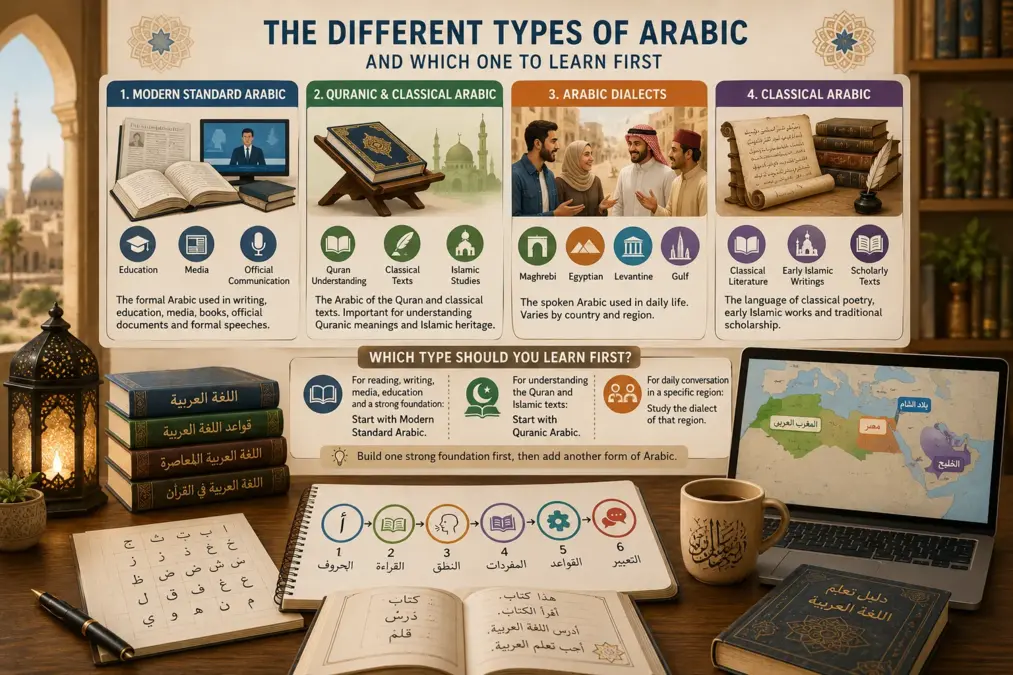
Modern Standard Arabic, often called MSA, is the formal Arabic used in education, media, books, official documents, speeches and many learning materials.
It is not usually the language of everyday casual conversation, but it is widely understood across the Arab world in formal contexts. This makes it a strong foundation for learners who want to read, write and understand Arabic seriously.
Where Is Modern Standard Arabic Used?
Modern Standard Arabic is used in schools, universities, newspapers, books, news broadcasts, official speeches, websites, formal communication and educational content.
It is also the form of Arabic most commonly taught to non-native learners who want a structured path. If you want to build strong foundations, Modern Standard Arabic is usually a good starting point.
Who Should Learn Modern Standard Arabic?
Modern Standard Arabic is useful if you want to:
- read and write Arabic;
- understand formal Arabic content;
- study grammar and vocabulary in a structured way;
- communicate across different Arabic-speaking countries in formal contexts;
- prepare for academic, professional or religious Arabic studies;
- later learn a dialect more easily.
2. Quranic Arabic and Classical Arabic
Quranic Arabic refers to the Arabic of the Quran. It is especially important for students who want to understand Quranic vocabulary, expressions and structures.
Classical Arabic is the broader form of Arabic found in classical literature, early Islamic texts, traditional scholarship and older works. Quranic Arabic is part of this classical heritage, but it has a unique religious status because it is the language of the Quran.
The Arabic of the Quran
The Quran was revealed in Arabic, and Muslims around the world recite it in Arabic. For this reason, Quranic Arabic has a central place in Islamic learning.
Students who want to understand Quranic meanings often study vocabulary, grammar, sentence structures and expressions found in the Quran. They may also study recitation rules through Tajweed.
If your goal is religious understanding, you can follow a Quranic Arabic course and complement it with online Quran and Tajweed classes.
Difference Between Quranic Arabic and Classical Arabic
Quranic Arabic is specifically connected to the Quran. Classical Arabic is a wider category that includes the language of classical poetry, early Islamic writings and traditional scholarly texts.
For beginners, the difference does not need to become complicated. If your goal is to understand the Quran, begin with Quranic Arabic. If your goal is broader classical texts, you may later study classical Arabic in more depth.
3. Arabic Dialects
Arabic dialects are the spoken forms of Arabic used in daily life. They vary from country to country and sometimes from one region to another within the same country.
Dialects are used in family conversations, markets, informal speech, local media, songs, films and everyday communication. They are very useful if you want to speak naturally with people from a specific region.
Maghrebi, Egyptian, Levantine and Gulf Dialects
There are many Arabic dialect groups. Maghrebi dialects are spoken in countries such as Morocco, Algeria and Tunisia. Egyptian Arabic is widely known because of Egypt’s media and cinema. Levantine Arabic is spoken in countries such as Syria, Lebanon, Jordan and Palestine. Gulf dialects are used in countries of the Arabian Peninsula.
Each dialect has its own pronunciation, vocabulary and expressions. Some dialects are easier for other Arabic speakers to understand than others, depending on exposure and regional proximity.
Why Dialects Vary by Region
Dialects vary because Arabic-speaking regions have different histories, cultures and linguistic influences. Contact with other languages, local traditions and historical developments shaped the way people speak.
This does not mean dialects are completely separate from Arabic. They share roots and structures, but they can sound very different to beginners.
Which Type of Arabic Should You Learn First?
For most beginners, Modern Standard Arabic is the safest foundation. It teaches reading, writing, vocabulary, pronunciation and grammar in a structured way.
Once you have a foundation in Modern Standard Arabic, it becomes easier to understand how dialects differ. You can then choose a dialect according to your family, travel, work or communication needs.
However, if your main objective is understanding the Quran, Quranic Arabic may be the most relevant path. If your only objective is speaking with one specific community, a dialect can also be useful.
You can read our guide on Modern Standard Arabic or dialect if you want help choosing the best path for your situation.
Can You Learn Several Forms of Arabic?
Yes, you can learn several forms of Arabic, but beginners should avoid mixing everything too early. Learning Modern Standard Arabic, Quranic Arabic and several dialects at the same time can create confusion.
A better method is to choose one main path first. Build strong foundations, then add another form of Arabic when your level becomes more stable.
For example, a student may start with Modern Standard Arabic, then add Quranic Arabic or a dialect later. Another student may begin with Quranic Arabic, then strengthen reading and grammar through Modern Standard Arabic.
Learn Arabic with a Teacher According to Your Goal
Choosing the right type of Arabic becomes easier with guidance. A teacher can help you define your goal and choose a program adapted to your level.
With online Arabic classes, you can study Arabic from home with a qualified teacher. Lessons can focus on Arabic for beginners, Modern Standard Arabic, Quranic Arabic, reading, pronunciation, vocabulary or grammar.
Beginners can also review the Arabic alphabet and use free Arabic books for beginners to strengthen the foundations between lessons.
Families can choose Arabic classes for kids, with a method adapted to each child’s age, level and learning rhythm.
Book your free trial of 30 minutes
Registration form
Conclusion: Each Type of Arabic Has Its Role
Arabic has several forms, and each one serves a different purpose. Modern Standard Arabic is useful for reading, writing, media, education and formal communication. Quranic Arabic is essential for understanding the Quran. Dialects are useful for daily conversation in specific regions.
The best type of Arabic to learn depends on your objective. A beginner who wants a strong general foundation can usually start with Modern Standard Arabic. A student focused on Quran understanding can choose Quranic Arabic. A learner focused on local conversation can study a dialect.
With a clear goal, a structured method and teacher correction, Arabic becomes easier to understand and more rewarding to learn.



No Comments
No comments yet.