

Teaching the Quran to children is an important concern for many Muslim parents. They want to give their children a living connection with the Book of Allah, while providing strong foundations in reading, recitation, Tajweed, memorization and good behavior.
However, Quran learning for children should not be approached in the same way as for adults. A child needs a gradual method, an adapted pace, encouragement, repetition and a teacher who can make lessons simple, clear and motivating.
Quranic education is not limited to reading a few verses or memorizing some surahs. It includes reading the Quran in Arabic, correct recitation, the basics of Tajweed, gradual understanding of meaning, memorization, revision and applying teachings in daily life.
In this article, we will see why teaching the Quran to children is important, where to begin, how to organize learning at home, how to approach recitation, Tajweed and memorization, and why online Quran classes can help children progress with method.
Why teach the Quran to children?
Learning the Quran helps the child build a positive relationship with their religion. They gradually discover reading the Arabic text, recitation, memorization of short surahs and essential teachings related to behavior, faith and the relationship with Allah.
For a child, the goal is not only to repeat words. It is also to learn with respect, attention and love for the Quran. A good method can help the child progress without excessive pressure.
The Quran is a source of guidance, wisdom and values. By teaching it gradually to children, parents help them develop a spiritual, moral and educational foundation that can accompany them throughout life.
Quranic education: more than memorization
Quranic education refers to learning the Quran through several dimensions. It includes the ability to read the Arabic text, recite correctly, understand the general meaning of verses and integrate Quranic teachings into behavior.
It is therefore not limited to memorization. A child can learn to recognize Arabic letters, improve pronunciation, discover the first Tajweed rules, memorize short surahs, listen to correct recitation and understand simple messages adapted to their age.
A structured path allows the child to progress step by step, without confusion and without turning learning into pressure.
The benefits of Quran learning for children
Learning the Quran can have several positive effects on a child when it is taught with gentleness, consistency and pedagogy.
Strengthening the connection with Allah and faith
The Quran helps the child discover the foundations of faith, learn some names of Allah, understand the importance of prayer, sincerity, gratitude, patience and good behavior.
This learning gradually strengthens their Muslim identity and helps them grow with a more natural connection to the Book of Allah.
Passing on values and morals
The Quran reminds us of important values: kindness, justice, patience, honesty, respect for parents, responsibility and awareness of Allah.
For a child, these values should be explained in simple words and connected to concrete situations in daily life.
Developing a love of learning
When learning is positive and encouraging, the child can develop a love of learning. They discover that the Quran is not only a subject to study, but a source of light, wisdom and closeness to Allah.
Visual supports, audio recitations, educational games and short goals can make learning more lively.
Improving Arabic language foundations
Since the Quran is recited in Arabic, learning it helps the child become familiar with Arabic letters, sounds, vowels, pronunciation and frequent words.
Even if the child does not become fluent in Arabic immediately, they build a useful foundation for reading the Quran, reciting correctly and gradually understanding certain words.
At what age can a child start learning the Quran?
There is no single age that applies to every child. Some children can start very early with listening, repeating short surahs and recognizing letters. Others may need to wait until they are more comfortable with concentration and reading.
For younger children, sessions should remain short, simple and encouraging. It is better to build a positive habit than to impose a program that is too heavy.
A child can begin by:
- listening to short surahs;
- repeating with a parent or teacher;
- recognizing a few Arabic letters;
- learning simple vowels;
- gradually memorizing short passages;
- connecting learning to regular and pleasant moments.
The role of parents in Quran learning
Parents play a central role in the Quranic education of children. They are often the first models the child observes. When a child sees their parents reciting the Quran, listening to a surah or respecting a learning time, they understand that the Quran has an important place in family life.
Parents do not need to be perfect to support their child. They can create a positive framework, encourage effort, follow progress and maintain regular communication with the teacher.
The most important point is to avoid turning learning into a source of tension. The child should feel that the Quran is connected to peace, encouragement and love for Allah.
Create a supportive learning environment
To teach the Quran effectively at home, it is useful to create a calm, simple and regular environment. The child should be able to focus without constant interruption.
A dedicated space, even a small one, can help: a clear mushaf, a notebook, a few visual supports, a tablet or computer for online lessons, and a fixed time during the week.
It is also beneficial to create moments of family recitation. Reciting a short surah together, listening to a passage or reviewing a few verses can strengthen the child’s motivation.
Which foundations should be studied first?
Before reading long passages of the Quran, the child needs to build strong foundations. These foundations include the Arabic alphabet, sounds, vowels and reading signs.
Recognizing Arabic letters
The first step is to recognize Arabic letters. The child learns to distinguish letters, their forms and their sounds. Some letters look similar, so they need to be studied with patience and repetition.
A free Arabic alphabet course can help children begin with letters before moving to Quran reading.
Reading vowels and signs
After the letters, the child discovers short vowels such as fatha, kasra and damma. They then gradually learn sukoon, shaddah, tanween and other useful signs for correct reading.
These elements are essential for reading Quranic words without relying only on phonetic transcription.
Working on pronunciation gradually
Pronunciation is an important step. Some Arabic sounds can be difficult for non-Arabic-speaking children. They should therefore be corrected gently and repeatedly.
The child should not be discouraged by mistakes. Corrections should be simple, regular and adapted to their age.
How to teach Quran recitation to children
Quran recitation requires listening, repetition and oral correction. The child can listen to a short passage, repeat it phrase by phrase, then read it with the teacher’s help.
It is better to begin with short and familiar passages, such as Al-Fatiha and short surahs. The teacher can then help the child improve fluency, pauses, sounds and reading accuracy.
To learn the Quran, progress should be slow and regular. Clear reading is better than fast but incorrect reading.
Tajweed for children: how to introduce it simply
Tajweed helps the child recite the Quran with precision. For children, it is better not to begin with overly complex explanations. Rules should be introduced gradually through practice.
For example, the child can first learn to pronounce certain letters correctly, lengthen some sounds or pay attention to pauses. Technical terms can come later, when the child is ready.
Online Tajweed classes can introduce these rules step by step, with exercises adapted to the child’s level.
Quran memorization: progress without pressure
Quran memorization can be beneficial for children, but it must remain adapted to their capacity. It is better to memorize little, but well, with correct recitation and regular revision.
A simple method can include:
- listening to the passage several times;
- repeating verse by verse;
- correcting pronunciation;
- reviewing the passage the next day;
- returning often to surahs already learned;
- avoiding adding too many new verses without revision.
An online Quran memorization program should always include an important part of revision, especially for children.
Encourage understanding of the verses
To make Quran learning more meaningful, it is useful to explain to children the general meaning of the surahs and verses they memorize.
This does not mean giving complex explanations. The goal is to help the child understand, in simple words, essential values and messages: thanking Allah, being sincere, asking for guidance, being patient, respecting parents or avoiding bad behavior.
Stories adapted to the child’s age, visual supports or concrete examples can make these teachings more accessible.
How to motivate a child to learn the Quran
A child’s motivation depends greatly on the learning atmosphere. If the lesson becomes a source of stress, the child may close off. If learning is gradual, positive and regular, the child can develop a more natural connection with the Quran.
Here are some useful tips:
- set short and achievable goals;
- praise effort, not only results;
- avoid comparisons with other children;
- choose a lesson duration adapted to the child;
- revise regularly without overload;
- connect learning to a calm moment;
- use audio and visual supports;
- maintain positive communication with the teacher.
Every child progresses at their own pace. Consistency is often more important than quantity.
Use audio, video and playful resources
Children often learn better when they listen, repeat and visualize. Audio recitations, educational videos, flashcards, progress charts and learning games can make Quran learning more engaging.
These resources should still serve a clear method. They should not replace oral correction, especially for pronunciation and Tajweed.
A good balance is to use digital resources for motivation and revision while keeping a teacher or parent to guide progress.
Why choose a qualified teacher?
A qualified teacher can adapt the method to the child’s age, reading level and concentration ability. They know how to correct without discouraging, explain simply and establish a realistic progression.
For non-Arabic-speaking children, guidance is especially important. The teacher helps distinguish Arabic sounds, read signs correctly and avoid bad habits from the beginning.
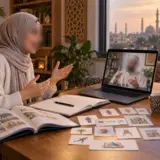
With Quran classes for children, the child can learn from home in a more flexible setting while benefiting from personalized follow-up.
Book your free trial of 30 minutes
Registration form
How to organize online Quran classes for children
Online lessons should be organized simply. For a child, it is better to plan regular sessions that are adapted to their age. A lesson that is too long can reduce concentration.
Good organization can include:
- a fixed weekly schedule;
- a duration adapted to the child’s age;
- a small goal for each lesson;
- revision time between sessions;
- follow-up on frequent mistakes;
- communication between parents and teacher;
- a balance between reading, recitation, Tajweed and memorization.
Online Quran classes for children must take into account the child’s rhythm, needs and family environment.
Quranic education for children: a complete path
A complete Quran learning path can include several stages. They are not all studied at the same time, but together they form a coherent progression.
- Arabic reading: recognizing letters, vowels and reading signs.
- Recitation: reading with attention, fluency and correction.
- Tajweed: respecting essential pronunciation rules.
- Memorization: gradually learning short surahs.
- Revision: strengthening what has already been learned.
- Understanding: discovering the general meaning of verses adapted to the child’s age.
- Behavior: connecting learning to Quranic values.
This approach allows the child to build a balanced relationship with the Quran, without reducing learning to mechanical repetition.
Common mistakes to avoid
When a parent wants to teach the Quran to their child, some mistakes can slow progress or create rejection of learning.
- starting with lessons that are too long;
- wanting to memorize too quickly;
- neglecting pronunciation;
- correcting too harshly;
- comparing the child to other students;
- constantly changing method;
- forgetting revision;
- not adapting the lesson to the child’s age;
- using only phonetics without learning Arabic letters;
- putting too much pressure on results.
Successful learning is based on patience, consistency, encouragement and progressive correction.
How to include Quran learning in the family routine
Quranic education requires consistency. It is better to study a little every week than to work intensively and then stop for a long time.
Here are some simple tips:
- choose a fixed time to read or revise;
- listen to correct recitation;
- read slowly before seeking fluency;
- note mistakes corrected by the teacher;
- revise previous lessons;
- set realistic goals;
- keep a progression adapted to the child’s age and level.
Consistency helps the child consolidate foundations and progress more peacefully.
FAQ — Teaching the Quran to children
At what age should a child start learning the Quran?
There is no single age. A child can start very early by listening to and repeating short surahs, then gradually learn Arabic letters, vowels and reading.
Should children start with reading or memorization?
Both can progress gradually. For a young child, listening and memorizing short surahs can begin early. Arabic reading should then be studied to build a solid foundation.
Is Tajweed suitable for children?
Yes, if it is introduced simply. A child can first learn correct pronunciation, elongations and pauses before studying technical terms later.
How long should a Quran lesson for children last?
The duration depends on age and concentration. A short, regular and positive lesson is better than a long session that tires the child.
How can you motivate a child to learn the Quran?
Encourage effort, avoid comparisons, set small goals, use adapted resources and create a positive atmosphere around learning.
Are online Quran classes suitable for children?
Yes, if the class is adapted to their age, with a patient teacher, a clear method, regular sessions and good communication with parents.
Conclusion: build a positive connection with the Quran
Teaching the Quran to children requires an adapted method. The child should progress gradually in Arabic reading, recitation, Tajweed, memorization and understanding, without excessive pressure and with caring support.
The role of parents is essential: creating a positive atmosphere, encouraging consistency, setting an example and supporting the child with patience. The teacher brings correction, structure and adapted progression.
With simple goals, regular lessons, a qualified teacher and good communication with parents, the child can develop a positive connection with the Quran and progress according to their level.




No Comments
No comments yet.
No comments yet.