
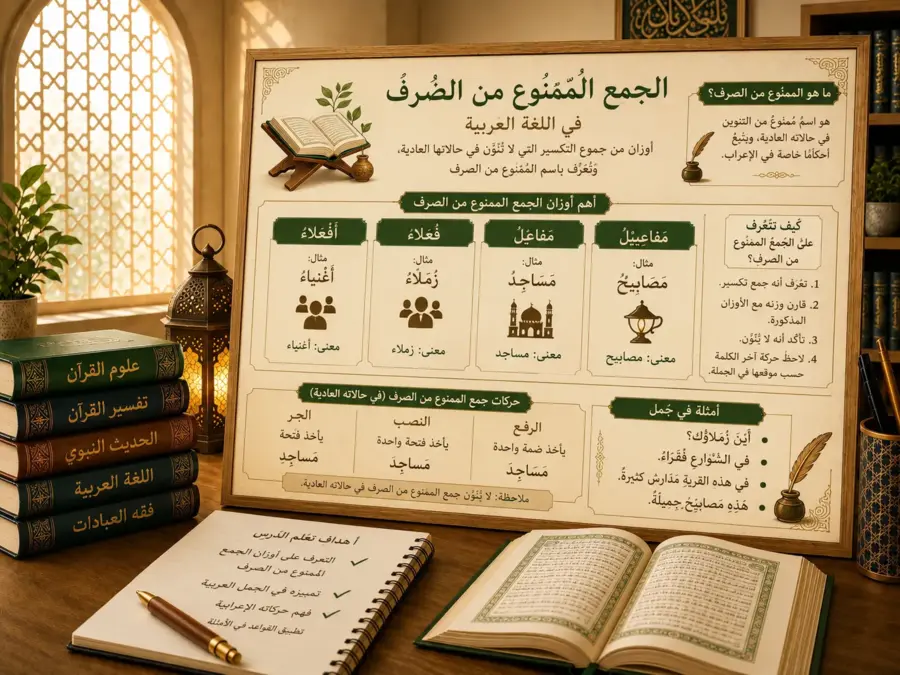
Arabic diptote plurals are an important topic in advanced Arabic grammar. They refer to certain broken plurals that do not decline like regular Arabic nouns. In Arabic, these words belong to the category called المَمْنُوعُ مِنَ الصَّرْفِ, which means “a word prevented from full declension”.
To learn Arabic accurately, students need to recognize these forms because they appear often in Modern Standard Arabic, literary Arabic, Quranic Arabic and fully vowelled Arabic texts. This lesson is especially useful for students who have already studied Arabic nouns, tanween, broken plurals and the basics of Arabic declension.
In this lesson, we will study several patterns of Arabic diptote plurals, such as فُعَلاءُ, أَفْعِلاءُ, مَفَاعِلُ and مَفَاعِيلُ.
What Is a Diptote Plural in Arabic?
A diptote plural is a plural form that does not take tanween in its normal use. This means that it does not carry a final double vowel like many regular Arabic nouns.
For example, the word مَسَاجِدُ, which means “mosques”, is a diptote broken plural. It does not decline exactly like a regular plural noun.
This rule is important because it affects the final vowel of the word according to its grammatical function in the sentence.
Reminder: What Is a Diptote?
A diptote is a noun or adjective that does not take tanween and follows a specific declension pattern. In Arabic, it is called المَمْنُوعُ مِنَ الصَّرْفِ.
Several types of words can be diptotes, including certain proper nouns, certain adjectives and certain broken plurals. This lesson focuses only on diptote broken plurals.
Why Are Some Arabic Broken Plurals Diptotes?
In Arabic, some broken plurals follow specific morphological patterns. When a plural belongs to one of these patterns, it becomes a diptote. This means that it does not take tanween and that its declension must be studied carefully.
These plurals are common in Arabic texts. Recognizing them helps students improve Arabic reading, Arabic grammar and sentence analysis.
The Main Patterns of Arabic Diptote Plurals
Among the important patterns of diptote plurals in Arabic, we find:
- فُعَلاءُ;
- أَفْعِلاءُ;
- مَفَاعِلُ;
- مَفَاعِيلُ.
The Pattern فُعَلاءُ
The pattern فُعَلاءُ is used for certain broken plurals. These words do not take tanween.
Examples:
- زُمَلاءُ: colleagues;
- فُقَرَاءُ: poor people;
- شُرَكَاءُ: partners or associates.
The Pattern أَفْعِلاءُ
The pattern أَفْعِلاءُ also concerns certain broken plurals that are diptotes.
Examples:
- أَغْنِيَاءُ: rich people;
- أَصْدِقَاءُ: friends;
- أَقْوِيَاءُ: strong people.
The Pattern مَفَاعِلُ
The pattern مَفَاعِلُ is very common in Arabic. Many broken plurals on this pattern are diptotes.
Examples:
- مَسَاجِدُ: mosques;
- مَكَاتِبُ: offices or desks;
- مَدَارِسُ: schools.
The Pattern مَفَاعِيلُ
The pattern مَفَاعِيلُ is another important diptote plural pattern to know.
Examples:
- مَصَابِيحُ: lamps;
- مَنَادِيلُ: tissues or handkerchiefs;
- مَفَاتِيحُ: keys.
Arabic Diptote Plurals Table
| Pattern | Arabic Example | Meaning | Note |
|---|---|---|---|
| فُعَلاءُ | زُمَلاءُ | colleagues | No tanween |
| أَفْعِلاءُ | أَغْنِيَاءُ | rich people | No tanween |
| مَفَاعِلُ | مَسَاجِدُ | mosques | No tanween |
| مَفَاعِيلُ | مَصَابِيحُ | lamps | No tanween |
Examples of Diptote Plurals in Arabic Sentences
Here are examples to help you understand how diptote plurals are used in Arabic sentences.
Examples with the pattern فُعَلاءُ:
- أَيْنَ زُمَلاؤُكَ؟: where are your colleagues?
- فِي الشَّوَارِعِ فُقَرَاءُ: there are poor people in the streets.
- شُرَكَاءُ كَثِيرُونَ ذَهَبُوا مَعًا: many partners went together.
Examples with the pattern أَفْعِلاءُ:
- هُمْ أَصْدِقَاءُ: they are friends.
- هَؤُلاءِ التُّجَّارُ أَغْنِيَاءُ: these merchants are rich.
Examples with the pattern مَفَاعِلُ:
- فِي هَذِهِ القَرْيَةِ مَدَارِسُ كَثِيرَةٌ: there are many schools in this village.
- هَذِهِ مَسَاجِدُ جَمِيلَةٌ: these mosques are beautiful.
- هَذِهِ مَكَاتِبُ خَشَبِيَّةٌ: these desks are made of wood.
Examples with the pattern مَفَاعِيلُ:
- هَذِهِ مَنَادِيلُ وَسِخَةٌ: these tissues are dirty.
- مَفَاتِيحُ ذَهَبِيَّةٌ لِلْبَيْتِ: the golden keys are for the house.
How to Recognize a Diptote Plural
To recognize a diptote plural, students should observe its pattern. If a broken plural matches one of the patterns studied in this lesson, it is likely to be a diptote.
Here is a simple method:
- Identify whether the word is a broken plural.
- Compare its form with the patterns فُعَلاءُ, أَفْعِلاءُ, مَفَاعِلُ or مَفَاعِيلُ.
- Check whether it does not take tanween.
- Observe its final vowel according to its function in the sentence.
This method is useful for improving Arabic reading and Arabic grammar, especially when studying vowelled Arabic texts.
Diptote Plurals and Declension
Diptote plurals do not take tanween. Their declension must therefore be studied carefully. In general, in their diptote use, they take:
- a single dammah in the nominative case;
- a fathah in the genitive case;
- a single fathah in the accusative case.
The full declension of diptotes should be studied separately, because it depends on the grammatical function of the word in the sentence. This rule is essential for understanding Modern Standard Arabic, literary Arabic and Quranic Arabic.
Learn Arabic Grammar with a Teacher
Diptote plurals are an advanced topic. To master them, students should already know Arabic nouns, broken plurals, tanween, grammatical cases and the basics of declension.
To learn Arabic effectively, online Arabic classes with an Arabic teacher online can help students progress step by step. A teacher can correct reading, explain final vowels and provide exercises adapted to your level.
At Al-Dirassa, you can take private Arabic lessons, progress in Modern Standard Arabic, strengthen your Quranic Arabic or use free Arabic books for beginners alongside your lessons.
Book your free trial of 30 minutes
Registration form
Conclusion
Arabic diptote plurals are broken plurals that do not take tanween. Among the important patterns to remember are فُعَلاءُ, أَفْعِلاءُ, مَفَاعِلُ and مَفَاعِيلُ.
This lesson helps you recognize these forms in Arabic sentences. However, to master Arabic grammar properly, students must also study their declension according to the grammatical cases: nominative, genitive and accusative.
Learning Arabic fully requires a progressive method, regular practice, exercises and correction from a teacher. With personalized learning, advanced rules such as Arabic diptote plurals become clearer and easier to apply.



No Comments
No comments yet.