
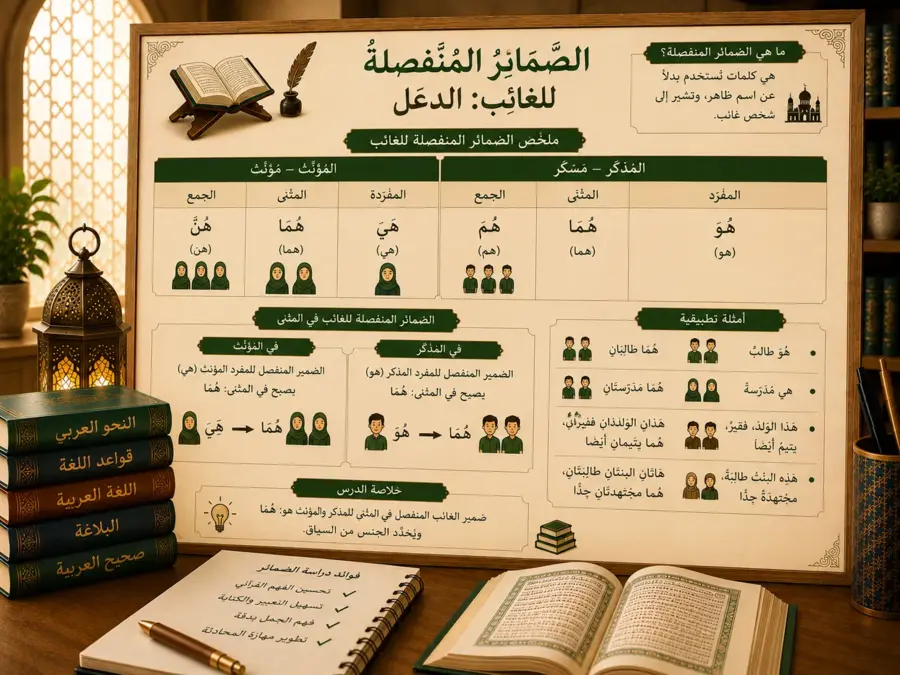
The Arabic pronoun هُمَا is a very important personal pronoun. It is used to speak about two absent people or two absent things. In Arabic grammar, this is called the dual form, known in Arabic as المُثَنَّى.
In this lesson, we will study how to use هُمَا as a detached third-person dual pronoun. This rule is essential for students who learn Arabic because Arabic clearly distinguishes between singular, dual and plural forms.
This lesson is useful for beginners, but also for students who want to improve their understanding of literary Arabic, Modern Standard Arabic and Quranic Arabic.
Understanding Arabic Personal Pronouns
Personal pronouns replace nouns or refer to people without repeating their names. In Arabic, pronouns change according to person, gender and number.
Arabic distinguishes between:
- singular: one person or one thing;
- dual: two people or two things;
- plural: three people or more.
This distinction is very important because the dual form exists clearly in Arabic, while English does not use it in the same way.
What Is a Detached Pronoun in Arabic?
A detached pronoun is a pronoun that can appear independently in the sentence. In Arabic, it is called ضَمِيرٌ مُنْفَصِلٌ.
Examples:
- هُوَ: he;
- هِيَ: she;
- هُمَا: they two.
A detached pronoun can be used to emphasize, identify a person or build a nominal sentence.
The Pronoun هُمَا for the Arabic Dual
The pronoun هُمَا is used to speak about two absent people or two absent things. It is special because it is used for both the masculine dual and the feminine dual.
The context helps students understand whether it refers to two men, two women, two boys, two girls or two things.
هُمَا for the Masculine Dual
When we speak about two absent masculine people or things, we use هُمَا.
Example:
هُوَ طَالِبٌ
He is a student.
هُمَا طَالِبَانِ
They are both students.
In this example, هُمَا replaces two masculine people.
هُمَا for the Feminine Dual
When we speak about two absent feminine people or things, we also use هُمَا.
Example:
هِيَ مُدَرِّسَةٌ
She is a teacher.
هُمَا مُدَرِّسَتَانِ
They are both female teachers.
In this example, هُمَا replaces two feminine people.
Table of Third-Person Arabic Pronouns
| Gender and Number | Arabic Pronoun | Meaning |
|---|---|---|
| Masculine singular | هُوَ | he |
| Masculine dual | هُمَا | they two |
| Masculine plural | هُمْ | they |
| Feminine singular | هِيَ | she |
| Feminine dual | هُمَا | they two |
| Feminine plural | هُنَّ | they, feminine |
This table shows that هُمَا is the same form for the masculine dual and the feminine dual.
Simple Examples with هُمَا
Here are several examples to understand how هُمَا is used in Arabic sentences.
- هُمَا طَالِبَانِ: they are both students.
- هُمَا مُدَرِّسَتَانِ: they are both female teachers.
- هَذَانِ الوَلَدَانِ فَقِيرَانِ، هُمَا يَتِيمَانِ أَيْضًا: these two boys are poor, they are also orphans.
- هَاتَانِ البِنْتَانِ طَالِبَتَانِ، هُمَا مُجْتَهِدَتَانِ جِدًّا: these two girls are students, they are very hardworking.
In these examples, the pronoun هُمَا always refers to two people.
How to Recognize the Dual in Arabic
To use هُمَا correctly, students need to recognize the dual form in Arabic. The dual indicates that there are two elements.
It is often recognized through the following endings:
- ـَانِ in the nominative case;
- ـَيْنِ in the accusative or genitive case.
Examples:
- طَالِبَانِ: two students;
- مُدَرِّسَتَانِ: two female teachers;
- وَلَدَانِ: two boys;
- بِنْتَانِ: two girls.
Difference Between هُوَ, هِيَ, هُمَا, هُمْ and هُنَّ
It is important to distinguish third-person Arabic pronouns clearly.
- هُوَ means “he” for one masculine person.
- هِيَ means “she” for one feminine person.
- هُمَا means “they two”.
- هُمْ means “they” for three or more masculine people.
- هُنَّ means “they” for three or more feminine people.
The pronoun هُمَا should not be confused with هُمْ or هُنَّ, because it refers only to two elements.
Common Mistakes to Avoid
Here are some common mistakes made by students who learn Arabic pronouns:
- using هُمْ for two people instead of هُمَا;
- using هُنَّ for two women instead of هُمَا;
- forgetting that هُمَا is used for both masculine and feminine dual forms;
- confusing the dual with the plural;
- not making the rest of the sentence agree with the dual.
These mistakes are normal at the beginning. They gradually decrease with reading, exercises and correction from a teacher.
Learn Arabic Pronouns with a Teacher
Arabic personal pronouns require students to understand person, gender, singular, dual and plural forms. The pronoun هُمَا is a good example of the precision of Arabic grammar.
To learn Arabic effectively, online Arabic classes with an Arabic teacher online help students move step by step. A teacher can correct your mistakes, explain the rules and provide exercises adapted to your level.
At Al-Dirassa, you can take private Arabic lessons, start Arabic for beginners, progress in Modern Standard Arabic, strengthen your Quranic Arabic or revise with resources such as the Arabic alphabet.
Book your free trial of 30 minutes
Registration form
Conclusion
The detached Arabic personal pronoun هُمَا is used to speak about two absent people or two absent things. It is used for both the masculine dual and the feminine dual.
The context helps students understand whether هُمَا means “they two” in a masculine or feminine sense. This rule shows the importance of the dual form in Arabic, an essential concept for understanding Arabic grammar.
With a progressive method, regular exercises and correction from a teacher, Arabic personal pronouns become clearer and easier to use in real sentences.



No Comments
No comments yet.