
Arabic personal pronouns are one of the essential foundations of Arabic grammar. They allow you to speak about yourself, address someone directly or refer to a person who is absent. To learn Arabic correctly, it is important to understand how these pronouns work, because they appear very often in Arabic sentences.
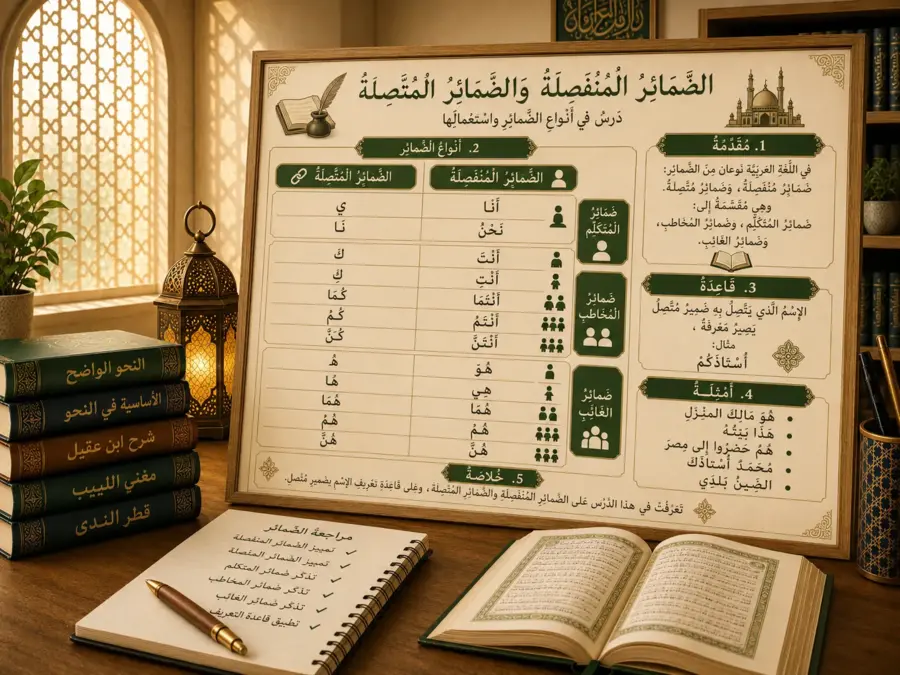
In Arabic, personal pronouns are mainly divided into two categories: detached pronouns, called الضَّمَائِرُ الْمُنْفَصِلَةُ, and attached pronouns, called الضَّمَائِرُ الْمُتَّصِلَةُ. Both types are essential for Arabic reading, Arabic writing, Modern Standard Arabic and Quranic Arabic.
This lesson is suitable for Arabic for beginners, adults, children and anyone who wants to learn Arabic online with a clear and progressive method.
What Are Arabic Personal Pronouns?
A personal pronoun is a word that replaces a noun or refers to a person. In English, common personal pronouns include “I”, “you”, “he”, “she”, “we”, “they” and “you all”.
In Arabic, personal pronouns vary according to several elements:
- person: first, second or third person;
- number: singular, dual or plural;
- gender: masculine or feminine;
- form: detached pronoun or attached pronoun.
Arabic also has a special dual form. It is used to refer to two people or two things. This is an important point in Arabic grammar because English does not use the dual in the same way.
The Two Types of Arabic Personal Pronouns
To understand Arabic pronouns clearly, it is important to distinguish between detached pronouns and attached pronouns. They do not play exactly the same role in a sentence.
Detached Pronouns in Arabic
Detached pronouns, or الضَّمَائِرُ الْمُنْفَصِلَةُ, are independent pronouns. They can appear on their own in a sentence.
For example:
- أَنَا: I;
- أَنْتَ: you, masculine singular;
- أَنْتِ: you, feminine singular;
- هُوَ: he;
- هِيَ: she;
- نَحْنُ: we.
Example:
أَنَا طَالِبٌ
I am a student.
In this sentence, أَنَا is a detached pronoun. It identifies the person who is speaking.
Attached Pronouns in Arabic
Attached pronouns, or الضَّمَائِرُ الْمُتَّصِلَةُ, are not used independently. They attach to a noun, a verb or a particle.
When attached to a noun, they often express possession. For example:
- كِتَابِي: my book;
- كِتَابُكَ: your book, masculine singular;
- كِتَابُكِ: your book, feminine singular;
- كِتَابُهُ: his book;
- كِتَابُهَا: her book;
- كِتَابُنَا: our book.
These forms are very useful for expanding Arabic vocabulary and building simple Arabic sentences.
Arabic Pronouns by Person
As in English, Arabic personal pronouns are classified according to person: first person, second person and third person.
First Person: I and We
The first person refers to the speaker.
- أَنَا: I;
- نَحْنُ: we.
The corresponding attached pronouns are:
- ـِي: my;
- ـنَا: our.
Examples:
أَنَا خَالِدٌ
I am Khalid.
بَيْتِي قَرِيبٌ
My house is near.
Second Person: You
The second person refers to the person being addressed. In Arabic, it changes according to gender and number.
- أَنْتَ: you, masculine singular;
- أَنْتِ: you, feminine singular;
- أَنْتُمَا: you two;
- أَنْتُمْ: you, masculine plural;
- أَنْتُنَّ: you, feminine plural.
The corresponding attached pronouns are:
- ـكَ: your, masculine singular;
- ـكِ: your, feminine singular;
- ـكُمَا: your, dual;
- ـكُمْ: your, masculine plural;
- ـكُنَّ: your, feminine plural.
Example:
أَنْتَ تِلْمِيذٌ وَمُحَمَّدٌ أُسْتَاذُكَ
You are a student, and Mohammed is your teacher.
Third Person: He, She and They
The third person refers to someone or a group being spoken about.
- هُوَ: he;
- هِيَ: she;
- هُمَا: they two;
- هُمْ: they, masculine plural;
- هُنَّ: they, feminine plural.
The corresponding attached pronouns are:
- ـهُ: his;
- ـهَا: her;
- ـهُمَا: their, dual;
- ـهُمْ: their, masculine plural;
- ـهُنَّ: their, feminine plural.
Example:
هَذَا بَيْتُهُ
This is his house.
Arabic Personal Pronouns Table
| Person | Detached Pronoun | Meaning | Attached Pronoun | Possessive Meaning |
|---|---|---|---|---|
| 1st person singular | أَنَا | I | ـِي | my |
| 1st person plural | نَحْنُ | we | ـنَا | our |
| 2nd person masculine singular | أَنْتَ | you | ـكَ | your |
| 2nd person feminine singular | أَنْتِ | you | ـكِ | your |
| 2nd person dual | أَنْتُمَا | you two | ـكُمَا | your, dual |
| 2nd person masculine plural | أَنْتُمْ | you | ـكُمْ | your |
| 2nd person feminine plural | أَنْتُنَّ | you | ـكُنَّ | your |
| 3rd person masculine singular | هُوَ | he | ـهُ | his |
| 3rd person feminine singular | هِيَ | she | ـهَا | her |
| 3rd person dual | هُمَا | they two | ـهُمَا | their, dual |
| 3rd person masculine plural | هُمْ | they | ـهُمْ | their |
| 3rd person feminine plural | هُنَّ | they | ـهُنَّ | their |
How to Use Attached Pronouns in Arabic
When an attached pronoun is added to a noun, the noun becomes definite. This means that it does not take a final double vowel, called tanween.
For example:
أُسْتَاذٌ
A teacher.
But with an attached pronoun:
أُسْتَاذُكَ
Your teacher.
The word أُسْتَاذُكَ is made definite by the attached pronoun ـكَ. Therefore, it does not take tanween.
This rule is very important for improving Arabic reading, Arabic grammar and the understanding of nominal sentences.
Examples of Arabic Personal Pronouns in Sentences
Here are several examples to understand how Arabic personal pronouns are used:
- هُوَ مَالِكُ الْمَنْزِلِ: he is the owner of the house.
- هَذَا بَيْتُهُ: this is his house.
- هُمْ حَضَرُوا إِلَى مِصْرَ: they came to Egypt.
- هَذِهِ فَنَادِقُهُمْ: these are their hotels.
- أَنْتَ تِلْمِيذٌ وَمُحَمَّدٌ أُسْتَاذُكَ: you are a student, and Mohammed is your teacher.
- أَنْتِ وَزَمِيلاتُكِ قَرَأْتُنَّ الْكِتَابَ: you and your classmates read the book.
- أَنَا خَالِدٌ وَالصِّينُ بَلَدِي: I am Khalid, and China is my country.
- أَنَا وَمُحَمَّدٌ زَمِيلَانِ، بُيُوتُنَا عِنْدَ الْمَسْجِدِ: Mohammed and I are classmates; our houses are near the mosque.
These examples show that Arabic pronouns do more than replace nouns. They also express possession, identify the subject and help build more precise sentences.
Tips to Memorize Arabic Pronouns
To memorize Arabic personal pronouns, it is better to progress step by step. Trying to learn all pronouns at once can make the lesson difficult, especially for a beginner.
Here is a simple method:
- Start with the most common detached pronouns: أَنَا, أَنْتَ, هُوَ, هِيَ and نَحْنُ.
- Then add the attached pronouns used for possession: ـِي, ـكَ, ـكِ, ـهُ and ـهَا.
- Use each pronoun with simple words such as book, house, teacher, student or country.
- Read the sentences aloud to improve your Arabic pronunciation.
- Review regularly with short examples.
This progressive approach helps strengthen Arabic grammar, Arabic vocabulary and Arabic reading. It is suitable for both Arabic classes for adults and Arabic classes for kids.
Learn Arabic Grammar with a Teacher
Personal pronouns are essential for understanding Arabic sentences. They are used in simple texts, conversations, Modern Standard Arabic and Quranic Arabic.
To learn Arabic effectively, students need a clear method, regular exercises and personalized correction. With online Arabic classes, you can study Arabic pronouns, Arabic grammar, Arabic reading, Arabic pronunciation and vocabulary with a private Arabic tutor who guides your progress step by step.
At Al-Dirassa, you can take private Arabic lessons, start Arabic for beginners, study Modern Standard Arabic, improve your Quranic Arabic or register your child for Arabic classes for kids.
Book your free trial of 30 minutes
Registration form
Conclusion
Arabic personal pronouns are divided into two main categories: detached pronouns, such as أَنَا, أَنْتَ, هُوَ and هِيَ, and attached pronouns, such as ـِي, ـكَ, ـهُ and ـهَا.
This lesson helps you understand an essential point of Arabic grammar. However, learning Arabic fully requires a progressive method, regular practice, exercises, correct pronunciation and feedback from a teacher. With personalized learning and consistent practice, Arabic becomes clearer, more structured and easier to use.



No Comments
No comments yet.