
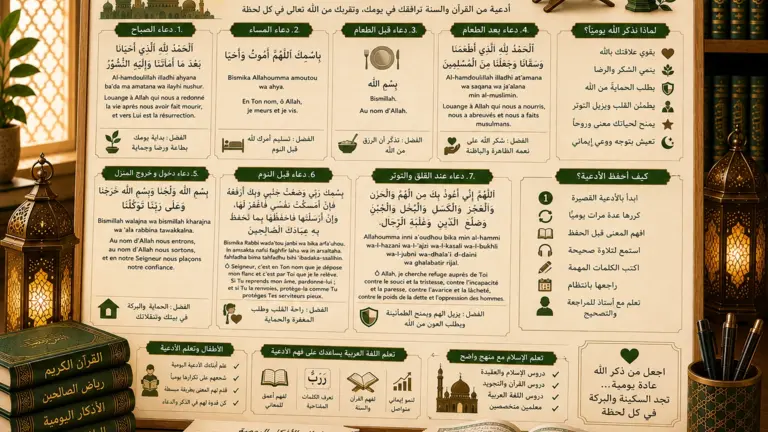
Daily supplications in Islam, also called duas, accompany the Muslim in simple moments of the day: waking up, eating, finishing a meal, entering or leaving the house, going to sleep or facing difficulty.
These supplications are not merely formulas to recite mechanically. They help the believer keep a living connection with Allah, strengthen faith, develop gratitude and give spiritual meaning to ordinary daily actions.
This article presents the main duas to include in a simple Muslim routine. For more detailed morning, evening or bedtime adhkar, dedicated guides are linked in the relevant sections.
To strengthen your understanding of faith, supplication and the remembrance of Allah, you can also visit our page to learn Islam.
Key points about daily supplications
Daily supplications help the Muslim remember Allah during ordinary actions. They help begin the day with gratitude, eat with awareness, leave home with trust, sleep under Allah’s protection and seek His help during hardship.
Among the essential supplications of daily life are:
- the supplication upon waking up;
- the supplication before eating;
- the supplication after eating;
- the supplication when entering the house;
- the supplication when leaving the house;
- the supplication before entering the restroom;
- the supplication after leaving the restroom;
- the supplication before sleeping;
- supplications during stress, fear or difficulty;
- essential duas such as Ayat al-Kursi, istikhara and the dua for knowledge.
The aim is to gradually build a simple, regular and sincere routine.
Why include supplications in daily life?
The Muslim is encouraged to remember Allah in every situation. Daily supplications transform ordinary actions into acts of faith: waking up, eating, leaving, returning, sleeping or facing anxiety.
Making dua regularly helps to:
- strengthen the relationship with Allah;
- develop gratitude;
- ask for divine protection;
- calm the heart during hardship;
- live the day with greater spiritual awareness;
- better understand the words of Prophet Muhammad ﷺ;
- teach children a simple religious routine.
These supplications are part of a broader learning of faith, prayer, character and the remembrance of Allah. To study these topics with structure, students can follow Islamic studies online courses.
Supplication upon waking up
Beginning the day with a supplication allows the believer to thank Allah for waking up and remember that every new day is an opportunity to do good.
Arabic text:
الْحَمْدُ لِلَّهِ الَّذِي أَحْيَانَا بَعْدَ مَا أَمَاتَنَا وَإِلَيْهِ النُّشُورُ
Transliteration: Al-hamdu liLlahi lladhi ahyana ba‘da ma amatana wa ilayhi n-nushur.
Meaning: Praise be to Allah who gave us life after causing us to die, and to Him is the resurrection.
Meaning explained: This supplication reminds the believer that sleep resembles a minor death and that waking up is a blessing granted by Allah.
For a complete list of morning supplications with adhkar in Arabic, transliteration and English, read our dedicated guide: morning adhkar in Islam.
Supplication before eating
Food is a blessing from Allah. Saying a supplication before eating allows the Muslim to begin the meal with gratitude and awareness.
Arabic text:
بِسْمِ اللَّهِ
Transliteration: BismiLlah.
Meaning: In the name of Allah.
Meaning explained: This short supplication reminds the believer that food comes from Allah and that the meal begins by seeking His blessing.
What to say if one forgets Bismillah before eating
If a person forgets to say Bismillah at the beginning of the meal, it may be said when remembered.
Arabic text:
بِسْمِ اللَّهِ أَوَّلَهُ وَآخِرَهُ
Transliteration: BismiLlahi awwalahu wa akhirah.
Meaning: In the name of Allah at the beginning and at the end.
Meaning explained: This formula allows the believer to return to Allah’s remembrance even after forgetting.
Supplication after eating
After eating, the Muslim thanks Allah for the food and drink granted. This habit anchors gratitude in daily life.
Arabic text:
الْحَمْدُ لِلَّهِ الَّذِي أَطْعَمَنِي هَذَا وَرَزَقَنِيهِ مِنْ غَيْرِ حَوْلٍ مِنِّي وَلَا قُوَّةٍ
Transliteration: Al-hamdu liLlahi lladhi at‘amani hadha wa razaqanihi min ghayri hawlin minni wa la quwwah.
Meaning: Praise be to Allah who fed me this and provided it for me without any power or strength from me.
Meaning explained: This supplication reminds the believer that material blessings come from Allah and should not be taken for granted.
Supplication when entering the house
Entering the home is a simple moment, but Islam teaches the believer to bring Allah’s remembrance, blessing and trust into it.
Arabic text:
بِسْمِ اللَّهِ وَلَجْنَا، وَبِسْمِ اللَّهِ خَرَجْنَا، وَعَلَى رَبِّنَا تَوَكَّلْنَا
Transliteration: BismiLlahi walajna, wa bismiLlahi kharajna, wa ‘ala Rabbina tawakkalna.
Meaning: In the name of Allah we enter, in the name of Allah we leave, and upon our Lord we place our trust.
Meaning explained: This supplication helps the believer place the home and family under trust in Allah.
Supplication when leaving the house
When the Muslim leaves home, one asks Allah for protection, uprightness and safety from harm.
Arabic text:
بِسْمِ اللَّهِ، تَوَكَّلْتُ عَلَى اللَّهِ، وَلَا حَوْلَ وَلَا قُوَّةَ إِلَّا بِاللَّهِ
Transliteration: BismiLlah, tawakkaltu ‘ala Llah, wa la hawla wa la quwwata illa biLlah.
Meaning: In the name of Allah, I place my trust in Allah, and there is no power nor strength except through Allah.
Meaning explained: This supplication reminds the believer to entrust movements, meetings and daily affairs to Allah.
Supplication before entering the restroom
Even in the most ordinary moments, the believer learns to seek Allah’s protection.
Arabic text:
اللَّهُمَّ إِنِّي أَعُوذُ بِكَ مِنَ الْخُبُثِ وَالْخَبَائِثِ
Transliteration: Allahumma inni a‘udhu bika mina l-khubuthi wa l-khaba’ith.
Meaning: O Allah, I seek refuge in You from male and female devils.
Supplication after leaving the restroom
After leaving the restroom, the Muslim may ask Allah for forgiveness.
Arabic text:
غُفْرَانَكَ
Transliteration: Ghufranak.
Meaning: I seek Your forgiveness.
5 essential supplications every Muslim should know
Some supplications have a special place in Muslim life. They are not limited to one moment of the day, but accompany decisions, protection, knowledge, gratitude and hardship.
1. Supplication for guidance: istikhara
Istikhara is a supplication the Muslim recites when asking Allah for guidance in an important decision. It expresses complete trust in Allah’s knowledge and wisdom.
2. Supplication of protection: Ayat al-Kursi
Ayat al-Kursi is among the greatest verses of the Quran. It reminds the believer of Allah’s greatness, sovereignty, knowledge and protection.
Reference: Surah Al-Baqarah, 2:255.
This verse is often recited in morning adhkar, evening adhkar and before sleeping. For a full protection routine, read our guide on evening and bedtime adhkar.
3. Supplication for knowledge
Arabic text:
رَبِّ زِدْنِي عِلْمًا
Transliteration: Rabbi zidni ‘ilma.
Meaning: My Lord, increase me in knowledge.
Reference: Surah Ta-Ha, 20:114.
4. Supplication for gratitude and worship
Arabic text:
اللَّهُمَّ أَعِنِّي عَلَى ذِكْرِكَ، وَشُكْرِكَ، وَحُسْنِ عِبَادَتِكَ
Transliteration: Allahumma a‘inni ‘ala dhikrika, wa shukrika, wa husni ‘ibadatik.
Meaning: O Allah, help me remember You, thank You and worship You in the best way.
5. Supplication during difficulty
Arabic text:
اللَّهُمَّ لَا سَهْلَ إِلَّا مَا جَعَلْتَهُ سَهْلًا، وَأَنْتَ تَجْعَلُ الْحَزْنَ إِذَا شِئْتَ سَهْلًا
Transliteration: Allahumma la sahla illa ma ja‘altahu sahla, wa Anta taj‘alu l-hazna idha shi’ta sahla.
Meaning: O Allah, nothing is easy except what You make easy, and You make difficulty easy if You will.
Evening supplication: ending the day with remembrance of Allah
Evening allows the believer to thank Allah, seek forgiveness for shortcomings and ask for His protection during the night.
Evening supplications include Ayat al-Kursi, Surahs Al-Ikhlas, Al-Falaq and An-Nas, as well as several formulas of protection and trust in Allah.
To avoid mixing search intents, the detailed evening supplications are gathered in our complete guide: evening and bedtime adhkar.
Supplication before sleeping
Before sleeping, the believer entrusts the soul to Allah. This supplication calms the heart and reminds us that life, sleep and waking are in His hands.
Arabic text:
بِاسْمِكَ اللَّهُمَّ أَمُوتُ وَأَحْيَا
Transliteration: Bismika Allahumma amutu wa ahya.
Meaning: In Your name, O Allah, I die and I live.
Supplication during stress, sadness or anxiety
Moments of stress, worry and sadness are part of life. Supplication allows the believer to seek refuge in Allah and regain inner stability.
Arabic text:
اللَّهُمَّ إِنِّي أَعُوذُ بِكَ مِنَ الْهَمِّ وَالْحَزَنِ، وَالْعَجْزِ وَالْكَسَلِ، وَالْبُخْلِ وَالْجُبْنِ، وَضَلَعِ الدَّيْنِ وَغَلَبَةِ الرِّجَالِ
Transliteration: Allahumma inni a‘udhu bika mina l-hammi wa l-hazan, wa l-‘ajzi wa l-kasal, wa l-bukhli wa l-jubn, wa dala‘i d-dayn wa ghalabati r-rijal.
Meaning: O Allah, I seek refuge in You from worry and sadness, from incapacity and laziness, from miserliness and cowardice, from the burden of debt and the domination of people.
How to memorize daily supplications in Arabic
For many learners, memorizing supplications in Arabic may seem difficult at first. However, with a gradual method, it becomes possible to learn them, understand them and recite them with greater presence.
- Begin with the shortest supplications.
- Repeat each dua in its real context.
- Learn the general meaning before full memorization.
- Listen to correct recitation to improve pronunciation.
- Write important words to strengthen Arabic vocabulary.
- Review regularly with an Arabic or Islamic studies teacher.
Children can also gradually learn short daily supplications, especially when repeated gently as a family. To support them, Al-Dirassa offers Islamic courses for children.
Learning Arabic to better recite supplications
Reading a supplication in transliteration can help at the beginning. But learning Arabic helps improve pronunciation, understand the meaning of duas and recognize frequent words in the Quran and Sunnah.
To recite supplications more accurately, it is useful to follow a structured path to learn Arabic online.
Studying a Quranic Arabic course also helps students better understand supplications, verses and religious vocabulary.
To improve recitation of the surahs and verses used in adhkar, you can explore our program to learn Quran and Tajweed online.
Building a simple routine of daily supplications
It is not necessary to learn everything at once. A lasting routine often begins with a few simple and regular supplications.
You can begin with:
- the supplication upon waking up;
- Bismillah before eating;
- the supplication after eating;
- the supplication when leaving the house;
- the supplication before sleeping.
Then you can gradually add morning adhkar, evening adhkar, travel supplications, supplications during hardship or formulas of seeking forgiveness.
To organize these supplications into a complete spiritual practice, read our guide on the Muslim daily routine with dhikr, adhkar and istighfar.
For more articles related to supplications, dhikr and Muslim life, you can visit our Islam and culture section.
Book your free trial of 30 minutes
Registration form
FAQ — Daily supplications in Islam
What are the most important daily supplications?
Important daily supplications include duas for waking up, eating, finishing a meal, entering and leaving the house, sleeping, and facing difficulty or stress.
What supplication should be said upon waking up?
One may say: Al-hamdu liLlahi lladhi ahyana ba‘da ma amatana wa ilayhi n-nushur, meaning: Praise be to Allah who gave us life after causing us to die, and to Him is the resurrection.
What supplication should be said before eating?
Before eating, the Muslim simply says: BismiLlah, meaning: In the name of Allah.
What are 5 essential duas to know?
Essential supplications include istikhara for guidance, Ayat al-Kursi for protection, Rabbi zidni ‘ilma for knowledge, Allahumma a‘inni ‘ala dhikrika for gratitude and Allahumma la sahla for ease.
Can daily supplications be recited in English?
Yes, it is permissible to call upon Allah in English or in one’s own language. However, learning supplications in Arabic remains beneficial for preserving their wording and pronunciation.
How can daily supplications be learned easily?
It is recommended to begin with short supplications, repeat them in their context, understand their meaning and learn them gradually with consistency.
Conclusion: living the day in remembrance of Allah
Daily supplications help the Muslim remain connected to Allah in the simplest moments of the day. They strengthen faith, nourish gratitude, calm the heart and transform ordinary habits into opportunities for remembrance.
This article presents the main duas to gradually include in daily life. For a more complete practice, one can structure the day around dhikr, morning and evening adhkar, istighfar and supplications before sleeping.
With a clear method, regular practice and correction from a teacher, it becomes easier to understand, memorize and recite supplications with presence of heart.





No Comments
No comments yet.
No comments yet.