
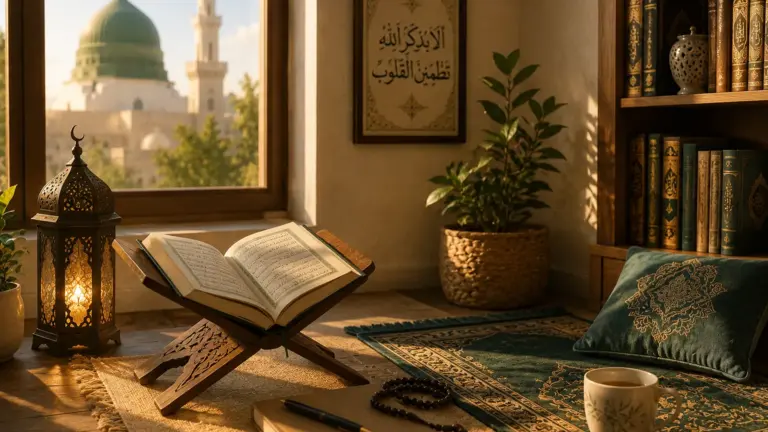
The Muslim was not created to live detached from the remembrance of Allah. On the contrary, dhikr, daily adhkar and istighfar are the living heart of faith, the permanent link between the servant and the Lord.
In a world marked by distraction, agitation and forgetfulness, the Muslim daily routine rests on a simple but fundamental principle: remembering Allah regularly, sincerely, authentically and consistently.
This article explains how to organize the day around dhikr, morning and evening adhkar, supplications after prayer, istighfar and bedtime supplications, without turning religion into an excessive burden.
To put this routine into practice, Al-Dirassa also offers resources and courses to learn Islam with structure.
Key points about the Muslim daily routine
The Muslim spiritual routine is not based on excessive quantity, but on consistency. It helps the believer begin the day under Allah’s protection, maintain the link with Him during daily occupations, purify the heart through istighfar and end the day in remembrance.
A simple routine may include:
- morning adhkar;
- a few daily supplications;
- adhkar after obligatory prayers;
- istighfar during the day;
- evening adhkar;
- supplications before sleeping;
- reciting or listening to Quran;
- sending blessings upon the Prophet ﷺ.
The most important step is to begin with a realistic routine and then progress gently.
What is dhikr in Islam?
The word dhikr means remembrance. In Islam, it refers to every form of remembering Allah, whether by the tongue, the heart or actions.
Dhikr includes:
- reciting the Quran;
- glorifying Allah: SubhanAllah;
- praising Allah: Al-hamdu liLlah;
- declaring Allah’s oneness: La ilaha illa Allah;
- magnifying Allah: Allahu akbar;
- seeking forgiveness: Astaghfiru Allah;
- sending blessings upon the Prophet ﷺ.
Allah says in the Quran:
Meaning: O you who believe, remember Allah with much remembrance.
Reference: Surah Al-Ahzab, 33:41.
This verse shows that remembrance of Allah should not be exceptional. It should accompany the believer’s life.
Difference between dhikr, adhkar and istighfar
To build a balanced spiritual routine, it is useful to distinguish three complementary concepts.
Dhikr
Dhikr is the general term. It refers to every remembrance of Allah, without a specific time: praise, glorification, Quran recitation, seeking forgiveness or supplication.
Adhkar
Adhkar are specific formulas of remembrance, often connected to specific moments:
- morning;
- evening;
- after obligatory prayers;
- before sleeping;
- when entering or leaving the house;
- during fear, difficulty or gratitude.
Istighfar
Istighfar is seeking forgiveness from Allah. It is part of dhikr and an important key to purifying the heart, returning to Allah and finding relief during hardship.
These three elements together form the foundation of the practicing Muslim’s routine.
Why is dhikr essential in the believer’s life?
Dhikr is not a secondary practice. It nourishes the heart, reminds the believer of the purpose of existence and helps one remain attached to Allah in ease and hardship.
Remembering Allah helps to:
- calm the heart;
- strengthen faith;
- drive away heedlessness;
- resist harmful thoughts;
- return to Allah after a mistake;
- keep a spiritual view of life;
- protect the day and night.
Allah says:
Meaning: Surely, in the remembrance of Allah do hearts find peace.
Reference: Surah Ar-Ra‘d, 13:28.
This peace does not mean the complete absence of trials, but an inner stability that helps the believer face them with more faith and trust.
Morning adhkar: beginning the day under Allah’s protection
Morning is a decisive moment. It is when the believer sets intentions, begins the day and asks Allah for protection, guidance and barakah.
Morning adhkar help the Muslim to:
- entrust the day to Allah;
- ask for protection from visible and invisible harms;
- renew faith;
- begin the day with gratitude;
- protect oneself from heedlessness.
For detailed formulas in Arabic, transliteration and English, read our complete guide on morning adhkar in Islam.
Daily supplications: keeping the link with Allah in simple actions
Between the main moments of remembrance, the Muslim can also remember Allah in ordinary actions: waking up, eating, leaving, returning, beginning a task, facing difficulty or going to sleep.
These daily supplications transform habits into opportunities for remembrance.
For a practical list of duas by moment of the day, read our guide on daily supplications in Islam.
After prayers: strengthening the relationship with Allah
The obligatory prayers are the pillars of the Muslim’s day. The moments after them are especially suitable for dhikr.
After prayer, the believer may recite:
- Astaghfiru Allah;
- SubhanAllah;
- Al-hamdu liLlah;
- Allahu akbar;
- supplications of protection and gratitude.
These adhkar extend presence of heart after salah and help maintain a spiritual connection between prayers.
Istighfar: seeking forgiveness every day
Istighfar is seeking forgiveness from Allah. It does not concern only major sins; it is part of the daily purification of the heart.
The believer may say:
أَسْتَغْفِرُ اللَّهَ
Transliteration: Astaghfiru Allah.
Meaning: I seek forgiveness from Allah.
Istighfar helps to:
- return to Allah after a mistake;
- purify the heart;
- fight heedlessness;
- develop humility;
- seek Allah’s mercy;
- strengthen spiritual awareness.
The Prophet ﷺ sought forgiveness from Allah very frequently. This shows that istighfar is not only for people far from religion; it is part of the believer’s daily life.
Evening adhkar: ending the day under Allah’s protection
Evening is a moment of review, gratitude and protection. The believer thanks Allah for blessings, seeks forgiveness for shortcomings and asks for protection during the night.
Evening adhkar include:
- Ayat al-Kursi;
- Surahs Al-Ikhlas, Al-Falaq and An-Nas;
- supplications of protection;
- requests for forgiveness;
- formulas of trust in Allah.
For the complete evening and bedtime supplications, read our guide on evening and bedtime adhkar.
Before sleeping: entrusting the soul to Allah
Sleep reminds the believer of dependence upon Allah. Before sleeping, the Muslim may recite supplications that express trust, entrusting the soul and asking for protection.
A short supplication before sleeping is:
بِاسْمِكَ اللَّهُمَّ أَمُوتُ وَأَحْيَا
Transliteration: Bismika Allahumma amutu wa ahya.
Meaning: In Your name, O Allah, I die and I live.
The believer may also recite the protective surahs and end the day with dhikr.
How to establish a simple spiritual routine
Establishing a spiritual routine does not mean doing everything immediately. The Sunnah teaches consistency, even in simple deeds.
A realistic routine can begin as follows:
- morning adhkar after Fajr;
- a short supplication before meals;
- a few minutes of Quran during the day;
- regular istighfar;
- dhikr after prayers;
- evening adhkar;
- a supplication before sleeping.
It is better to preserve a short routine throughout the year than a very long routine abandoned after a few days.
Common mistakes to avoid
Despite the simplicity of this routine, some mistakes can reduce its benefits.
Abandoning consistency
Initial enthusiasm may lead to intense but short-lived practice. Consistency is more important than a large quantity quickly abandoned.
Reciting mechanically without understanding
Dhikr remains a good deed, but its effect on the heart is stronger with presence, understanding and sincerity.
Limiting dhikr to moments of difficulty
Remembrance of Allah should not be reserved for times of distress. It is protection before trials, not only refuge after them.
Trying to memorize everything too quickly
The routine is built gradually. Starting small often helps one remain consistent longer.
Learning Arabic to better understand dhikr and adhkar
Reading supplications in transliteration can help at the beginning, but learning Arabic helps improve pronunciation, understanding and awareness of the formulas of remembrance.
To progress step by step, you can follow a structured path to learn Arabic online.
Studying a Quranic Arabic course also helps students understand frequent words from the Quran, adhkar and prophetic supplications.
Learning Quran and Islam with method
The Muslim daily routine becomes stronger when supported by a gradual understanding of faith, prayer, Quran and supplications.
To improve recitation and your connection with Allah’s Book, you can explore our program to learn Quran and Tajweed online.
Children can also learn the foundations of faith, short supplications and Muslim values through Islamic courses for children.
For more articles related to dhikr, supplications and Muslim life, visit our Islam and culture section.
Book your free trial of 30 minutes
Registration form
FAQ — Muslim daily routine, dhikr and istighfar
What is the difference between dhikr and adhkar?
Dhikr is remembrance of Allah in general. Adhkar are specific formulas of remembrance, often connected to particular times such as morning, evening, after prayer or before sleeping.
What simple spiritual routine can one begin with?
One can begin with morning adhkar, a few daily supplications, dhikr after prayers, istighfar during the day and a supplication before sleeping.
When should morning adhkar be recited?
The best-known time is after Fajr, at the beginning of the day. The essential point is to include them regularly in the morning routine.
When should evening adhkar be recited?
Evening adhkar are recited toward the end of the day, generally from the afternoon until the beginning of the night.
How many times should one make istighfar daily?
There is no single obligatory number for everyone. What matters most is consistency, even with a small amount, and gradual increase according to ability.
Does dhikr replace effort and taking means?
No. The Muslim combines remembrance of Allah, trust in Him and lawful means: work, treatment, learning, organization and responsibility.
How can one remain consistent in a routine?
Start small, choose fixed moments, avoid overloading yourself and connect the routine to habits already present, such as prayers, meals or sleep.
Conclusion: dhikr, the living heart of faith
The Muslim daily routine is not based on accumulating actions, but on consistency in remembering Allah. It is not quantity alone that transforms the heart, but regularity, sincerity and presence.
Dhikr, adhkar and istighfar are not secondary practices: they are a source of inner peace, protection, purification and closeness to Allah.
Beginning today, even with little, but with consistency, can transform the way one lives the day. Whoever attaches the heart to Allah’s remembrance sees the heart become brighter, trials become lighter and faith grow stronger day after day.





No Comments
No comments yet.
No comments yet.