

Many people who discover Islam ask where the Quran comes from. The question is sometimes phrased as “Who wrote the Quran?” or “Who made the Quran?” In Islamic belief, the answer is clear: the Quran is not considered a human work, but the Word of Allah revealed to Prophet Muhammad ﷺ.
To understand this belief properly, it is important to distinguish between several elements: the revelation of the Quran, its transmission, its memorization, its writing and its compilation into the Mushaf. These stages help explain the central place of the Quran in Islam and why learning it remains so important for Muslims.
In this article, we will explain the origin of the Quran in Islam, how it was revealed, transmitted and preserved, and why learning to read the Quran in Arabic is essential for those who want to study it seriously.
What Does It Mean to Ask About the Origin of the Quran?
When someone asks “who made the Quran?”, they may be looking for different types of answers. Some people want to understand the Muslim belief about the Quran. Others are interested in its history, its transmission or its compilation. This is why the answer should be precise and respectful.
From the Islamic perspective, the Quran is the revelation of Allah. Prophet Muhammad ﷺ did not compose it. He received it through revelation, recited it to his companions, taught it and instructed that its verses be memorized and written.
This distinction is important: Muslims believe that the Quran comes from Allah, while its text was transmitted to people through revelation, recitation, memorization and writing.
Is the Quran Considered the Word of Allah?
Yes. In the Muslim faith, the Quran is considered the Word of Allah revealed in the Arabic language. It has a unique place in Islam because it is the main source of guidance, belief, worship and moral direction.
Muslims therefore do not consider the Quran to be a book written by Prophet Muhammad ﷺ, nor a religious text produced by a community. They consider it to be divine revelation transmitted to the Prophet ﷺ.
This is why Quran reading, recitation, memorization and study occupy such an important place in Muslim spiritual and educational life.
The Revelation of the Quran to Prophet Muhammad ﷺ
According to Islamic tradition, the revelation of the Quran began when Prophet Muhammad ﷺ received the first verses through the angel Jibril. This revelation continued gradually over about 23 years.
The Quran was not revealed as a complete book given all at once. Its verses were revealed according to circumstances, the needs of the community, questions that arose and events experienced by the first Muslims.
The Role of Angel Jibril
The angel Jibril, known as Gabriel in English, is considered in Islam to be the intermediary through whom Allah transmitted revelation to Prophet Muhammad ﷺ. The Prophet ﷺ received the verses, recited them to his companions and taught them.
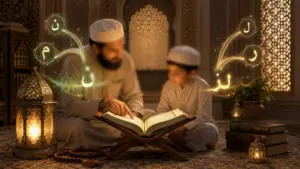
This oral transmission is essential to understanding the place of recitation in Islam. The Quran is not only a text to be read silently. It is also a recitation that is transmitted, listened to, repeated and preserved.
A Gradual Revelation over About 23 Years
The gradual revelation of the Quran accompanied the believers in different aspects of their lives: faith, worship, behavior, patience, justice, social relations and responsibility before Allah.
This gradual process also explains why some verses respond to specific situations. To understand the Quran properly, it is useful to study the context of revelation, the Arabic language and explanations transmitted by qualified scholars.
How Was the Quran Transmitted?
The Quran was transmitted through recitation, memorization and writing. During the lifetime of the Prophet ﷺ, his companions learned the verses, recited them, memorized them and some of them wrote them on the available materials of that time.
This dual transmission, oral and written, is central to the preservation of the Quran. Memorization remains a living tradition in the Muslim world until today.
Memorization by the Prophet ﷺ and His Companions
Prophet Muhammad ﷺ recited the Quran and taught it to his companions. Many of them memorized the verses carefully and recited them in prayer, teaching and transmission.
Quran memorization, also known as Hifz, remains an important goal for many Muslims. It requires correct reading, regular revision and often guidance from a teacher.
Writing the Verses during the Revelation Period
In addition to memorization, some companions wrote down the revealed verses. This writing was done on the materials available at the time. The Prophet ﷺ also indicated the placement of verses within the surahs.
It is therefore important to understand that the Quran was not transmitted only from memory without structure. Its recitation, order and writing were preserved carefully by the first Muslims.
The Compilation of the Quran into the Mushaf
After the death of the Prophet ﷺ, the companions gave great importance to preserving the Quran. The compilation of the text into the Mushaf allowed the verses to be gathered into one written form.
This stage does not mean that the Quran was “created” after the Prophet ﷺ. It means that the verses already revealed, memorized and written were gathered in order to preserve the text and facilitate its transmission.
This distinction is essential: revelation belongs to the prophetic period, while compilation refers to the written organization of the transmitted text.
Why Is the Quran in Arabic?
The Quran was revealed in the Arabic language. Arabic carries the recitation, sounds, structures and precision of the text. Translations can help people approach the general meaning, but they do not replace the Arabic text of the Quran.
This is why many Muslims seek to study Quranic Arabic, even when they are not native Arabic speakers. Understanding common words, recognizing structures and reading the Arabic text correctly can strengthen the learner’s relationship with the Quran.
To go further, studying Quranic Arabic can help students recognize frequent vocabulary and expressions from the Quran more easily.
Why Learn to Read the Quran in Arabic?
Learning to read the Quran in Arabic allows the student to recite the text in the language of revelation. For a beginner, this starts with Arabic letters, vowels, reading signs, then words and verses.
This step requires patience, but it is fundamental. It helps the learner avoid excessive dependence on phonetic transliteration and gradually enter into the real reading of the Quranic text.
A structured path to learn Quran can help the student progress step by step, from the foundations of reading to more fluent recitation.
The Link between Quran Reading, Recitation and Tajweed
Reading the Quran in Arabic is a first step. To improve recitation, the learner then needs to work on pronunciation, articulation points, pauses, elongations and Tajweed rules.
Tajweed helps the student recite the Quran with more precision. It is not learned only from books: it also requires listening, repetition and oral correction.
Tajweed lessons online can help students correct their recitation progressively, according to their level and learning needs.
Studying the Quran with a Qualified Teacher
Understanding the origin of the Quran can strengthen the desire to study it correctly. However, a complete Quran learning journey requires method, consistency and suitable correction.
With online Quran classes, students can learn to read, correct their recitation, study Tajweed or begin a memorization program with a qualified teacher.
For children, an adapted path of Quran classes for kids allows them to learn progressively, with simple goals and teaching adapted to their age.
Book your free trial of 30 minutes
Registration form
Conclusion: Understanding the Origin of the Quran to Study It Better
According to Islam, the Quran is the Word of Allah revealed to Prophet Muhammad ﷺ through the angel Jibril. It was transmitted through recitation, memorized by the companions, written during the period of revelation and later compiled into the Mushaf to preserve and transmit it.
Understanding this origin helps explain the central place of the Quran in Muslim life. But to truly study it, the learner needs to read it in Arabic, listen to correct recitation, correct pronunciation, discover Tajweed rules and progress regularly with guidance from a qualified teacher.



No Comments
No comments yet.