
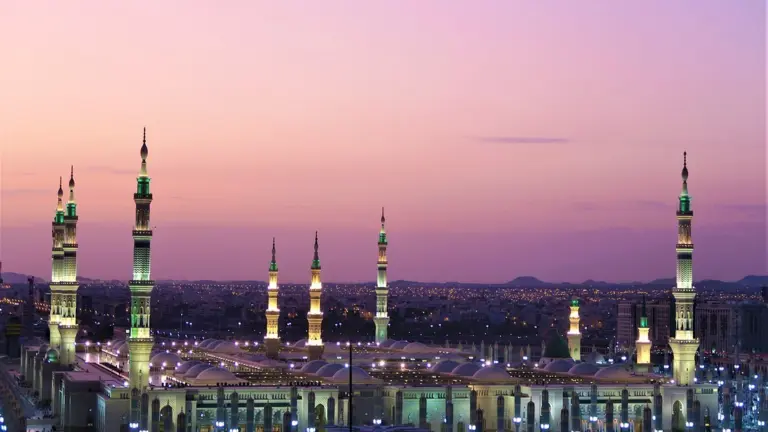
The Prophet’s Mosque in Madinah, called in Arabic Al-Masjid an-Nabawi or Masjid an-Nabawi, is one of the most important places in Islam. Located in the heart of Madinah, it holds a special place in Muslim history, spirituality and the memory of the Ummah.
After Makkah, Madinah is one of the most beloved cities for Muslims. It is connected to the Hijrah, the birth of the first organized Muslim community, the teaching of the Prophet ﷺ and the transmission of the foundations of Islam.
Understanding the history of Masjid an-Nabawi helps one better understand the importance of Madinah in Muslim faith. This mosque is not only a monument. It reminds believers of prayer, brotherhood, knowledge, patience, solidarity and the efforts of the first Muslims.
To better understand the foundations of faith, prayer, Sunnah and Islamic history, visit our page to learn Islam.
Key points about the Prophet’s Mosque in Madinah
Masjid an-Nabawi is the mosque built in Madinah after the Prophet ﷺ migrated from Makkah. It became one of the most important centers of religious, social and educational life for the first Muslims.
This mosque reminds us of several essential realities:
- the Hijrah of the Prophet ﷺ to Madinah;
- the birth of an organized Muslim community;
- the central place of the mosque in Islamic life;
- the teaching of the Quran and Sunnah;
- the brotherhood between the Muhajirun and the Ansar;
- the care for the poor and travelers;
- the presence of the Rawdah;
- the deep link between loving the Prophet ﷺ and following his teaching.
What is Masjid an-Nabawi?
Masjid an-Nabawi is the Mosque of the Prophet ﷺ in Madinah. It was built after the Prophet ﷺ arrived in the city, which was previously known as Yathrib.
It served as a place of prayer, teaching, consultation, community gathering and organization of Muslim life. Believers learned the Quran, rules of worship, good character and the principles of community life there.
Today, the mosque welcomes millions of visitors and worshippers. Many Muslims who perform Hajj or Umrah also travel to Madinah to pray in this mosque and remember the history of the Prophet ﷺ and his companions.
Why does Madinah hold an important place in Islam?
Madinah, also called Al-Madinah al-Munawwarah, has a central place in Islamic history. It is the city where the Muslim community found refuge after the persecution faced in Makkah.
The city became a place of safety, teaching and collective construction. Muslims learned there to live faith not only as an individual belief, but also as a social, family and community practice.
Madinah therefore reminds us of essential values: brotherhood among believers, welcoming the emigrants, patience through trials, obedience to Allah and transmission of religious knowledge.
The Hijrah and the arrival of the Prophet ﷺ in Madinah
The Hijrah, or migration of the Prophet ﷺ from Makkah to Madinah, took place in 622 CE. This event marks a major turning point in Islamic history. It represents the transition from a period of persecution to a stage of building, organization and transmission.
Before the arrival of the Prophet ﷺ, Madinah was known as Yathrib. The city had tribal tensions and internal divisions. The arrival of the Prophet ﷺ would deeply transform its role in Islamic history.
The Hijrah is also the starting point of the Islamic calendar. It reminds us that faith sometimes requires sacrifice, patience and deep trust in Allah.
In Madinah, the Prophet ﷺ established bonds of brotherhood between the Muslims who came from Makkah, known as the Muhajirun, and the people of Madinah who supported them, known as the Ansar. This brotherhood remains a powerful example for the Muslim community.
The construction of the Prophet’s Mosque
After arriving in Madinah, the Prophet ﷺ had a mosque built that would become Masjid an-Nabawi. The first construction was simple, modest and adapted to the needs of the new Muslim community.
This simplicity reminds us that the value of a mosque is not only in its architecture, but in the prayer, sincerity, knowledge, worship and brotherhood lived within it.
A simple mosque serving the community
The first mosque was built with simple materials. It met the essential needs of the believers: gathering, praying, learning and organizing religious life.
It also showed that Islam gives great importance to the mosque as a place of spirituality, but also as a place of education, consultation and solidarity.
A place of prayer, teaching and gathering
Masjid an-Nabawi was a place where the companions learned directly from the Prophet ﷺ. They received teachings about the Quran, Sunnah, prayer, purification, social relations, morals and belief.
The mosque therefore played a central role in the formation of the first Muslims. It was at the same time a place of worship, transmission and unity.
As-Suffah: a place of care and solidarity
Among the important elements connected to the first mosque was As-Suffah, an area where some poor companions, travelers or those without resources found shelter and support.
As-Suffah reminds us that the mosque was not only a place of individual prayer. It was also a place of brotherhood, mutual aid, knowledge and care for the most vulnerable.
This social dimension shows that Islam connects worship of Allah with good behavior toward others.
The historical expansions of Masjid an-Nabawi
Over the centuries, the Prophet’s Mosque went through many expansions and renovations. Caliphs, governors and Muslim authorities sought to preserve this place and welcome a growing number of worshippers.
These expansions transformed the original mosque into a vast architectural complex. Despite these developments, its spiritual importance remains connected to its origin: a place built for prayer, learning and remembrance of Allah.
The history of its expansions also shows the attachment of Muslims to Madinah and to preserving places connected to the beginnings of Islam.
The Rawdah and important places inside the Prophet’s Mosque
Among the well-known places in Masjid an-Nabawi is the Rawdah, called in Arabic ar-Rawdah. It is located between the house of the Prophet ﷺ and his minbar. Muslims consider it a particularly important place for prayer and reflection.
The mosque also contains spaces connected to the history of the first Muslims, religious teaching and the life of the community of Madinah.
It is important to visit these places with respect, modesty and restraint. The believer should avoid excessive behavior, pushing and any practice that does not respect Islamic rules.
What is the spiritual importance of Masjid an-Nabawi?
The Prophet’s Mosque holds a special place in the hearts of Muslims. It reminds them of the life of the Prophet ﷺ, his teachings, patience, mercy and role in transmitting the message of Islam.
Praying in this mosque has great merit. Many Muslims feel a deep sense of peace in Madinah because the city is connected to faith, knowledge, remembrance of Allah and Muslim brotherhood.
However, visiting Masjid an-Nabawi should not be reduced to emotion. It should also lead the Muslim to better learn Islam, follow the Sunnah with knowledge and improve religious practice in daily life.
Masjid an-Nabawi and the teaching of Islam
The Prophet’s Mosque was one of the first great centers of Islamic learning. The companions learned revealed verses, Quran recitation, rules of prayer, purification, belief, character and community life there.
This mosque reminds us that Islam is not learned only through emotion or attachment to sacred places. It is also learned through knowledge, transmission, practice and reform of character.
The believer who visits Madinah should therefore return with a stronger desire to learn, pray correctly, read Quran and follow the Sunnah sincerely.
How to visit the Prophet’s Mosque with respect
Visiting the Prophet’s Mosque requires respect, calmness and spiritual awareness. The Muslim should remember that one is entering a place of worship, prayer and remembrance of Allah.
Useful advice includes:
- preserve modesty and good behavior;
- avoid disturbing other worshippers;
- respect organizational instructions;
- increase prayer, dhikr and supplications;
- avoid arguments, pushing and excesses;
- learn the correct manners of visiting before traveling;
- keep a sincere intention and seek Allah’s pleasure.
The visitor should also distinguish sincere love for the Prophet ﷺ from excessive practices. Loving the Prophet ﷺ means respecting his teaching, following his Sunnah and worshipping Allah according to Islamic rules.
Visiting Madinah during Umrah or Hajj
Many Muslims visit Madinah during a journey for Umrah or Hajj. Visiting Madinah is not part of the rites of Umrah, but it remains a very important visit for many believers.
A Muslim may pray in Masjid an-Nabawi, remember the life of the Prophet ﷺ, reflect on the Hijrah, visit known places with respect and strengthen the connection with Islamic history.
To better understand the rites and spiritual meaning of Umrah, read our guide: Umrah in Islam.
Learning Islamic history with method
The history of Masjid an-Nabawi shows that Islam is learned through transmission, patience and method. The mosque was a place where the companions learned the Quran, prayer, belief, rules of worship and good character.
To deepen your understanding, you can read more articles about Islam and culture, covering history, religious practice, spirituality and Islamic culture.
If you wish to review the foundations of religion, our page to learn Islam helps you understand the basics of Islam step by step.
For structured learning with a teacher, explore our Islamic studies online courses, adapted to beginners, adults and students who wish to progress in Islamic sciences.
Since the history of Madinah is strongly connected to the Quran, prayer and Sunnah, you can also strengthen your recitation with our program to learn Quran and Tajweed online.
Learning Arabic also helps better understand religious texts, supplications and terms related to Islamic history. To progress step by step, explore our programs to learn Arabic online.
Studying a Quranic Arabic course also helps students better understand verses, religious concepts and Sunnah vocabulary.
Book your free trial of 30 minutes
Registration form
FAQ — Prophet’s Mosque in Madinah
What is the Prophet’s Mosque called in Arabic?
It is called Al-Masjid an-Nabawi, in Arabic المسجد النبوي. It is also commonly written as Masjid an-Nabawi.
Where is Masjid an-Nabawi located?
Masjid an-Nabawi is located in Madinah, Saudi Arabia. Madinah is one of the most important cities in Islamic history.
Why is the Prophet’s Mosque important?
It is connected to the Hijrah, the building of the first Muslim community in Madinah, the teaching of the Prophet ﷺ and the transmission of the Quran and Sunnah.
What is the Rawdah?
The Rawdah is an area located between the house of the Prophet ﷺ and his minbar. It is considered a very important place for prayer and reflection.
Is visiting Madinah part of Umrah rites?
No, visiting Madinah is not part of the rites of Umrah. However, many Muslims visit Madinah during their journey to pray in Masjid an-Nabawi and remember the history of the Prophet ﷺ.
What does As-Suffah represent?
As-Suffah was an area connected to the first mosque where some poor companions, travelers or those without resources found shelter, support and learning. It reminds us of solidarity and the place of knowledge in the Muslim community.
How should the Prophet’s Mosque be visited respectfully?
One should preserve modesty, avoid disturbing other worshippers, respect instructions, increase prayer and supplications, and avoid excessive behavior.
Conclusion: Masjid an-Nabawi, a place of faith, history and transmission
The Prophet’s Mosque in Madinah is a place deeply connected to Islamic history. It reminds Muslims of the Hijrah, the brotherhood of the first believers, the teaching of the Prophet ﷺ and the central place of the mosque in religious life.
Visiting Masjid an-Nabawi can be a powerful spiritual experience, but this visit should be accompanied by knowledge, respect and sincerity. The believer finds in it a strong reminder: love for Islam is also shown through learning, prayer, good character and following the Sunnah.
By studying the history of Madinah, the Prophet ﷺ and the first Muslims, the believer better understands the foundations of Islam and strengthens religious practice with greater awareness.



No Comments
No comments yet.
No comments yet.