
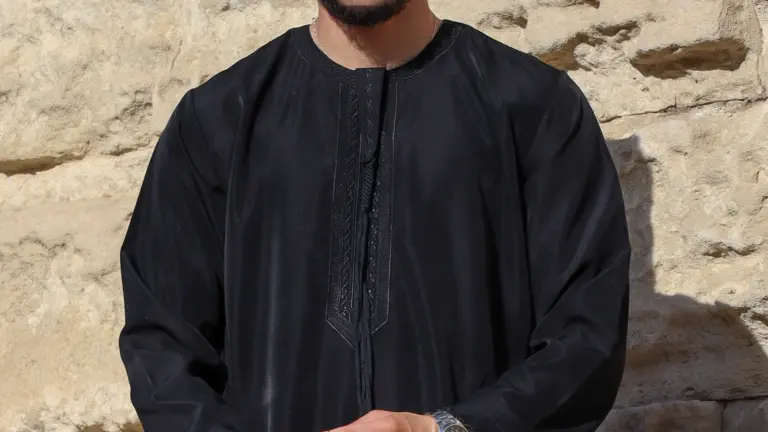
The qamis is a long, loose garment traditionally worn by many Muslim men in different parts of the world. It is often associated with modesty, simplicity and Islamic clothing traditions.
But what does the qamis really represent in Islam? Is it obligatory? What is its connection with awrah, modesty and Muslim behavior? To answer these questions, it is important to distinguish between religious rulings, cultural traditions and the general spirit of modesty encouraged by Islam.
In this article, we will explain what the qamis is, its origin, its meaning and the place it can have in a balanced Islamic practice.
What Is a Qamis?
The qamis is a long and loose garment for men, usually covering most of the body. Depending on the country and culture, it may also be called a thawb, jubbah, kandura or dishdasha.
Its shape varies from one region to another. In some Gulf countries, it is often white, straight and worn with a head covering. In North Africa, Egypt or South Asia, the cuts, fabrics and colors may be different.
The general idea remains the same: the qamis is a loose, covering and simple garment, often worn for prayer, religious occasions, celebrations or daily life.
Is the Qamis Obligatory in Islam?
The qamis, as a specific garment, is not an obligation for every Muslim man. Islam does not impose one single cultural outfit for all Muslims. Muslims live in different countries and cultures, with different clothing habits.
What Islam requires is respect for the general rules of modesty: covering what must be covered, avoiding indecent, transparent or provocative clothing, and maintaining a modest attitude.
The qamis can therefore be a good clothing choice because it is loose and covering. However, it should not be confused with the broader Islamic obligation of modesty.
Modesty in Islam: A Central Value
Modesty has an important place in Islamic practice. It does not only concern outward appearance, but also the gaze, speech, behavior and relationship with others.
In Islam, clothing should protect human dignity. It should also remind the believer that a person is not defined only by appearance, but by faith, conduct, sincerity and relationship with Allah.
The concept of awrah
The term awrah refers to the parts of the body that must be covered in front of those concerned by this ruling. This concept belongs to Fiqh, meaning the practical understanding of Islamic rulings.
For men, the awrah is generally understood to be the area between the navel and the knees, according to the well-known scholarly view. For women, the rulings are broader and may be explained according to context, schools of Fiqh and specific situations.
The qamis naturally helps cover the body in a loose way. This is why it is often associated with male modesty in Muslim societies.
Modesty in dress and behavior
Modesty is not limited to clothing. A person may wear traditional Islamic clothing while having poor manners. On the other hand, someone may gradually learn the rules of Islam and improve their clothing, speech and behavior step by step.
Modesty in Islam should therefore be understood in a complete way. It concerns the body, but also the tongue, intentions, social relations and respect for others.
The Origin and History of the Qamis
The qamis is linked to the clothing traditions of the Arabian Peninsula and other Muslim regions. Before Islam, people already wore long and loose garments adapted to the climate, heat, sun and daily life.
Over time, this type of garment spread across many Muslim cultures. It took different forms depending on the country: qamis, thawb, kandura, djellaba, jubbah or dishdasha.
Its history shows that Muslim clothing is often the result of a balance between religious guidelines, local traditions, climate and social habits.
Qamis, Thawb and Kandura: What Is the Difference?
These words refer to similar garments, but they are used in different cultural contexts.
- Qamis: a term often used in French and English-speaking Muslim communities to describe a long Muslim tunic for men.
- Thawb: a common Arabic term in several Arab countries for a long garment worn by men.
- Kandura: a term used especially in some Gulf countries.
- Dishdasha: another regional term for a long male garment.
- Jubbah: a long garment often worn in religious or traditional contexts.
The differences are mainly related to the cut, collar, sleeves, fabric and local usage.
Why Do Some Muslims Wear the Qamis?
The reasons may vary from one person to another. Some wear it because of cultural attachment, others for comfort, others for prayer, and others because they see it as a reminder of simplicity and modesty.
A loose and simple garment
The qamis is often appreciated because it is wide, comfortable and covering. It allows a person to pray easily and appear in a sober and respectful outfit.
In some mosques or during certain religious occasions, it is also seen as a suitable and dignified garment.
A reminder of modesty
For many Muslims, the qamis is a reminder that clothing should not be a means of arrogance or showing off. It can help cultivate a simple, dignified appearance in line with the spirit of modesty.
However, true modesty is never limited to clothing. It must also appear in behavior, speech, patience, sincerity and respect.
A link with Muslim traditions
The qamis is also a cultural marker in many Muslim societies. It may express belonging, family memory or a connection with certain traditions.
At the same time, it is important not to judge a person’s piety only by clothing. Islam teaches the importance of the heart, actions, knowledge and sincerity.
How to Teach Children About Islamic Clothing
The topic of clothing can also be introduced to children as part of Islamic education. It is important to explain modesty gently, without harshness and without confusing religion with culture.
A child can gradually learn that Islam encourages cleanliness, dignity, modesty, self-respect and respect for others. Clothing then becomes part of a broader learning process: prayer, good manners, love of the Quran, politeness and awareness of Allah.
For families looking for a suitable learning framework, Islamic classes for kids can help teach these concepts in a simple and progressive way.
Learning Islam Beyond Appearances
The qamis is an interesting topic because it allows us to speak about modesty, Muslim culture and Islamic practice. However, learning Islam is not limited to clothing.
A complete Islamic education should also cover Islamic belief, the pillars of Islam, purification, prayer, manners, the Quran, the Sunnah and the basics of Fiqh.
If you want to learn Islam with a clear and progressive approach, you can begin with the essential foundations of the religion. For structured support with a teacher, Al-Dirassa also offers Islamic studies online for adults, beginners and families.
You can also read more Islamic articles to deepen your understanding of Islamic culture, religious rulings and Muslim practice in daily life.
Book your free trial of 30 minutes
Registration form
Conclusion
The qamis is a long and loose male garment found in many Muslim traditions. It is often associated with modesty, simplicity and respect for the concept of awrah.
However, Islam should not be reduced to one specific garment. The qamis can be a meaningful reminder of modesty, but Islamic modesty also concerns the heart, speech, behavior and actions.
Understanding the meaning of the qamis helps explain one aspect of Islamic culture. But to learn Islam properly, a person needs method, regularity, reliable sources and guidance from a qualified teacher.



No Comments
No comments yet.
No comments yet.