
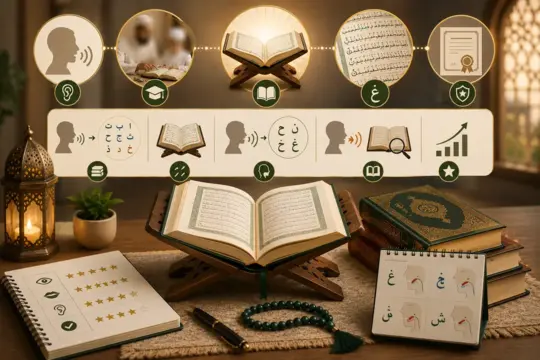
The riwayat of the Quran are part of the sciences related to recitation, transmission and preservation of the Quranic text. For many students, this subject may seem complex because it involves precise notions such as qira’at, chains of transmission, Tajweed rules and Quran Ijaza.
Understanding the riwayat helps the learner better appreciate the richness of Quranic recitation. They are not different translations of the Quran, nor contradictory versions. Riwayat are recognized modes of transmitting Quran recitation, studied carefully by scholars and specialists of the Quran.
In this article, we will explain what a riwayah is, the difference between qira’ah and riwayah, why several transmitted readings exist, and how this subject is connected to Tajweed, Quran recitation and Quran Ijaza.
What Is a Riwayah of the Quran?
The Arabic word riwayah means transmission or narration. In the context of Quranic recitation, a riwayah refers to a transmitted way of reciting the Quran through a specific narrator, connected to an imam of recitation.
A riwayah should not be understood as a translation or a personal interpretation. It is a transmitted recitation with precise rules, a chain of teaching and specific features related to pronunciation, elongation, pauses or the reading of certain words.
The most widespread riwayah today in much of the Muslim world is the riwayah of Hafs from Imam ‘Asim. In other regions, especially in North Africa and parts of Africa, the riwayah of Warsh from Nafi‘ is also widely known.
What Is the Difference between Qira’ah, Riwayah and Tariq?
To avoid confusion, it is important to distinguish three terms: qira’ah, riwayah and tariq.
A qira’ah refers to a reading attributed to a recognized imam of recitation. For example, one may speak of the qira’ah of Nafi‘, the qira’ah of ‘Asim or the qira’ah of Abu ‘Amr.
A riwayah refers to the transmission of that reading through a narrator. For example, Hafs and Shu‘bah transmit the qira’ah of ‘Asim. Warsh and Qalun transmit the qira’ah of Nafi‘.
A tariq is a more detailed route of transmission within a riwayah. This notion mainly concerns advanced students who study the Quranic readings in a specialized way.
In simple terms:
- the qira’ah is the reading of a recognized imam;
- the riwayah is the transmission of that reading by a narrator;
- the tariq is a more specific route of transmission within a riwayah.
Why Are There Several Riwayat of the Quran?
The riwayat exist because Quran recitation was transmitted orally with great precision. The companions learned the Quran from Prophet Muhammad ﷺ, then transmitted it to their students. This transmission continued through generations of reciters and teachers.
The different riwayat reflect recognized modes of recitation within the Muslim tradition. They may include differences in pronunciation, elongation, pauses or the reading of certain words, according to established rules.
These differences are not improvisations. They belong to a transmitted science that has been studied and preserved with care. This is why learning the riwayat requires a qualified teacher and a serious method.
Do Riwayat Change the Meaning of the Quran?
Riwayat should not be understood as different or contradictory texts. They are transmitted readings of the Quran according to recognized rules. In some cases, a reading difference may bring a linguistic nuance, but it does not undermine the overall message of the Quran.
This subject should be approached with care. Riwayat and qira’at are not studied properly through quick comparisons between texts or recitations. They require knowledge of Arabic, recitation, Tajweed and transmission.
For most students, the first goal is not to study all riwayat, but to master one reading correctly, often Hafs from ‘Asim, before moving further.
Examples of Well-Known Riwayat
Several riwayat are studied in the sciences of recitation. The following examples are among the best known, but they do not summarize the entire science of Quranic readings.
Hafs from ‘Asim
The riwayah of Hafs from Imam ‘Asim is today the most widespread in much of the Muslim world. Many printed mushafs and Quran learning programs use this reading.
For a beginner who wants to learn Quran, Hafs from ‘Asim is often the first reading taught because it is widely used in learning materials and available recitations.
Warsh from Nafi‘
The riwayah of Warsh from Imam Nafi‘ is widely known in several regions of North Africa and Africa. It has specific reading features that students need to learn carefully, especially in some rules of elongation and pronunciation.
A person used to Hafs may be surprised when hearing Warsh, but it is a transmitted reading studied according to its own rules.
Qalun from Nafi‘
Qalun is also a transmitter of the qira’ah of Nafi‘. His riwayah is studied in specialized contexts and in some regions. It has its own recitation rules, which the student should learn with a competent teacher.
Al-Duri from Abu ‘Amr
The riwayah of Al-Duri from Abu ‘Amr is also among the known readings in the sciences of recitation. Like other riwayat, it requires precise study of pronunciation, rules and transmission.
These examples show that riwayat are connected to a structured teaching tradition, not to simple regional or personal differences.
The Link between Riwayat, Recitation and Tajweed
Riwayat are directly connected to Quran recitation. To understand them, the student first needs to master the foundations of Arabic reading, vowels, reading signs, articulation points and Tajweed rules.
Tajweed helps the learner recite the Quran with precision. It concerns the pronunciation of letters, the characteristics of sounds, elongations, rules of nūn sākinah, Tanween, stopping and starting.
Tajweed lessons online can help students correct their recitation before approaching more advanced subjects such as riwayat or qira’at.
Why Riwayat Matter in Quran Ijaza
Quran Ijaza is connected to transmission. In an Ijaza path, the student recites to a qualified teacher, who checks the precision of the reading, the application of Tajweed and the ability to transmit the studied recitation correctly.
Depending on the level and program, an Ijaza may focus on a specific riwayah, such as Hafs from ‘Asim, or on a more advanced path related to the qira’at. This requires rigor, regular revision and careful follow-up.
A Quran Ijaza online program is generally intended for students who already have strong foundations in reading, recitation and Tajweed.
Should You Learn Several Riwayat?
For most students, it is not necessary to begin with several riwayat. It is better to first master one reading with precision, especially if the student is still developing Quran recitation skills.
Learning several riwayat requires time, a strong command of Arabic, solid recitation and a qualified teacher. Without these foundations, the student may mix rules and lose precision.
Advanced students may later study other riwayat according to their goals, especially if they want to deepen their knowledge of the sciences of recitation or follow a more specialized Ijaza path.
How to Study Riwayat with Method
The study of riwayat should be progressive. It should not begin with simple comparisons between mushafs or recitations. Strong foundations must come first.
A coherent path may follow this order:
- learn to read the Quran in Arabic;
- correct the pronunciation of letters;
- study Tajweed rules;
- recite regularly with correction;
- master one main riwayah;
- revise consistently;
- approach other riwayat with a qualified teacher if the level allows it.
With online Quran classes, the student can begin by strengthening reading and recitation before moving toward more advanced goals.
If you want to improve your recitation, learn Tajweed or prepare for an Ijaza path, Al-Dirassa offers personalized guidance with qualified teachers. The goal is to progress according to your level, with method, correction and regularity.
Book your free trial of 30 minutes
Registration form
Conclusion: A Science of Transmission to Study Seriously
The riwayat of the Quran show the precision with which Quranic recitation has been transmitted. They are not different translations, but recognized transmissions of Quran recitation, connected to the qira’at and studied according to precise rules.
To understand this subject properly, it is necessary to distinguish qira’ah, riwayah and tariq, then place these notions within the science of Tajweed and transmission. Learning the riwayat requires method, patience, regularity and guidance from a qualified teacher, especially when the student aims for advanced recitation or Quran Ijaza.



No Comments
No comments yet.