
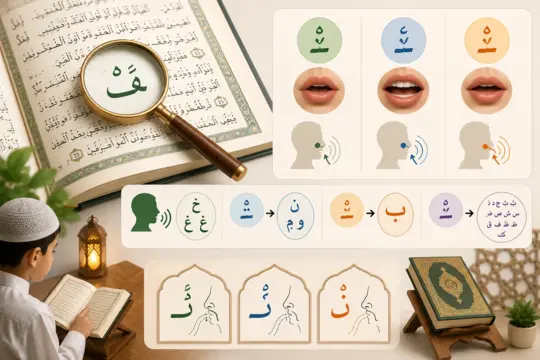
Tanween is one of the important signs in Arabic reading and Quran recitation. For beginners, it may look like a small mark placed at the end of a word, but it has a direct impact on pronunciation, fluency and the correct application of Tajweed rules.
Understanding Tanween helps students recognize Arabic word endings, pronounce them more accurately and improve their Quran reading step by step. It is an essential topic for anyone who wants to learn Quran, study Arabic pronunciation or begin Tajweed with a clear method.
In this article, we will explain what Tanween means in Arabic, the three types of Tanween, how to pronounce them and why they are important in Quran recitation and Tajweed.
What Is Tanween in Arabic?
Tanween, written in Arabic as tanwīn, is a sign placed at the end of certain Arabic words. It represents a short vowel followed by a nasal sound close to the letter n.
In Arabic grammar, Tanween is often used with indefinite nouns. In simple terms, it can indicate that a word is not defined by the article al. For example, depending on the grammatical context, a word with Tanween may carry the meaning of “a book” rather than “the book”.
For students learning Quran reading, the main goal is not only to recognize Tanween visually. The learner must also pronounce it correctly, especially when the next word begins with a letter that changes the way Tanween is recited. This is why Tanween is closely connected to Tajweed rules.
Why Is Tanween Important in Quran Reading?
Tanween helps the reader pronounce Arabic words with accuracy. In Quran recitation, it affects how the end of one word connects to the beginning of the next word. Depending on the following letter, the sound of Tanween may remain clear, merge, change or become partially hidden.
This means that Tanween is not only a grammar topic. It is also part of the Tajweed rules for beginners. Incorrect pronunciation of Tanween can make Quran reading less precise and may affect the fluency of recitation.
Learning Tanween therefore strengthens several skills at the same time: Quran reading, Arabic pronunciation, listening, oral repetition and the gradual application of Tajweed rules.
The Three Types of Tanween
There are three main types of Tanween. They correspond to the three short vowels in Arabic: Damma, Fatha and Kasra.
Tanween Damm: ـٌ
Tanween Damm is generally pronounced with the sound un. It is placed above the final letter of the word.
Example: kitābun, which may mean “a book” depending on the context.
This sign shows that the word ends with a short u sound followed by a nasal ending. It should not be pronounced as a long vowel. The sound must remain short, clear and controlled.
Tanween Fath: ـً
Tanween Fath is generally pronounced with the sound an. It is usually placed above the final letter of the word and is often accompanied by an alif at the end, depending on the word form.
Example: kitāban, which may also mean “a book” in a specific grammatical context.
A common mistake among beginners is to lengthen this ending too much. In correct Quran reading, the learner should keep the sound balanced and follow the pronunciation taught by a qualified teacher.
Tanween Kasr: ـٍ
Tanween Kasr is generally pronounced with the sound in. It is placed below the final letter of the word.
Example: kitābin, which may also refer to “a book” depending on the sentence structure.
This form requires careful attention because the Kasra sound is lighter and lower than the other short vowels. Listening practice helps the learner distinguish clearly between un, an and in.
How to Pronounce Tanween Correctly
To pronounce Tanween correctly, the learner must combine two elements: the short vowel and the final nasal sound. Tanween is not simply a doubled vowel. It creates a specific word ending that should remain short, accurate and natural.
In simple terms:
- ـٌ is generally pronounced un;
- ـً is generally pronounced an;
- ـٍ is generally pronounced in.
In Quran recitation, the main difficulty appears when the following word begins with a letter that affects the pronunciation of Tanween. The learner must then apply the Tajweed rules related to nūn sākinah and Tanween.
Tanween in Tajweed Rules
In Tajweed, Tanween is studied together with the rules of nūn sākinah. These rules explain how the final Tanween sound should be pronounced when it is followed by specific Arabic letters.
The main Tajweed rules related to Tanween are Idhar, Idgham, Iqlab and Ikhfa. These rules should be learned gradually, with listening, repetition and correction, because they directly affect Quran recitation.
Tanween and Idhar
Idhar means clarity. When Tanween is followed by certain throat letters, the Tanween sound remains clear. It is pronounced distinctly, without merging or hiding.
For beginners, this rule helps show that the nasal sound of Tanween does not always disappear. In some cases, it must be clearly heard.
Tanween and Idgham
Idgham means merging. In this case, the sound of Tanween merges into the following letter. The recitation becomes smoother, but it still needs to be controlled and precise.
This rule is very important for students who want to improve Quran recitation, because it appears frequently in the Quran. It requires oral practice and careful correction with an online Quran teacher or a Tajweed teacher.
Tanween and Iqlab
Iqlab means transformation. When Tanween is followed by the letter bā, the Tanween sound changes into a sound close to m, with nasalization.
This rule can be difficult at the beginning because the learner must recognize the following letter and adjust the pronunciation at the same time. With repetition and listening to correct recitation, it becomes easier and more natural.
Tanween and Ikhfa
Ikhfa means hiding or concealment. The Tanween sound is neither completely clear nor fully merged. It is pronounced in an intermediate way, with a nasal sound adapted to the following letter.
Ikhfa requires good control of the mouth, nose and articulation point of the next letter. This is why it is often easier to master through Tajweed lessons online, where the teacher can listen and correct the student’s recitation.
Simple Examples of Tanween in Arabic
Here are simple examples to recognize the three forms of Tanween:
- كِتَابٌ: kitābun;
- كِتَابًا: kitāban;
- كِتَابٍ: kitābin.
These examples show that the same word can keep the same root while changing its ending according to its grammatical role. For Quran reading, the learner needs to recognize these marks quickly and pronounce them without hesitation.
It is useful to practise slowly, listen to correct recitation, then repeat the words while respecting both the short vowel and the final nasal sound.
Common Mistakes When Learning Tanween
Beginners often make several mistakes when learning Tanween. These mistakes are normal at the start, but they should be corrected gradually.
- Confusing the sounds un, an and in;
- lengthening Tanween as if it were a long vowel;
- forgetting the final nasal sound;
- pronouncing Tanween the same way regardless of the following letter;
- not applying the Tajweed rules linked to Tanween;
- reading too quickly without checking pronunciation accuracy.
The best method is to progress step by step: recognize the sign, pronounce the sound in isolation, read simple words, then apply the rules in Quran recitation.
How to Learn Tanween Rules Step by Step
To learn Tanween rules properly, reading a theoretical explanation is not enough. The learner also needs to listen, repeat and receive correction. Tajweed is a practical science: the tongue, lips, breath and articulation points must be trained regularly.
A good learning path may follow this order:
- learn the Arabic short vowels;
- recognize the three forms of Tanween;
- practise the sounds un, an and in;
- study the rules of nūn sākinah and Tanween;
- read simple examples;
- apply the rules in short Quran passages;
- correct the recitation with a qualified Quran teacher.
If you want to learn Quran online, improve your recitation or study Tajweed step by step, Al-Dirassa offers online Quran classes with qualified teachers. The program is adapted to your level, your pace and your learning goals.
Book your free trial of 30 minutes
Registration form
Is Tanween Useful for Children Learning Quran?
Yes, Tanween is also useful for children who are beginning Quran reading. When it is taught in a simple way, with visual examples and regular repetition, children can learn to recognize the signs and pronounce them correctly.
In a structured Quran course for children, Tanween can be introduced progressively after Arabic letters, short vowels and Sukoon. The goal is not to rush, but to build strong foundations in reading and recitation.
The Link Between Tanween, Tajweed and Quran Memorization
Tanween is not only useful for reading. It also supports students who want to memorize the Quran, because correct pronunciation helps revision and reduces repeated mistakes.
In a Quran memorization program, the student needs to listen carefully, repeat accurately and correct mistakes before they become habits. Tanween rules are part of this precision.
For advanced students, strong Tajweed foundations are also important in a Quran Ijaza online path, where recitation must be studied carefully with a competent teacher.
Conclusion: Tanween as a Key Step in Quran Reading
Tanween may seem simple at first, but it is an important foundation for Arabic reading and Quran recitation. It helps the learner recognize word endings, pronounce Arabic sounds more accurately and understand several Tajweed rules connected to nūn sākinah.
To master Tanween, the student should combine theory with practice: observing the signs, listening, repeating, receiving correction and applying the rules in Quran reading. A complete learning journey requires method, consistency and guidance from a qualified teacher, especially for those who want to improve Quran recitation or learn Tajweed online step by step.





No Comments
No comments yet.